
Recovery From Falling Off The Wagon
How to recover progress and momentum on goals after you've lost consistent engagement with them.

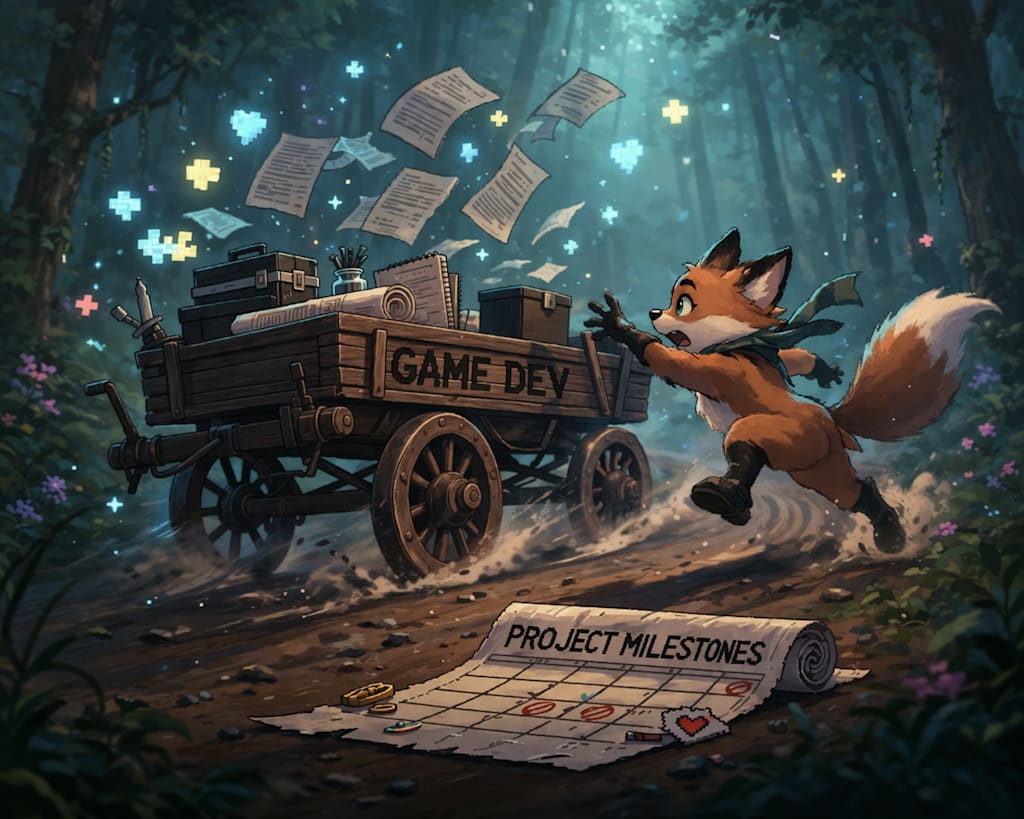
Since the beginning of 2026 I had decided to dive into game development, which is something I have been thinking about doing and learning about for a few years. I just didn't really know where to start or how to get a game made. After attending art school and getting a Game Art degree, I finally had a foundation of knowledge to guide me on the general process, but I knew going in that I still had a ton to learn before I can make a game. Granted, there are faster and easier ways to make games than the goals I set for myself, but I have reasons for choosing a more challenging path, not the least of which is that I don't just want to put out games fast, I want to make games that are high quality. That part takes much more time and effort, usually.
I decided to share my game development progress while I was learning and building so that people could follow along and see the process and challenges. That required consistency and accountability to maintain progress toward my goal. Unfortunately, life hit me hard and...
I fell off the wagon.
However, I digress, this article is not so much about game development as it is about the general situation of deciding to work on a goal, then for one reason or another, you just seem to stop. It doesn't even have to be sudden, it could be gradual slowing to a stop. This could happen for any goal, resolution, or plan. Things don't go as expected, more things get piled on, other priorities demand attention, and before you know it, the goals or plans you were so determined to accomplish get shoved aside and pushed down the priority list until there is no time, energy, or motivation to work on them anymore.
The Law of Diminishing Returns
Years ago, I networked with some marketers who taught me about the Law of Diminishing Returns. This means that the longer you take to start something, or the longer you go without doing something or making progress, the less likely you are to even try or to keep going. We can see this at work in our daily lives. Here are some examples of this law in action. See if you can relate:
1. You set your alarm early to get a workout in before starting the main obligations of the day. You decide to hit snooze instead because you're tired and it's too hard to get out of bed, then before you know it, you find yourself rationalizing how it's better to get more sleep and you can make up the workout another time. Then, you run out of time or get over-scheduled and don't do it.
2. You make a New Year resolution to get more sleep and eat healthier. You start off strong for a few days or weeks, maybe even as far as a month or more. But after a while, life starts being too busy again, you can't get to bed early enough to feel rested because you have so much to do, then you don't have time for yourself, and when choosing between your demands or need for your own downtime and sleep, you choose to sacrifice sleep. Then your fatigue wears on your motivation to cook healthy meals. The cost of healthy ingredients goes up, or you just don't like to cook or the cleanup, and you start making "exceptions" just once in a while. You then blink and a moment later you're back into unhealthy food and sleep habits and you don't know what happened to your resolution and feel it's too far gone to achieve your goals now.
3. You set a financial savings goal, but you're still living paycheck to paycheck and setting money aside is already a challenge, but you're determined to cut back on unnecessary subscriptions, eating out, and you won't use your credit cards anymore so you don't have more debt and higher minimum payments interfering with saving money. Then life happens. Your job hours get cut or you lose it. You have emergencies come up that are expensive, like medical, vehicle, or other family emergencies. You find yourself unable to stay within your budget so you relent and use credit cards again, which boosts those pesky minimum payments that eat up any extra money you could've set aside. This continues for months on end, and then you look back and wonder how you ever thought you could save any money, and since you're already so miserable avoiding entertainment or restaurants to save money in vain, you might as well get a little joy by eating out once in a while on credit or indulging in those entertainment subscriptions again, because at least that's better than being miserable while not saving money.
Here's the principle: When you have something to get done, if you ever put it off to do later, the likelihood that you will ever do it (or keep doing it) decreases exponentially with the length of time or frequency it is postponed.
The excuses used to justify putting off your goal or one activity or another "just this once" is irrelevant. The affects are the same. The exceptions and procrastinations get easier while the discipline and wise decisions get harder and less appealing. Soon, you just don't feel like you care as much about that task or goal and don't see it as that important to do anymore.
This is what happened to me with game development. I had some starting progress and was making videos about concepts and steps I was taking, and showed my work on social media and in my emails, but then life filled up with urgent priorities, big changes, emergencies and excessive expenses. I had to work longer hours, get another job, move, and spend a lot of time managing everything that seemed to hit all at once. I had no more time or energy to keep working on game development, but I figured after a month or so I would get back to it. A month went by, then two, then three... I still wasn't working on game developmment progress or giving any updates to my followers.
Some people might give up on the goal at that point. The motivation has faded and there are just too many obligations to make time for this side project. But, the desire to bring my ideas to fruition remained. I wanted to keep trying, but how can I get back to it with so many hinderances?
Is it possible to get back on the wagon?
YES. No matter how long you've been "off the wagon" you can still climb back on. The catch is to be strategic about it.
Consider the reasons for falling off the wagon in the first place. For me, it was because I got overwhelmed with too many other ugent priorities and obligations that sucked up my time and energy to work on my project. So, if I try to jump back on full speed and intensity, I will likely burn out and get overwhlemed again, resulting in me falling off once more. Making slower progress is better than burning out fast and making no progress for a long time again.
Before I stopped working on my project, I was doing well to make 3 social media posts per week, one video per week, and send out emails to my subscribers around once per week as well. In between those social media updates, I needed to actually spend time learning the skills needed to make games and make progress toward my game idea. After life ramped up my obligations and priorities, I could no longer keep up with that routine. Since the pace of my obligations has stayed somewhat higher since stopping, I need to wade back into more cautiously to avoid burnout, and commit to a much lighter schedule of activities and progress.
I might not be able to go back to 3 social media updates, a video, and an email update per week as before, but if I can even do one update a week, or one video or email per month, that will still be progress and will be better than nothing. The key is to just start showing up again.
1. Try spending 15 minutes learning something, three times per week.
2. Apply something I learned once per week.
3. Tell people about that little step forward and celebrate it.
Baby steps are easier to sustain than giant leaps forward. It's like a tortoise vs. the hare situation. Energetic bursts of speed can lead to rapid burnout, or overconfidence in the pace or progress, but may be short lived. Slow and steady small steps extend energy and can go longer without burnout, which can help you finish without killing yourself in the process.
The key to getting back on the wagon of a goal: Start showing up again, even for short periods of time with simple actions.
Just pick a more manageable pace and be consistent.
Check your perspective
Don't look at falling off the wagon as failure. It doesn't have to be unless you never try again. Taking time away from a goal or project can be both good and bad, so choose to make it good. Here's what I mean:
PROS - Capitalize on these benefits when you have breaks in progress...
- Take a step back to revisit the big picture and reason for pursuing the goal in the first place.
- Clarify your goal and methods for reaching it.
- Re-strategize your steps, progress activities, and demands.
- Decompress and refresh yourself for your next attempt.
- Intentional re-commitment can sometimes be stronger than running on continuous momentum.
CONS - These become more risky the longer you wait to try again...
- Skills can begin to atrophy and diminish with lack of practice.
- Habits and "rhythm" can be disrupted, losing momentum and focus.
- Confidence can fade with self-doubts or feelings of failure or self-critical thoughts.
- Drifting and fading community or audience support or interest with loss of consistent engagement.
- Increasing difficulty restarting progress over time away = The Law of Diminishing Returns
Decide to climb back on the wagon
Don't let falling off the wagon stop you from trying again. You don't necessarily have to "start over" either. You already made some prior progress by experiencing a first attempt. You already have a foundation of what did or didn't work for you the first time. Build on that.
Practical Steps to Help
- Don't change the goal necessarily, just the approach and pacing.
- If one part of the goal is starting to feel stale or blocked, (e.g. - writer's block, bored with a tedious part, unmotivated to do something), switch it up to re-ignite interest. Work on a different chapter or creative idea, switch from coding to design or art, alter the habit to be a bit different while still in line with the goal.
- Reward baby-step progress. Give yourself quick wins and repeated rewards for small steps forward.
- Prioritize things that give visible forward progress that you can see and feel. Keep is small and for short periods of time, but make it tangible so you don't feel stagnant.
- Allow intentional, limited, and moderated breaks and exceptions to habits for refreshment, but be careful not to lose the new momentum. Be selective.
- Engage with others on similar goals or with insights about the topic to spark ideas and motivation, but don't replace doing things with just consuming content.
- Remember and reconnect with your reasons and purpose behind your goals and habits.
Now, jump back on the wagon! (Carefully!)
About the Creator
D. E. King
Life is an adventure and is what you make of it, so make it good!
Portfolio: https://reynart.artstation.com
Instagram: https://www.instagram.com/ReynArtGames
Facebook: https://www.facebook.com/ReynArtGames
X: https://x.com/ReynArtGames
Enjoyed the story? Support the Creator.
Subscribe for free to receive all their stories in your feed. You could also become a paid subscriber, letting them know you appreciate their work.
Comments
There are no comments for this story
Be the first to respond and start the conversation.