
Real‑Life "National‑Server Sun Ce"
The story of a food delivery guy who executed a perfect real‑world ultimate move—and earned a custom award from the game that inspired his nickname.
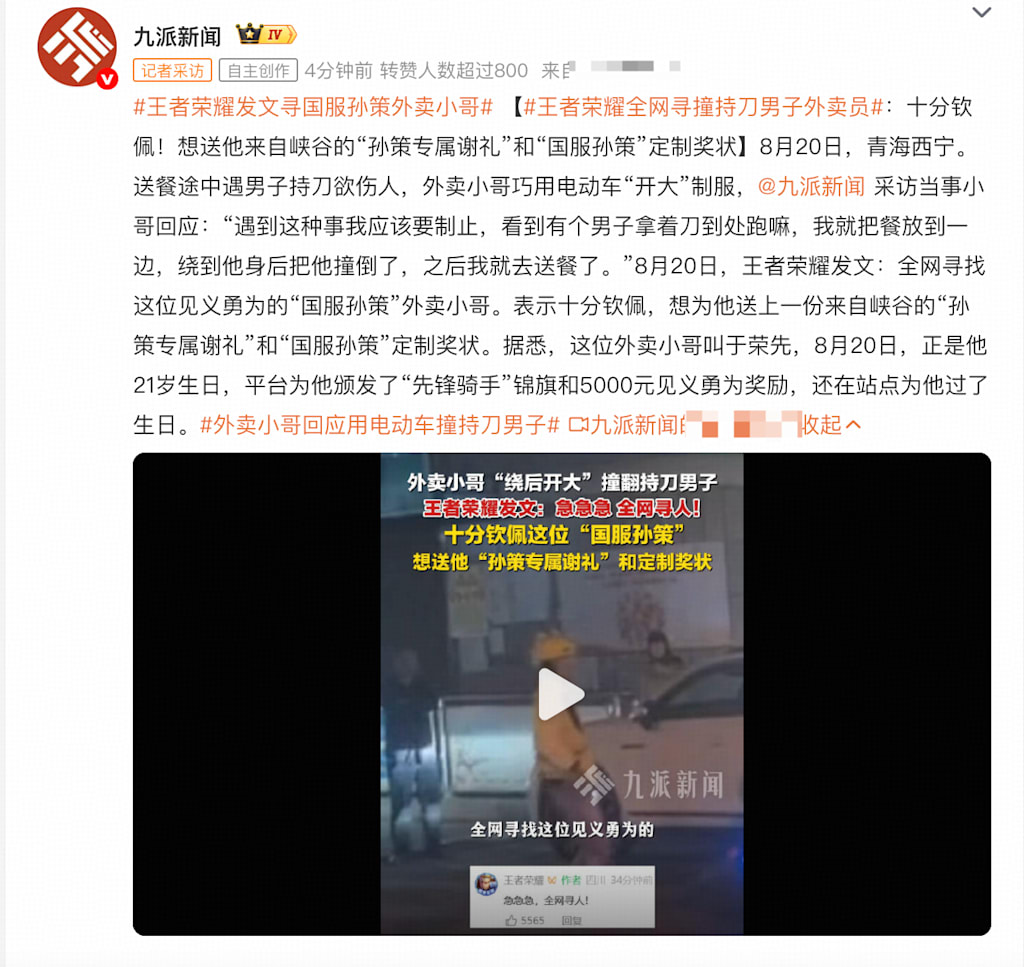
At 9:17 p.m. on August 18, 2026, on an unnamed street in Chengdong District, Xining, Qinghai.
A figure in a fluorescent vest enters the frame from the right. He bends down and places the item in his hand on the ground—later we learn it was a takeout order of spicy hotpot—then mounts his e‑scooter, arcs around in a half‑circle, and approaches the knife‑wielding man from behind. The scooter is not moving fast. It is less a charge than a well‑aimed shove. The knife falls. The man goes down. The crowd that had been holding sticks and chairs in a standoff rushes in. The fluorescent vest slips out through a gap in the crowd, picks up the spicy hotpot, and vanishes off the left side of the screen.
The whole thing: seventeen seconds.
The next day, a netizen spliced the surveillance footage side‑by‑side with an animation of the ultimate move of the hero Sun Ce from the game Honor of Kings. The two trajectories are almost identical: a straight‑line approach, a precise strike, and an immediate disengagement. The comments exploded. "Real‑life national‑server Sun Ce." "A hundred‑star王者 rank with that move." "The way he put down the takeout looked like planting a flag."
Three days later, the game's official account put out a call to find the rider. They said they wanted to give him all Sun Ce skins and a custom‑made "National‑Server Sun Ce" certificate. Meituan found him the next day, voided all his late‑delivery records from that night, awarded him a "Pioneer Rider" banner and a 5,000‑yuan bonus. Niu Electric said they would give him a new e‑scooter.
On August 20, Yu Rongxian turned 21. His colleagues at the delivery station cut him a birthday cake.
All the excitement happened after those seventeen seconds. The seventeen seconds themselves were quiet, as if nothing had occurred.
Anchor 1: He Left a Little Throttle Unused
In an interview, Yu Rongxian said something that later became a headline for many outlets: "I didn't press the throttle all the way down."
Those words carry more weight than the phrase "acts of heroism."
At the scene, an intoxicated man had already slashed two people with a knife. Quite a few onlookers had gathered. Some held sticks. Some held chairs. No one dared to step forward. It was not that they did not want to. They were afraid. Against a waving blade, any close‑quarter struggle involves uncontrollable risks. All Yu had was an e‑scooter.
He chose the only right approach. He used the vehicle as a weapon, speed as an advantage, and distance as a shield.
But he did not twist the throttle to the max. The impact of an e‑scooter can be fatal, especially when hitting an unsuspecting person from behind. A blow to the back of the head. A broken neck. Internal organ damage. Any of those outcomes could turn a rescue into a crime. Yu used no legal jargon in the interview. He simply said: "Knocking him down was enough. No need to hurt him more."
That sentence reveals two things. First, he knew exactly what he wanted: to stop the assault, not to punish the perpetrator. Second, he knew what he did not want: no overreaction, no loss of control, no turning himself from a lifesaver into an injurer.
Later, lawyers on social media pointed out that even if the knife‑wielding man had been injured by the impact, Yu would bear no legal liability. His actions fully met the criteria for justifiable defence under Article 20 of China's Criminal Law: the unlawful attack was ongoing, the defence was directed at the attacker, the purpose was legitimate, and the force did not exceed what was necessary.
The law protected him. But it protected the version of him who did not press the throttle all the way down. If he had cranked it to the limit and rolled over the man again, the law's verdict would have been different.
That sense of proportion, in a 21‑year‑old ordinary person, is rarer than courage itself.
Anchor 2: What Hides Behind the Act of Putting Down the Takeout
Almost all the discussion focused on the moment of the hit. Few asked: why did he put down the takeout first?
Yu's own explanation was simple: "I was afraid it would spill, and the customer was waiting."
The answer is so plain that it hardly sounds like something a hero would say. But that very act pulls the whole story away from hot‑blooded impulse and back into the territory of cool‑headed judgment.
An impulsive person would not set the meal down before rushing in. Someone craving attention would not pick up the delivery and continue the route after saving a life. A person who needs to be celebrated would not see himself throughout as merely a rider who happened to do something on his way.
By setting down the takeout, he made it clear that at that moment he was still a working man. He did not lose sight of his role because of the danger. He did not imagine himself as a protagonist about to perform a great deed. He simply inserted a subtask—knock down the knife‑wielder—into his main task of delivering food. After finishing it, he resumed the main thread.
This is not indifference. It is the task‑switching ability unique to a delivery rider who shuttles through city streets every day, handles dozens of orders, and has been trained by time and routes. The danger did not turn him into someone else. He remained Yu Rongxian, 21, a delivery rider whose 23rd order of that night was still undelivered.
This self‑consistency of not seeing himself as a hero is what makes all the subsequent rewards and praise legitimate. If a rescuer constantly emphasises his own sacrifice and courage after the fact, the story becomes brittle. But Yu did not. He did not even actively tell anyone what he had done. It was the surveillance footage that first found the netizens. The netizens who found the game. The game who found the media. And the media who finally found him.
He was the last person to be located in the entire chain of dissemination.
Anchor 3: Three Responses, Three Kinds of Restraint
Yu's story generated a sustained wave of public attention not just because of what he did, but also because the responses from different parts of society came together in a kind of tacit harmony.
The first response came from netizens. Turning the surveillance footage into a game move might seem playful, but it actually performed a function of translation. A serious act of bravery, through the gaming meme, became understandable and shareable among a large young audience. The label "National‑Server Sun Ce" described Yu's action more precisely than any "heroic deed" narrative: straight‑line approach, precise hit, quick disengagement. The netizens were not exploiting him. They were using the language they know best to sculpt his image.
The second response came from the game's official team. The wording of Honor of Kings' call‑out was well judged. They used phrases like "greatly admire," "want to give a special gift," and "customised certificate." They avoided worn‑out terms like "pay tribute to heroes" or "promote positive energy." They positioned themselves as a game company that happened to be moved, rather than an enterprise seizing the chance to make a statement. The difference is crucial: the former is a human reaction; the latter is a PR move. A human reaction can be accepted. A PR move will be scrutinised.
The third response came from Meituan. Voiding the late records, presenting a banner, offering a cash bonus, and throwing a birthday party at the station: four layered and progressive actions. Voiding the records was a correction at the institutional level. The banner was recognition at the honour level. The bonus was material compensation. And the birthday party was emotional closure. The entire process of a grassroots worker being seen, acknowledged, compensated, and cared for unfolded within four days.
Together, the three responses covered the spectrum from grassroots meme‑making to official endorsement, from spiritual encouragement to material reward, and from public praise to private sentiment. Yu did not need to ask for anything more. Goodwill had already come to him on its own.
Anchor 4: He Knocked Down More Than Just a Man
Yu's e‑scooter knocked down a knife‑wielding man. But what the act truly struck was something deeper.
In recent years, when dangerous incidents occur in public spaces, the behaviour of bystanders is often explained by the bystander effect: the more people present, the fewer step in. It is not cold‑heartedness. It is diffusion of responsibility. Fear of liability. The rational choice of "better not get involved." When that rationality accumulates, it becomes a collective hesitation.
Yu's seventeen seconds were an answer to that hesitation.
He did not weigh the pros and cons. He did not wait for someone else to go first. He did not calculate who would pay the medical bills if he got hurt, or who would cover the fines for late deliveries. He saw it, felt that he should stop it, and then did it. That "should" did not come from any external order. It came from the most basic response of an ordinary person facing another's distress: the inability to bear watching.
Hannah Arendt wrote about the banality of evil—the way people lose their moral judgment within systems and routines, becoming complicit in wrongdoing. What Yu showed was the reverse: the banality of good. No training. No planning. No deep calculation. Only, at that moment, the sense that he could not stand by.
That inability to bear watching is the bedrock of every civilised society. It requires no lofty slogans. No profound arguments. Only that when one person sees another in danger, a tiny string inside them stirs.
And that string, for too many people, had not been plucked for a long time. Yu plucked it. The echo was loud.
Anchor 5: The Heat Will Fade. Then What?
By August 22, the cumulative readership of topics related to Yu had exceeded 300 million. His Douyin followers jumped from a few hundred to over a hundred thousand. In his direct messages: invitations from gaming streamers. Inquiries from MCN agencies about signing him. Local business owners wanting him to drop by their shops.
He knew what all of that meant. In an interview with local media, he said something strikingly clear‑headed: "I still want to deliver food. This job is pretty free."
At 21, faced with a sudden flood of attention and opportunities, his first reaction was not to grab but to step back. Back to the life he knew. Back to the scooter. Back to the dozens of delivery routes each day.
This is not timidity. It is a confirmation of who he is. He knows that those seventeen seconds cannot define his entire life. He knows that online traffic will not last. And he knows that all these sudden "opportunities" carry hidden costs he cannot yet see. So he chose the safest place: the everyday.
This is the most reassuring part of the whole affair. Yu was not trapped by the label of "hero." He did not feel that because he did this, he had to maintain a certain image. He did not think that because he received a bonus, he had to make public statements. He did not assume that because he gained followers, he needed to keep producing content. He did what he had to do, accepted what was fairly given, and then went back to his deliveries.
The heat will fade. What will truly remain are two sets of decisions he made: the judgments that night—how to strike, how hard, where to go afterward; and the judgments in the afterglow—how long to stay, what to take, and where to return.
Both times, he did not miss.
Epilogue: After Those Seventeen Seconds
On the evening of August 20, his colleagues at the station threw him a birthday party. There were 21 candles on the cake. Someone urged him to make a wish.
As he closed his eyes, one can only wonder if he thought back to those seventeen seconds. The surveillance footage has no sound. Nobody knows if he yelled anything while knocking the man down, or what was going through his mind as he pushed the throttle.
But everyone who has seen that video remembers one thing: a young man in a fluorescent vest, first setting down a takeout order, then arcing around half a circle, knocking someone to the ground, then picking up the takeout and riding away.
As if nothing had happened.
And yet everything already had.
About the Creator
Jin
Writer of reamstories
https://reamstories.com/jin
Enjoyed the story? Support the Creator.
Subscribe for free to receive all their stories in your feed. You could also become a paid subscriber, letting them know you appreciate their work.
Comments
There are no comments for this story
Be the first to respond and start the conversation.