
Quit or Stick? The Surprising Truth About Success Hidden in ‘The Dip’
Success is about timing — know when to quit and when to press on

There’s a quote by Seth Godin that stopped me cold when I first read The Dip: “Quit the wrong stuff. Stick with the right stuff. Have the guts to do one or the other.”
That one line captured something I’d been feeling for years but couldn’t articulate.
I’d always believed that persistence was the key to success — that the people who won were the ones who simply refused to quit.
But somewhere along the way, I started realizing that “never quit” wasn’t always wise advice. In fact, it was slowly suffocating me.
I was two years into a job in tech marketing. It looked great on paper: fast-growing company, stable paycheck, upward mobility.
But inside, I was slowly disconnecting.
The work didn’t challenge me, the company culture felt hollow, and I couldn’t remember the last time I’d felt proud of something I created.
Still, I stuck around. Because I’d internalized the idea that quitting meant failure.
Enter The Dip. I bought the book impulsively after hearing Tim Ferriss mention it on his podcast.

It’s a slim, punchy read, but what it lacks in length it makes up for in clarity. Seth Godin wastes no time in challenging the traditional narrative around quitting.
Right from the start, he reframes the issue: “Winners quit all the time. They just quit the right stuff at the right time.”
That sentence cracked something open in me. I had always thought quitting meant weakness.
But Godin was offering a different view: that strategic quitting isn’t cowardice — it’s courage.
It’s the ability to say no to mediocrity, to walk away from dead ends, to stop spending time on things that don’t matter.
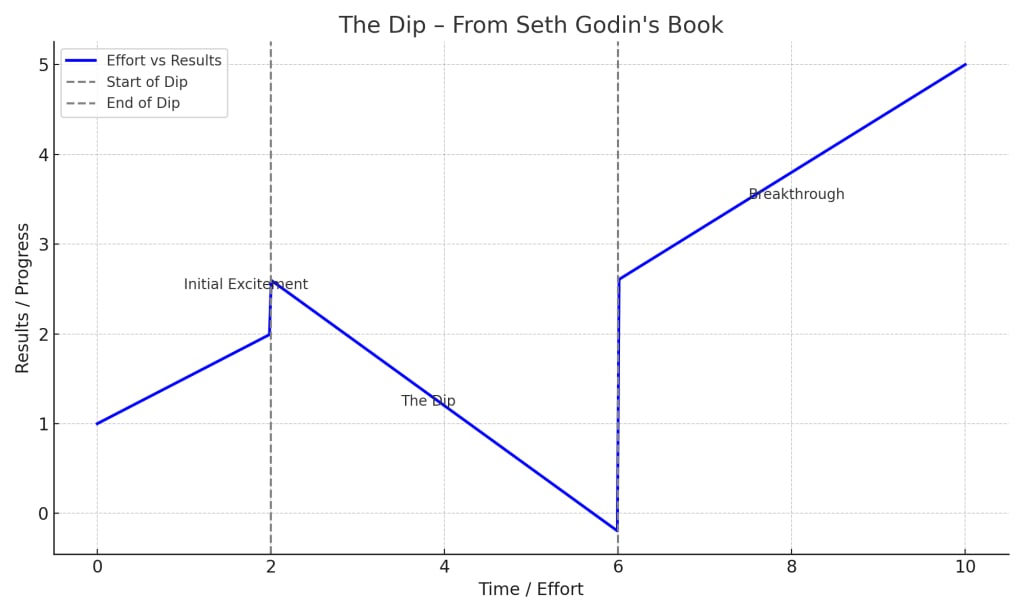
He introduces the concept of “The Dip” — a temporary setback that separates those who are committed from those who are just interested.
In every worthwhile pursuit, Godin says, there’s a point when things get harder.

That’s the Dip. It’s where most people give up. But if you push through it — and only if it’s a Dip and not a dead end — you reach a place where few others have gone, and that’s where the real rewards lie.
“The Dip is the long slog between starting and mastery.”
That idea put my whole career into focus. I wasn’t in a Dip — I was in a dead end, what Godin calls a “cul-de-sac.”
That’s when you work and work and nothing ever changes. There’s no growth, no impact, no trajectory. Just a cycle of effort with no payoff.
He puts it bluntly: “If you realize you’re at a dead end compared to others, the best thing to do is quit. Right now.”
Reading that felt like getting permission to leave.
Not to give up on ambition, but to stop investing it in the wrong place. I wasn’t a bad employee — I just didn’t care about the goal anymore.
I was holding on out of fear, pride, and the inertia of being “almost there.” But almost there doesn’t matter when the destination isn’t where you want to go.
After weeks of sleepless nights and long walks with a friend who had read the book years earlier, I quit.
No plan B. No two-weeks-until-something-better. Just a hard stop. I remember the exit interview vividly.
HR asked why I was leaving. I told them I wanted to do work that made me feel alive again.
They nodded, confused. I walked out of the building into the cold air, terrified — and free.
At first, I floated. I freelanced a bit, wrote blog posts for clients, did some ghostwriting.

I quit partnerships where I wasn’t respected. I even quit a writing course I realized I had outgrown.
And each time I quit the wrong thing, I made space for something better.
One of the most overlooked ideas in The Dip is this: “Quitting creates scarcity. Scarcity creates value.”
It sounds paradoxical, but it’s true.
The fewer things you commit to, the more energy and focus you can give them. That’s what makes you exceptional — not being a jack-of-all-trades, but being the best in one.
Godin argues that the market doesn’t reward average — it rewards remarkable.
And the only way to be remarkable is to pick your Dip and go all in.
I think we fear quitting because it feels like starting over.
But what if that’s the point?
What if every time we quit the wrong thing, we’re not falling behind — we’re actually getting closer to the work that matters?
Seth Godin says it perfectly: “The brave thing to do is to tough it out and end up on the other side — getting all the benefits that come from scarcity. The mature thing is to not even bother starting to snowboard because you’re probably not going to make it through The Dip.”
That’s the paradox: Don’t start what you can’t finish — and don’t finish what you shouldn’t have started.
These days, I approach new projects with that lens. Am I willing to suffer for this?
Will this matter to me when it stops being fun? If the answer is yes, I dive in. If not, I walk away.
The Dip didn’t just change how I approach work. It changed how I view ambition itself. It’s not about doing more.
It’s about choosing wisely, quitting bravely, and sticking when it counts.
So if you’re at a crossroads — tired, burnt out, unsure — don’t default to persistence.
Don’t cling to momentum just because you’ve already spent time. Ask yourself the hard question:
Is this the Dip, or is it a dead end? And if it’s the wrong mountain, climb down.
There’s no shame in quitting. The shame is in wasting your life on something you know you’ll never love.
About the Creator
Enjoyed the story? Support the Creator.
Subscribe for free to receive all their stories in your feed.
Comments
There are no comments for this story
Be the first to respond and start the conversation.