

To learn any language is difficult.
I can say that for certain, because I learned several languages. And learning each one was nowhere near easy. It required 1000s of hours of practice and constant repetition. But it was all well worth it.
But Japanese leads the score board in difficulty. I realized that only AFTER I started learning. Then I looked at the stats, and it turns out that Japanese is one of the most popular languages to learn right now. That is mainly because of the popularity of Manga and Anime, the literature now available in English, like books by Haruki Murukami, the Art like Hokusai, and the desire to get to know the secrets of Japan's life, which is so very different and unique, as compared to any other place on Earth.
So, according to the stats, there are millions of people worldwide currently trying their hand (and heads) at learning Japanese. Most don't go beyond the 3 months mark. The others are the hard-headed ones, and I was, and still am- among them. I say ''still'', because it takes years to learn Japanese.
What keeps me going is the aesthetics of the Kanji, and now being able to read hiragana with nearly equal easiness of reading English. I can attribute the first to my passion for art, and the second - to relentless DAILY practice. Yes, spending time on daily learning and continuous repetition seems to be the only way to success to reach the goal of becoming somewhat good at Japanese.
But there is another factor to learning Japanese, one that at first seems unimportant to the entire process, because it is not directly related to the study per se. And that is getting to know the culture, history, way of thinking, traditions and habits of Japan and its people. And again, it is like nothing of any western country, and maybe this is what sets Japan apart from any place on the globe. Even historically-speaking, when the most changes and progress in various areas were happening in Europe between 1500's and 1900's, Japan closed itself to and from any outside influences, to preserve their own lifestyle and culture. That impacted the country greatly, because they did reach their goal of keeping things as they were for centuries, but it also forced Japan to invent (and we know that Japan is a leading force in inventing in areas like technology, progress of any kind, improvement of what already exists), a way to catch up and eventually surpass the rest of the world.
I speak several languages, but learning Japanese - although it is a lot of fun - was a whole new ball game.
The two primary reasons for me were:
The sheer amount of memorization, Japanese has an estimated 500, 000 words, while for example English has 150, 000 words, and Spanish has 93, 000.
There are 123 million speakers of Japanese worldwide, most of them are in Japan
in comparison to English:
there are 1.45 billion English speakers worldwide, with only 379 million native speakers, and over1 billion, who speak English as a second language.
The secondary reason is the ambiguity of the spoken and written language,
Many words have several meanings, and one word can be said in many different wats according to the context. The word ‘’Life’’ has 73 variations in Japanese.
The three writing styles add to this linguistic difficulty, although they are fun to learn, nevertheless.
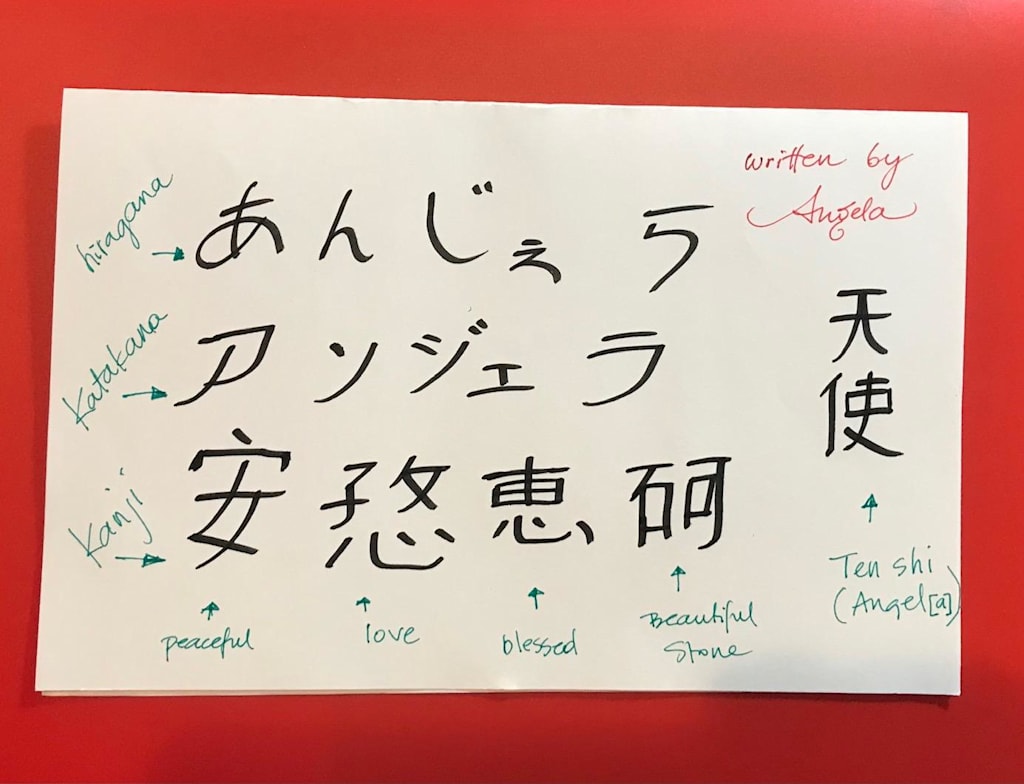
Below, I’ve written my name, Angela, in hiragana, katakana, and Kanji. Under each Kanji i included the meaning for each one, and on the side I wrote my name Angela , ten-shi in Kanji, which means Angel, but is also used for Angela.
About the Creator
Angela Neik
After reaching 23,000,000 (23 million) views on my writings on Quora, I found ''Vocal''.
Life Coach, artist, writer, avid reader of good books.
So grab some coffee, and read on to see what all the hoopla is all about.
Angela
Enjoyed the story? Support the Creator.
Subscribe for free to receive all their stories in your feed.
Comments
There are no comments for this story
Be the first to respond and start the conversation.