
In a World That Never Rests, We Forgot The Rusty Swings
Why hobbies matter more than ever — for children, for adults, and for our sanity


As I sat and asked the server for a tea, my friend looked at the man playing his guitar outside the restaurant, under a tree in front of the beautiful lake. We meet at this restaurant next to the lake once a week, sometimes twice or thrice, to discuss work, life, and other topics to clear our minds.

This was our chance to breathe and find peace from the continuous drilling. Usually, all we ever see is the flock of people returning from work, eager to get back home and sleep, but today we saw this man completely relaxed, playing his guitar and singing his notes, which was also soothing for the eyes that have exceeded 8 hours of screen time. This prompted the question, “When was the last time I did anything as a hobby?” My friend said, “Probably back in the school days.
This makes me wonder…
Do people forget about hobbies as they grow up? Or is the ‘hobby’ considered the least important on people’s agendas? Let alone the adults, who are busy with taxes.
What about the children? Isn’t it their priority to figure things out by trying out different activities? That is not the case; most children are growing up without hobbies! On average, a high schooler spends roughly 7 hours a day or 49 hours a week on their phone (Susic, 2023). Many people would say it’s a simple fix: we just take the phones away, but then what?
Are children even being given the platform or time to figure out what they actually enjoy?
In many Asian countries with intense education systems, it’s not just about reducing screen time — it’s about what replaces it. A typical school day lasts around 7 hours, followed by tuition or coaching, leaving little time for rest, let alone self-exploration or hobbies. Even during holidays, instead of being guided toward new interests, kids often default to screens for lack of better options. The real issue isn’t just screen use, but the absence of structured, pressure-free opportunities for children to explore and find their passions.
The children grow up to be the adults fighting for work-life balance, when there is no life to balance, and I am not exaggerating.

Study 1: A Japan public health center study (Wang et al., 2024) followed 56,381 adults aged 40–69, grouped by hobby engagement (none, one, or many). Using Cox proportional hazard models, they found that having one or many hobbies reduced the risk of CVD by 10% and 20%, and stroke by 13% and 20%, respectively. Hobbies were linked to lower CVD risk.
Study 2: Nelson & Martin (2019) studied 91 low-income, predominantly African American middle school girls (average age 12.43). 91.2% took part in organized activities, and 82.4% had at least one hobby. Hobbies were associated with fewer negative same-sex peer interactions; organized activities correlated with better prosocial behavior and interpersonal skills, especially in disadvantaged families.
Study 3: Matsumura et al. (2023) tracked 22,377 Japanese adults (aged 40–69) over 11 years. Compared to those without hobbies, individuals with one hobby had an 18% lower risk of disabling dementia, and those with many hobbies had a 22% lower risk. The benefit was stronger for non-stroke-related dementia and consistent across age groups.
Study 4: A Harvard Medical School study analyzed data from over 93,000 adults aged 65+ across 16 countries. Hobbies were linked to better health, greater happiness, fewer depression symptoms, and higher life satisfaction — benefits consistent across cultures and unaffected by income or employment status.
These studies conclude that hobbies contribute to Creativity and Self-expression, Cognitive simulation, Social connection, and Stress relief.
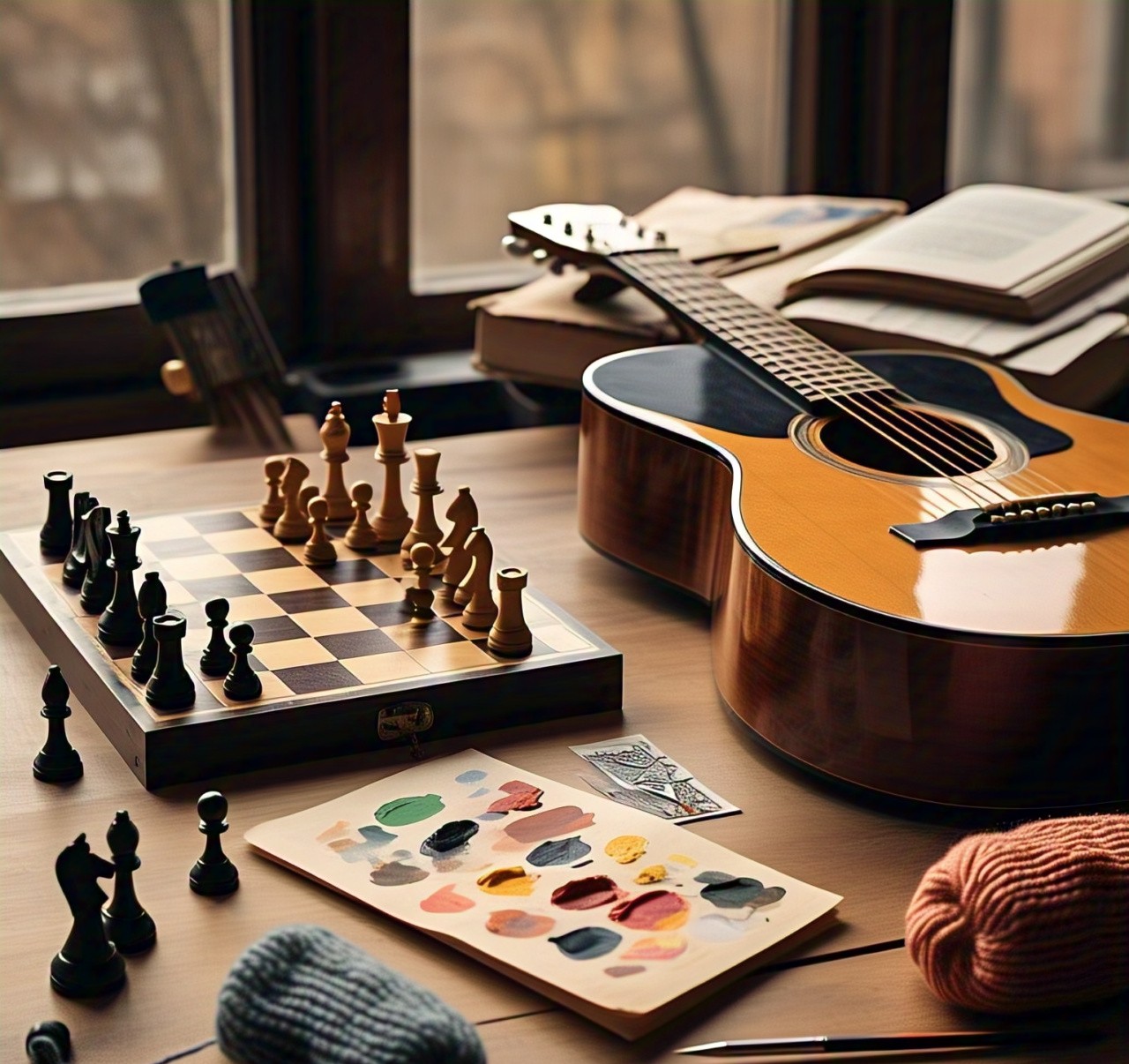
“Now that you’re telling all this, what should I do?” a question that might pop in your head and the same from my sister that needs addressing; hobbies themselves cover a wide spectrum, ranging from solo to social, relaxing to stimulating, indoors to outdoors, and creative to analytical.
❁ Creative hobbies like drawing, painting, writing, and photography
❁ Physical hobbies like sports, fitness, dance, hiking
❁ Intellectual hobbies like reading, puzzles, chess, coding, and learning languages
❁ Hands-on hobbies like cooking, baking, woodworking,
❁ Social/community hobbies like public speaking, debate, and volunteering
❁ Entertainment like collecting, gaming
❁ Adventure like traveling, camping, etc.

“What about the platforms you talked about?”
Oh yes, allow children to follow their curiosity, supporting without pressure is important. Anything forced is never true exploration. Let children have unstructured time. Unstructured time gives them space to wander, and boredom? That’s the cherry on top — it’s often the beginning of the most brilliant ideas.
Children should also be encouraged to form groups, interact, and learn from each other. Those unsure of what interests them can be inspired by peers, as sharing interests within a group often leads to discovering new passions , like lighting a spark from someone else’s flame.
Adults have it contradicting, structure your time, and give a space for hobbies in that calendar of yours. Treat hobbies like meetings.
“Keep your expectations low to avoid giving up within the first few tries. make the hobby convenient to your life, meaning that no matter the activity, keeping it easily accessible in your life is crucial to maintaining it. Overall, hobbies are meant to be enjoyable leisure activities that provide us with a feeling of creativity and fulfilment throughout life.” From the article “Get a Hobby. No, Really!” from Washington Post, Renee Yaseen(2023).
I had to get up, try a few things, and writing and expressing myself was one of them. And here I am.
Thank you
Mayzee ❣️
[Originally published on Medium under Mayzee]
Comments
There are no comments for this story
Be the first to respond and start the conversation.