
I Climbed Ama Dablam and the Mountain Didn’t Care
A Raw Account of the 2016 Ama Dablam Expedition
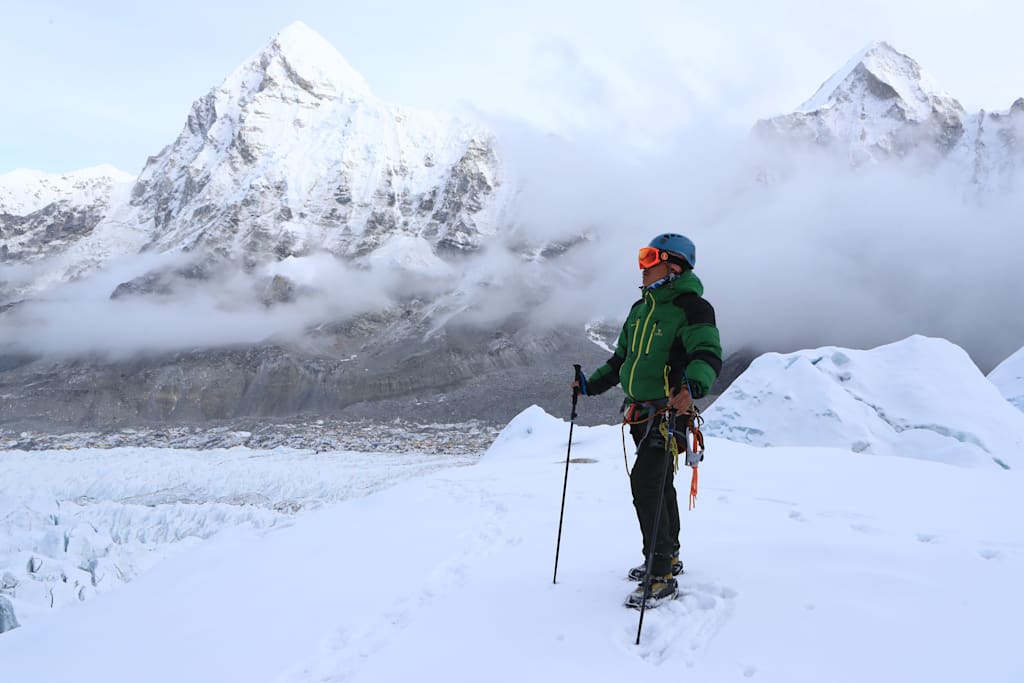
There is a moment on any serious mountain when the romance dies.
You trained for it. You planned for it. You told people about it at dinner parties and watched their eyes go wide. And then you're at Camp II at 4 a.m., your down suit stiff with cold, wind hammering
the tent fabric so hard it sounds like someone slapping the shell of a helicopter. The mountain reminds you, quietly but firmly, that it does not care about your story. That is where Ama Dablam expedition begins to reveal itself.
The Mountain That Looks Impossible From Every Angle
Ama Dablam (6,812m) rises from the Khumbu valley like something drawn by a child who had never seen a gentle slope. It doesn't gradually build. It erupts. A dramatic pyramid with a hanging glacier called the Dablam draped from its upper face like a pendant, it's the kind of peak that stops trekkers in their tracks on the way to Everest Base Camp. Beautiful, yes. But also clearly, unmistakably, serious.
When our small team arrived at Base Camp in 2016, we spent the first day just looking at it. That's part of the process: letting the scale register before the climbing starts.
The route up the Southwest Ridge is considered the standard line, but standard on Ama Dablam is not a word that should be trusted. It involves three camps, sustained technical terrain, and sections that would be called difficult on any mountain in the world. The Yellow Tower alone, a steep band of rock at altitude, demands full attention, full technique, and complete trust in your fixed ropes.
Rotations: The Un Glamorous Core of High-Altitude Climbing
Most people imagine expeditions as a steady march upward. The reality is an exhausting zigzag. The first weeks were spent rotating: Base Camp to Camp I, back down. Camp I to Camp II, back down. Rest, eat, sleep, repeat. Acclimatization is not optional at this altitude. It is the whole game.
Your body needs time to produce enough red blood cells to function at elevations where the air holds roughly half the oxygen it does at sea level.
By the third rotation, I was moving through it mechanically. Wake before dawn. Eat something.
Gear up in the dark. Clip in. Climb. The mountain has a way of stripping life down to its simplest decisions: move or stop. Eat or don't. Rest now or push.
The weather was the constant uncertainty. Himalayan conditions shift without warning, and the upper section of Ama Dablam is exposed to wind in ways that make timing everything. We watched windows open and slam shut over those weeks, adjusting, waiting, recalibrating.
Summit Day: When Everything Narrowed
We began the final push before first light.
The wind had been building for two days, and that morning it hadn't backed off. What usually takes climbers several hours to the ridge above Camp II became a careful, deliberate exercise in not making mistakes. On the Yellow Tower, every placement mattered. Every clip into the fixed line had to be deliberate. Below you, the mountain drops away into nothing.
Above you, the summit is still out of sight. I remember thinking, somewhere on that exposed ridge, that there is a very specific kind of focus that altitude and danger produce. Not panic, not calm exactly, but something in between. A narrowing. The entire world compresses into the next hold, the next step, the next breath.
The technical sections above the tower are relentless. Steep, icy, exposed. You move through them with a rhythm that feels almost trance-like by the time the ridge proper comes into view.
The Moment That Stayed
It happened just before the summit, on the ridge.
The clouds, which had been building and pressing in, briefly pulled apart. For a few seconds, maybe less, the Himalayas opened up in every direction. Everest. Lhotse. Makalu, faint and blue in the distance. An ocean of peaks stretching further than the eye could properly process.
I was exhausted. My legs were burning. The wind was still howling around me. And yet there was this strange silence in the mind, a complete quieting, as if everything I had been carrying for the past weeks had simply set itself down for a moment.
That contrast, the physical howl of the storm and the absolute internal stillness, is the thing I still can't fully explain to people who haven't been there. It wasn't peace in any comfortable sense. It was more like clarity stripped of everything unnecessary.
We reached the summit shortly after. There is no dramatic moment at the top. You take it in, you photograph it, you know with absolute certainty that the mountain is now about getting you down safely. The summit is the halfway point. The mountain reminded me of that quickly
What the Mountain Taught Me
Ama Dablam is not a beginner's peak. It is not a walk-up. It demands technical competence, altitude experience, and, perhaps most importantly, the ability to make sound decisions when you are tired, cold, and far from help.
But what it also demands, and what I did not fully expect, is patience with uncertainty. The weather will not cooperate on your schedule. Your body will not acclimatize on your schedule. The mountain will not move for you. The only thing you can control is your preparation, your judgment, and the honesty with which you assess both.
I think about that often. About how the mountain doesn't grade on effort, only on decision-making. About how many times I watched the Himalayas in the early morning light and felt both small and entirely awake.
We came down. We broke camp. We walked out through the Khumbu valley, past the trekkers who stopped to look up at Ama Dablam and said "God, can you imagine climbing that?"
I didn't say anything. Just looked back at it one more time. I know what it feels like from the other side now. The wind. The silence. The weight of the thing. And yes, I can imagine it. That's exactly the problem.
If you've climbed Ama Dablam or are planning an expedition there, I'd love to hear your experience in the comments.
About the Creator
Temba Tsheri Sherpa
Hi everyone, it’s me, Temba Tsheri Sherpa. I’m a young climber who summited Mount Everest at the age of 16. Through this space, I’ll be sharing my climbing stories, real expedition experiences, and lessons from the mountains.
Enjoyed the story? Support the Creator.
Subscribe for free to receive all their stories in your feed.
Comments
There are no comments for this story
Be the first to respond and start the conversation.