
Consumer Purchase in Debt Economy
Motivation to borrow money smartly

Recently, I had to buy a new washer-dryer set. My previous one was installed by my horrible renters and the washer started to malfunction several months ago. Having it in my house as the last reminder of the bad tenants was not giving me a lot of peace of mind.
So I went to Lowe's. I had to quickly apply for the store credit card because I saw a hot promo deal for a set with a detachable spindle in the top-load washer that can be taken out for large things like blankets and sheets. I couldn't pay for the set right away, which would be my preferred way of purchasing household items, because I am not getting any salary in the summer (still on unpaid leave from my college for the year of teaching abroad).
I got approved for the store credit card within minutes. The promotional deal gave me a deferred payment option: I won't have to pay any interest if I pay off the entire borrowed amount within 12 months. I even agreed to the $100 recycling fee to haul away my failing set and got the new set delivered and installed on Wednesday. I was a happy consumer.
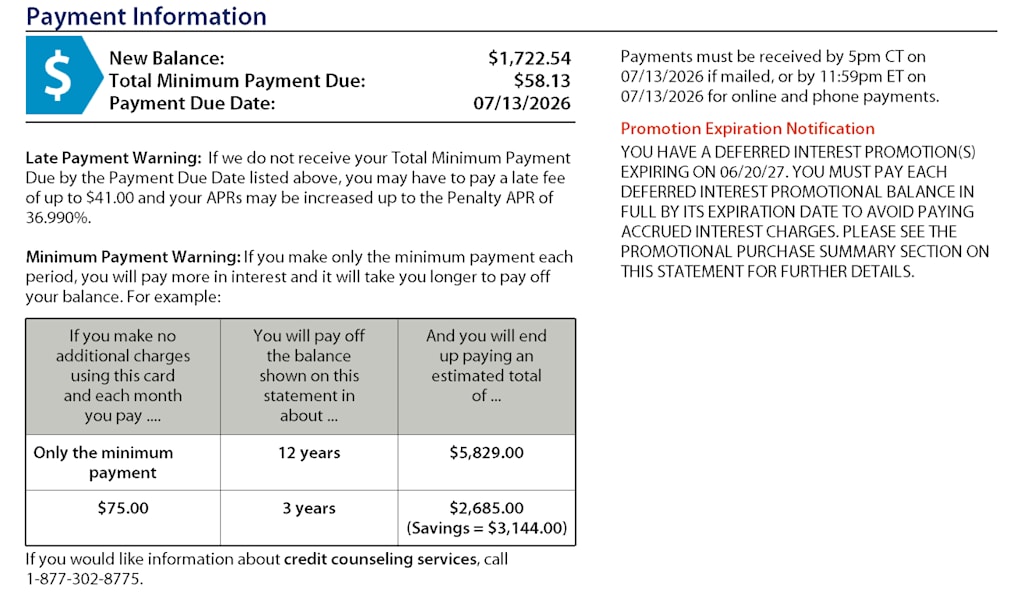
Last Friday, I received my first credit card statement, a portion of which is in the cover image. And it motivated me to write this article because I couldn't find anywhere on it how much I need to pay each month to avoid paying interest on this purchase. Because the APR is freaking 31.99% on this card and as someone who got her first credit card in 1996, I still can't believe that it went from 12% then to today's obscenely high rates. And who comes up with these numbers, by the way? Why not just put 32%, which essentially is the same high number?
I started to dig around to find the answer to my question. Of course I could just do the easy math and split the borrowed $1,723 into 12 monthly payments, which comes up to roughly $144. But I was really tickled by the fact that they only listed the minimum payment and the second arbitrary payment of $75 for comparison, which shows you great savings of over $3.1K compared to the amount you would have paid out with the minimum payment of $58 over 12 (!!!) years.
I wrote here about the debt economy, unpacking its logic. But I was still floored by how it works, in this simple example. Here's the break-down:
Lowe's wants to sell you the new appliance set so that you take it home the same day. You have no money to pay for it outright, so they have this program with the Synchrony bank for a great 12-month promo deal. They will get that money out of the bank right away and you get your set. Lowe's, you, and the economy are happy.
Synchrony, however, is playing a totally different game. Their goal is not for you to pay off the loan in 12 months because that way they just helped Lowe's move its inventory without making a single penny on you. The bank wants your account to stay active for longer so they can charge you some interest after the promo deal is over.
And this is where their credit card statement is becoming a piece of persuasive communication. The bank says:
Hey, here's a marvelous deal: you can pay as little as $58 (everyone can afford that!) every month (don't be late or missing your payments, though, because if you do your APR will go up to 37% of the penalty rate) and be done with your borrowed amount in 12 years, having paid out an equivalent of 3.4 washer-dryer sets you just bought.
OR, listen to this, you can pay just a little more, $75 a month, be done in 3 years and save (!!!) $3,144 of the total amount of what you would have paid out with the minimum payment. Isn't this a fabulous deal?
Why nowhere on the statement do they give you the third option, of paying $144 a month and be done with it before your 12-month promotional rate expires?
Well, because it is not in their interest, they will make no money on you that way, and because the federal law requires them to disclose only two numbers: the minimum payment to keep the account active and the second, larger, amount for comparison, to illustrate how the interest accrues.
This is the shortcut of persuasive communication: Pay little to stay in the game, rather than end it in your best interest with a larger payment, like a financially literate and disciplined consumer would do.
Fortunately, according to the Consumer Financial Protection Bureau (CFPB), which studied deferred-interest promotions in 2020, about 80% of such deferred-interest balances were paid off in full before the promotional period ended. In other words, roughly 4 out of 5 consumers succeeded, which is not a bad trend. The current numbers might be different or unavailable, with Trump's active attack on and dismantling CFPB.
But I'm focusing on communication through credit card statements. If our economy was oriented toward consumers and protected their interests more than the interests and business models of the banks, your statement would have shown you $144 as the amount you need to pay before the promo deal expires. But we live in the great US of A, not some socialist Europe, so you have to work out the math on your own.
Or just don't. And pay either $58 or $75/month, making the bank extremely happy. And don't even think about how many times over you would have payed for the washer-dryer set in total when you are done. Who needs long-term big-picture thinking these days? Certainly not your bank!
Now, if you want to be really savvy and stick it to the bank, you can pay $58 consistently for 10-11 months and then pay out the remaining amount of about $1,100 in the 12th month. That way the bank, seeing that you are a disciplined borrower, will be anticipating the interest it will start collecting in month 13, and boom -- you pay it all off before they can. But if even $1 remains unpaid, they can accrue all the interest rate you didn't pay during the promo time retroactively. Their statement clearly says so.
I've just made my first payment of $145.
About the Creator
Lana V Lynx
Avid reader and occasional writer of satire and short fiction. For my own sanity and security, I write under a pen name. My books: Moscow Calling - 2017 and President & Psychiatrist
@lanalynx.bsky.social
Enjoyed the story? Support the Creator.
Subscribe for free to receive all their stories in your feed. You could also become a paid subscriber, letting them know you appreciate their work.
Comments
There are no comments for this story
Be the first to respond and start the conversation.