
Your Immune System Could Kill Every Gut Bacterium. Why Doesn't It?
The colon runs a border checkpoint, not a killing field. Mucus, Tregs, and IgA keep 100 trillion bacteria from turning your gut into a war zone.
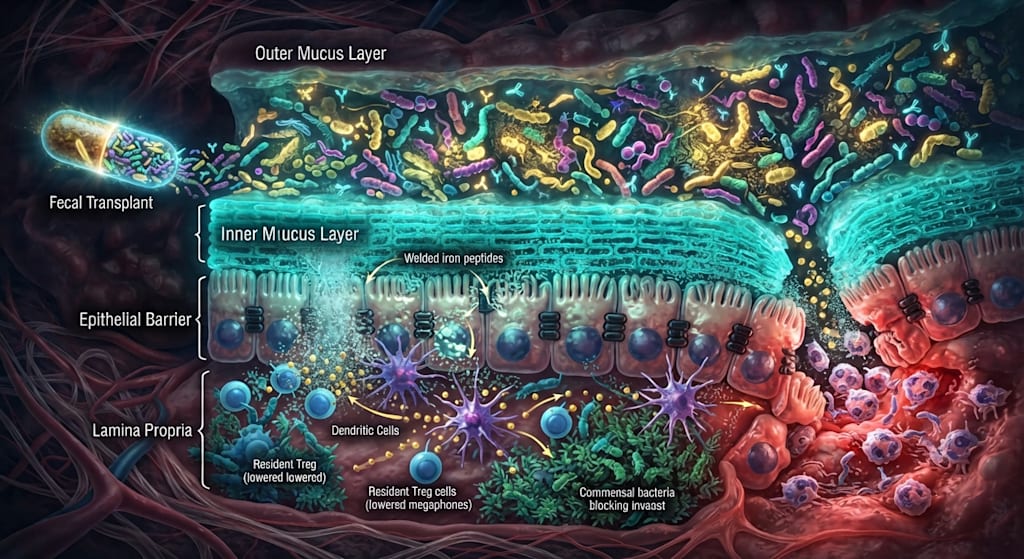
In the large intestine, a single gram of feces contains hundreds of billions of bacteria.
Immune cells sit just a millimeter below. They have not started fighting.
The stomach and small intestine have acid, bile, and pancreatic enzymes that kill as they pass. By the time things reach the large intestine, most of those digestive fluids have been recycled. What is left is residue. The large intestine does slow work: absorbing water, forming stool, letting residue linger. Warm, moist, constantly nourished. It would be strange if bacteria did not grow.
The immune system could kill them all. But the first casualties often are not the bacteria. They are the intestinal wall itself. Inflammation damages the epithelium. A damaged epithelium attracts more immune cells. More immune cells cause more damage. In the end, the bacteria survive. The large intestine gets torn into a sieve. Diarrhea, bleeding, ulcers, perforation. One after another.
The large intestine chose a different way to live.
First, it builds a wall.
Goblet cells secrete mucin, mainly MUC2. Mucin unfolds in water and cross-links into a net. This mucus layer has two parts. The outer layer is loose and porous. Bacteria settle here, eat residue, ferment fiber. The inner layer is dense and tight against the epithelium. Bacteria cannot drill through.
The outer layer is a night market. The inner layer is customs.
The mucus sheds regularly. The old outer layer carries some bacteria downward, and new mucus takes its place. No single type of bacteria can permanently claim the wall.
Behind the mucus is the epithelial layer. Cells are joined by tight junctions, like welded iron gates. Epithelial cells secrete antimicrobial peptides, defensins, lysozyme. Paneth cells at the base of the crypts pour out disinfectant. If bacteria want to get near the tissue, they have to pass these checkpoints.
But no wall is without cracks.
Bacterial fragments, metabolites, residue. They cling to the intestinal wall. Epithelial cells get damaged. Immune cells in the lamina propria are too close to the lumen. They could sound the alarm at any moment. If the immune system were still single-minded, kill rather than let one pass, the large intestine would have been inflamed long ago.
So Tregs step in.
Dendritic cells or CX3CR1⁺ macrophages extend pseudopods to sample near the lumen. Antigen information is reported up the chain. Naive T cells are induced into regulatory T cells. Tregs do not join the hunt. They press up against other immune cells, showing their faces, continuously producing IL-10 and TGF-β.
A dendritic cell nearby had already raised its inflammation megaphone. The Treg comes over. It lowers the megaphone.
This is mucosal immune tolerance. The immune system did not cease fire. It changed tactics.
Tregs have another move. The TGF-β they produce pushes B cells to differentiate into plasma cells. Plasma cells make IgA. IgA crosses the intestinal epithelium into the mucus layer and sticks to bacterial flagella. Bound bacteria are restricted. They cannot adhere to the epithelium, cannot invade tissue, and eventually get carried out with mucus and feces.
Not killed. Escorted out.
Commensal bacteria pay protection money, too. They break down dietary fiber and produce short-chain fatty acids: butyrate, propionate, acetate. Butyrate enters colon epithelial cell mitochondria and fuels the intestinal wall. Short-chain fatty acids also promote Treg differentiation.
More Tregs mean stronger immune tolerance. Stronger tolerance means less intestinal inflammation. Less inflammation means a stable microbiota. A stable microbiota means more short-chain fatty acids. More short-chain fatty acids mean more Tregs. The loop keeps turning.
Commensal bacteria also act as their own security. They occupy ecological niches, consume nutrients, produce bacteriocins, maintain an anaerobic environment, and regulate pH. A stable microbiota is like a forest full of residents. Foreign species have a hard time getting a foothold. If harmful bacteria want in, they first have to ask the local gang.
This system is usually quiet. So quiet you forget it is working.
But the agreement is not ironclad.
The barrier breaches. The microbiota is disrupted. Tregs cannot suppress Th17. Neutrophils flood in. The intestinal wall swells. Abdominal pain, diarrhea, bloody stool, weight loss. Crohn's disease, ulcerative colitis. Recurrent, hard to cure.
Many gut problems feel like magic. You feel sick, tests say you are fine. Sometimes it tortures you, sometimes it heals on its own. A cold is one pathogen, one disease. Gut problems are more like a system collapse: complex causes, varied symptoms, sometimes it recovers, sometimes the more you treat it, the worse it gets.
When the microbiota completely collapses, doctors sometimes perform fecal microbiota transplantation. Healthy stool is processed and delivered into the patient's large intestine to rebuild order. For recurrent Clostridioides difficile infection, it works well.
Next time someone mocks you with "You can't even eat shit while it's still warm," you can say: The doctor said, warm or not does not matter. Freshness is what counts.
Doctor: I did not say that. I was not there. Do not put words in my mouth.
Under the microscope, in the outer mucus layer, a bacterium is dividing. In the inner layer, the tight junctions are closed. Below the epithelium, a Treg has just finished secreting IL-10. Outside, feces are moving down.
No one wins. But tomorrow, they will talk again.
About the Creator
Jin
Writer of reamstories
https://reamstories.com/jin
Enjoyed the story? Support the Creator.
Subscribe for free to receive all their stories in your feed. You could also become a paid subscriber, letting them know you appreciate their work.
Comments
There are no comments for this story
Be the first to respond and start the conversation.