
The Top 5 Cancer List Is Not a Death Sentence List
More cases found does not always mean more danger. Screening, age, and public health can rewrite the numbers before you ever see them.
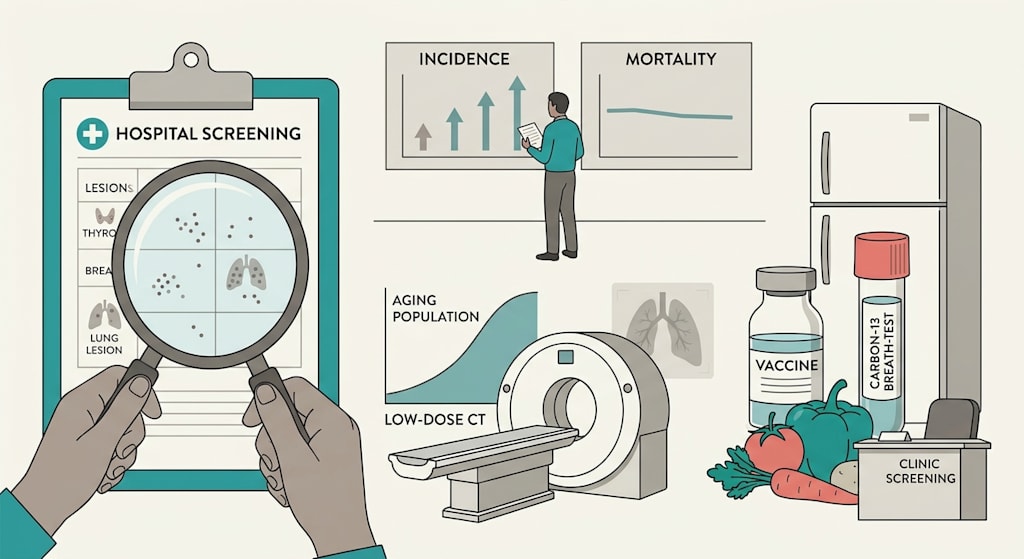
An incidence ranking answers how many new cases are found in a population. A mortality ranking answers how many people die. The numbers relate. They do not replace each other. A cancer can rise in the ranking because it is more common, because screening found cases that once went unnoticed, or because people live longer. Mix those three and the list stops explaining anything.
That is why a top-five incidence list belongs in public health first. It shows where screening resources should go, which risk factors deserve attention, and which groups need closer follow-up. It does not tell you which cancer is more deadly. It does not tell an individual what their risk is.
Thyroid cancer: the ultrasound sees nodules a few millimeters wide
Thyroid cancer rose most directly because ultrasound became common. High-resolution ultrasound can find tiny nodules and microcarcinomas. Lesions that could not be felt, caused no symptoms, and never entered statistics now do. Many thyroid cancers grow slowly. Researchers and the public still argue over overdiagnosis. Finding more cancers does not prove more life-threatening cancers exist. Public health has to balance early detection, avoiding overtreatment, and spending resources where they help.
Breast cancer: the hormone exposure window got longer
Breast cancer incidence rose for several reasons. An older population means more cases. Women’s reproductive patterns changed too. Breast tissue responds to estrogen and progesterone. With better nutrition and growth, menstruation starts earlier. First birth comes later. Women have fewer children. Over a lifetime, that means more menstrual cycles and longer exposure to the body’s own sex hormones. For estrogen receptor-positive breast cancer, cumulative hormone exposure is one cause. It is not the only cause. Breast ultrasound and mammography also brought early cancers into the statistics that would not have been found then. Prostate cancer follows a similar pattern: longer life means longer androgen exposure, and better diagnosis pushes the count up.
Lung cancer: low-dose CT pulled early lesions into the count
Lung cancer incidence still rests on aging and outside pollution. DNA damage accumulates. Cells age. Immune surveillance changes. Carcinogen exposure adds up. The longer people live, the higher the risk. Smoking and PM2.5 need no long explanation. Air quality has improved. Younger generations appear to smoke less. More public places are smoke-free. But cancer incidence reflects exposure over decades. Those effects will linger.
Low-dose spiral CT is the factor people misread most often. County hospitals and township clinics can run it. It finds millimeter-level nodules and ground-glass spots. Early lung adenocarcinoma often had no symptoms and did not show on chest X-rays. From 2020 to 2023, more lung exams happened. Early lung cancers entered the statistics in a cluster. That is not a mystery. Chinese women smoke less overall, but lung cancer still weighs heavily on them, especially adenocarcinoma. That type is not closely tied to smoking. Pollution, cooking fumes, and genetic susceptibility are all discussed. The research has not nailed the cause.
Digestive tract cancers fall out of the top three: refrigerators, vaccines, and carbon-13
Two digestive tract cancers remain in the top five. They are no longer in the top three. Twenty years ago, the top five was all digestive tract cancers. That shift matters. Stomach, liver, and esophageal cancers connect to H. pylori, hepatitis B, diet, and sanitation. Then several changes arrived at once. Carbon-13 breath tests found H. pylori. Triple and quadruple therapy cleared it. Most people know someone who went through that. Refrigerators became standard. Fewer leftovers got eaten. Less salted meat, preserved eggs, pickles, and winter-stored vegetables got eaten. Hepatitis B vaccination cut HBV-related liver cancer. Communities ran health checks for older adults. Screening reached more high-risk people. These are population-level interventions. No single drug did this. No single exam did this. Individuals should still seek care for symptoms.
Two double-edged trends
Two trends sit behind the ranking changes. Living conditions improved. Diseases tied to poor hygiene and unsafe food fell. Colorectal cancer risk from red meat, processed meat, and too little fiber remains. Longer life stretches the window for carcinogen exposure. Hormones inside the body. Smoking, pollution, and radiation outside it. Exposure accumulates. So do chances for early detection and treatment. Rising incidence and better survival can happen together.
Rankings can guide public health. They cannot judge one person’s risk.
The top-five incidence changes show something concrete. Decades of public health work can change a country’s cancer spectrum. H. pylori control, hepatitis B vaccination, better food hygiene, and wider screening are not slogans. They appear in the numbers. The ranking still has limits. Next time a headline says a cancer is rising, ask three questions. Did detection increase? Did the population get older? Did exposure increase? If you cannot separate those, the ranking reads as panic. If you can, it tells you where to put screening resources and which risk factors to attack.
About the Creator
Jin
Writer of reamstories
https://reamstories.com/jin
Enjoyed the story? Support the Creator.
Subscribe for free to receive all their stories in your feed. You could also become a paid subscriber, letting them know you appreciate their work.
Comments
There are no comments for this story
Be the first to respond and start the conversation.