
My Son’s Rubber Duck Squirted Black Water. Then I Took Apart Everything He Chews, Drinks From, and Plays With.
A parent’s field notes on mold, hidden gaps, and why “looks clean” is not a safety standard.
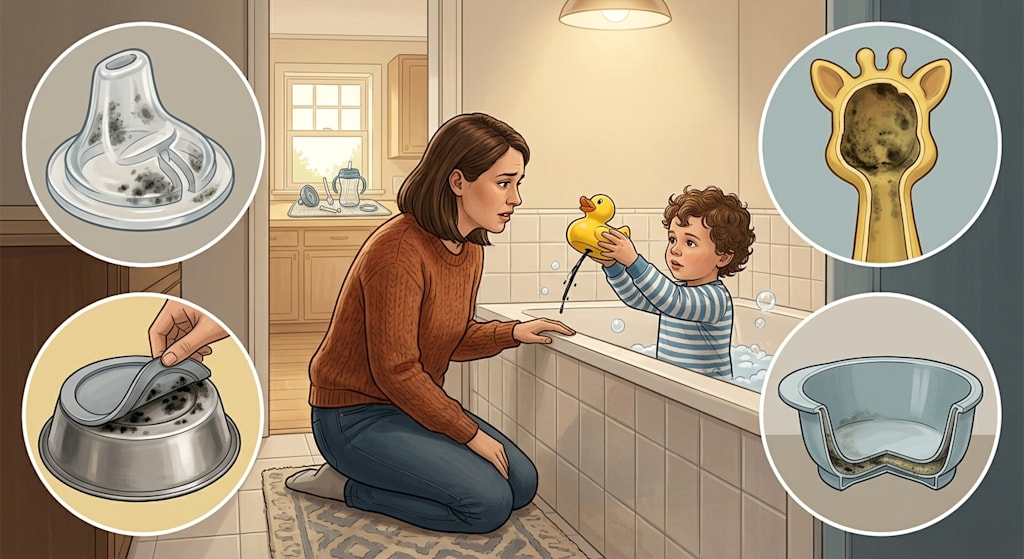
That night, halfway through my son’s bath, he held up the little rubber duck and shouted, “Mom, the duck peed!”
I looked down. A stream of black water was coming out of the little hole in the duck’s bottom. It was not dripping. It was spurting. He squeezed once, and a jet came out. He squeezed again, and another jet came out. The water was grayish-black, with a damp smell I could not name.
I fished all the toys out of the bath, put them in a trash bag, tied it tight, and threw it away. My son cried for two minutes. I wiped his face and told him the duck was broken and we would buy a new one tomorrow. He said okay.
But I did not buy a new one. I started going through everything in the house that he chewed, drank from, or bit every day.
1. Duckbill Cups, Sophie the Giraffe, and the Dog Bowl
Let’s start with the duckbill cup. When my son was little, he used a very popular duckbill cup. The spout was soft silicone with a valve inside. I always thought scalding it with boiling water was enough. Then I saw that a parent had cut the spout open. Inside was a ring of black mold spots that a brush could never reach. Milk had seeped in through the valve slit, and over time it settled there. I threw that cup away that same day. When I threw it out, I squeezed the spout. It was soft, and the surface looked clean.
The Sophie the Giraffe story is more famous. An overseas mother cut open the little giraffe her child chewed every day and found it full of black mold. The mold had been growing for as long as the child had been chewing it. The outside was smooth rubber. The child bit it with a squeak, and parents felt reassured watching. But the teether had a hole. Saliva, milk residue, and washing water went in through the hole. Inside was hollow. No sun, no brush, no way to dry. The cleaner the outside, the more hidden the inside.
The dog bowl was my own oversight. There was a ring of non-slip silicone on the bottom. Every time I washed it, I put it upside down to dry. The surface dried, but the gap between the silicone and the bowl stayed wet. After a while I turned it over and saw a ring of dark green mold on the bottom. The dog ate from that bowl every day.
These three things seem unrelated. One is a spout, one is a teether, one is a dog bowl. Structurally, they follow the same logic: there is a place where water can get in, a brush cannot reach, and air cannot dry.
2. The Bath Duck Test
Minsheng Laboratory did an episode testing bath ducks. Three ducks, used for two months, one year, and two years. On the surface they all looked quite clean and did not smell.
They cut them open and poured out the water inside. The two-month duck’s water was still relatively clear. The one-year duck’s water had changed color. The two-year duck’s water was murky, had sediment, and even contained a hair.
Lab testing showed colony counts: 7,600 for two months, 2.1 million for one year, and 4.3 million for two years.
A high total colony count does not necessarily mean it will cause disease. Many of those are environmental bacteria. But the numbers matter less than the image. Every day at bath time the child squeezes the duck. Water gets sucked in through the hole and squirts out onto the face, onto the arms, sometimes straight at the eyes, sometimes into the mouth when he laughs with it open. You do not know what is in that water, because you cannot see it.
I remember a few risks the experts listed. Dirty water squirting into the eyes can cause conjunctivitis. Getting into the ear canal can trigger otitis media. If a child chews the duck or sucks the water inside, it can cause abdominal pain and diarrhea. Mold spores in the air can trigger allergic rhinitis and wheezing. Pseudomonas aeruginosa on broken skin can cause redness, swelling, and inflammation.
Not every duck will make a child sick. But I am not willing to gamble on a structure that always holds a puddle of water inside.
3. Insulated Bowls
When my son was eating solids, I bought a double-layer insulated bowl. I thought he ate slowly, food got cold fast, and an insulated bowl was practical.
Later I tried to take the bowl apart. It could not be taken apart. The inner layer was fully sealed, with only a tiny water-filling hole. I felt inside the hole with my finger. It was a little sticky. I put a cotton swab in and turned it around. The tip came out yellow.
In that bowl’s inner layer, food residue and water could seep in through the filling hole, the vent, and the gaps around the seal. Once in, they could not get out. And the whole point of an insulated bowl is to keep things warm, so the inner layer stays warm and damp for long periods. Warm, damp, and with food residue. Once all three conditions are met, bacteria and mold start to multiply.
I am not saying no double-layer insulated bowl can be used. I am saying that a non-removable, non-washable inner layer is itself a hygiene blind spot. You rinse the bowl clean every day, scald it, put it upside down. On the surface there is no problem at all. But that bit of leftover water and milk residue inside the layer is something you cannot see and cannot control.
Later I switched to a plain stainless steel bowl with an insulated bag. When we went out, I put the bowl in the bag, and it stayed warm just the same. A temperature-controlled warming plate also works. A physical workaround is more reliable than an inner layer.
4. Three Questions Before I Buy Anything
After throwing out a round of things, I made a rule for myself. Before buying anything that goes into my child’s mouth, I ask three questions.
Can it be taken apart? Can the spout, seal, weighted ball, and non-slip pad be completely removed? If not, I do not buy it.
Can it be brushed? Once it is apart, can a brush get in? Inside the valve, around the bend of a straw, inside the hole of a teether. If I cannot brush it, I do not buy it.
Can it dry? After washing, can it be air-dried with ventilation? If it can only be wiped, not air-dried, I do not buy it.
These three questions filtered out a lot. Some cups were pretty, with a one-piece spout, but the valve slit could not be washed. Pass. Some teethers were cute, but they had a little hole that let water in. Pass. Some plates had suction bases, but the gap between the suction base and the plate could not be separated. Pass.
Fewer things stayed, but every one of them could be taken apart, brushed, and dried.
5. How I Wash Things Now
Before, I would rinse a cup, shake it twice, and put it upside down on the drying rack. Now I take off all the seals, run a thin brush through the spout twice, take the weighted ball apart and rinse it, lay all the parts out on a gauze cloth, and put them somewhere with ventilation. After using the steam sterilizer, I let everything dry again. Sterilizing is not the same as drying. If you put it back wet after sterilizing, you might as well not have sterilized it.
For bath toys, I switched to hole-free one-piece ones, the kind you cannot squeeze water out of. Occasionally there are ones with holes. After washing, they must be squeezed dry and put on the windowsill to air out. I check them once a week, and if black water comes out when I squeeze, I throw them away.
The silicone pad on the dog bowl now comes off every time I wash it. I dry the bottom of the bowl and the pad separately before putting them back. Or I just use a bowl without a silicone bottom. The bottom touches the floor directly, with no gap.
For teethers, I only buy one-piece, hole-free, seam-free ones. I regularly hold them up to the light to check for tears, and if there is a tear, I replace it. I no longer just scald them with boiling water and call it done. If it does not dry after scalding, it is still wet inside.
6. When Something Has to Be Thrown Away
I do not agonize over it now. If any of the following applies, it goes straight in the trash. No repairing, no rescuing.
Bath toys that squeeze out black water, murky water, or smell bad. Spouts or seals that are black or moldy inside and cannot be brushed clean. Teethers with tears, water in the holes, or visible mold spots inside. Insulated bowls with a smelly inner layer or dirty water coming out of the filling hole. Any mouth-contact item that still smells moldy after washing and drying.
Once my son asked me why the duck was thrown away. I said it was dirty inside and could not be washed clean. He said oh. He did not ask for it again.
What I Learned
I am not writing this to scare anyone. At first I thought I was pretty careful. Scald with boiling water, wash often, and if it looks clean, that is enough. But that stream of black water spurting out of the rubber duck’s bottom made me understand one thing. Between “looks clean” and “actually clean” lies an entire blind spot you cannot wash.
You cannot see what is in that blind spot. But your child is chewing, sucking, and biting it every day.
So now when I buy things, appearance, features, and brand all come later. First I turn it over and look at the bottom. Is there a silicone ring? Is there a small hole? Is there an inner layer that cannot be taken apart? Can it be taken apart, brushed, and dried? Only if all three are true do I consider buying it.
That night, after throwing out the bath toys and after my son fell asleep, I took apart every cup on the kitchen drying rack again. Seals were spread across the counter. One seal inside a cup lid had turned black. I scraped it with my fingernail and it would not come off. I threw it away.
The next morning, he drank milk from the simplest cup we had. The lid screwed off. There was no valve, no straw. After he finished, I took it apart into three pieces, brushed them, and set them on the windowsill to dry. Sunlight came in, and the water droplets on the cup slid slowly down.
After he finished, he handed the cup to me and said, “Mom, this cup is easy to wash.”
I said, “Yes. Easy to wash.”
About the Creator
Jin
Writer of reamstories
https://reamstories.com/jin
Enjoyed the story? Support the Creator.
Subscribe for free to receive all their stories in your feed. You could also become a paid subscriber, letting them know you appreciate their work.
Comments
There are no comments for this story
Be the first to respond and start the conversation.