
A Cockroach Crawled Into His Ear. The Panic Made It Dangerous.
The safest move is not to slap, flush, or dig. It is to stop the bug with oil and get to a doctor.
1. What the report says
The ENT endoscopy report from Lecong Hospital in Shunde District, Foshan, has four lines worth reading closely:
Cockroach remnants seen in the ear canal; after cleaning, the tympanic membrane is intact and slightly hyperemic; the mucosa of the ear canal wall is slightly red and swollen; some mucosal defects are seen.
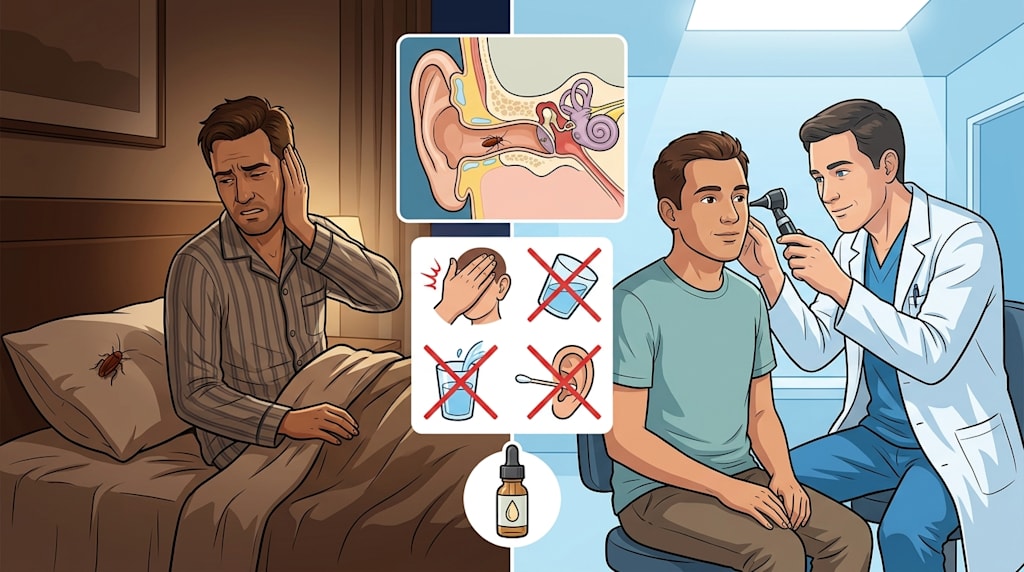
Mr. Liang, 33, went home to Shaoguan, Guangdong, for the National Day holiday. He slept in a guest room at his grandmother’s house that was rarely used. On the night of October 3, something crawled on the outer part of his left ear and woke him. He could not tell whether it was a cockroach or a gecko. He grabbed at it and pinned its tail. The insect broke free and went into his ear canal. He lay down, slapped his head, and flushed the ear with water. The insect died inside. He waited a week before going to the hospital. The doctor told him the eardrum had nearly perforated and that he needed follow-up exams.
The report does not say “infection.” The eardrum was intact, only slightly hyperemic. The ear canal had mucosal defects, but a dead cockroach sat there for a week without causing a serious infection. The lining of the ear canal can defend itself to some degree. But “nearly perforated” points to another cause: the slapping and the water, not the cockroach, pushed the risk to the eardrum.
2. What he did wrong
First, he grabbed it. The insect was crawling on the outer ear. Mr. Liang pinned its tail. It broke free and crawled into the nearest gap. The cockroach may not have wanted to enter the ear canal. Being grabbed and pinned down drove it into a narrow, dark space. A first reaction can turn “passing by” into “going in.”
Second, he slapped his head. The ear canal is a narrow, curved tube with thin skin. The eardrum sits at the end. An insect inside has little room. Slapping the head creates vibration and noise. That stimulates the insect and makes it struggle. It may scratch the canal wall or push deeper. The skin is delicate. The eardrum is thinner. Slapping gives the insect a reason to fight.
Third, he flushed the ear with water. If you do not know whether the eardrum is perforated, pouring water into the canal is a gamble. A small perforation can let water carry bacteria into the middle ear. Water can also push the insect and debris deeper. The Merck Manual advises against irrigating the ear canal when a perforation is suspected.
Fourth, he waited a week. A dead cockroach stayed in the canal for seven days. It caused mild redness, swelling, and mucosal defects. There was no serious infection. He was lucky. “No serious infection” is not a reason to wait. An insect in the ear, dead or alive, should come out soon.
3. The ear canal is not a good home for cockroaches
People often ask whether cockroaches like to crawl into ears. If German cockroaches did, ENT clinics would be full every day. Insects in the ear are rare accidents. Most people never have one. The odds are lower than pushing a cotton swab tip into your ear and failing to get it out.
The ear canal is dark, narrow, and warm. That fits some cockroach preferences. But insects have smell and taste receptors on their antennae and legs. When they touch human skin, they usually sense that the temperature, moisture, and smell are wrong. Most land arthropods that land on a person try to leave. Insects that approach people on purpose are usually blood feeders or species with special habits. Cockroaches are not in that group.
Earwax is not the enemy. Normal earwax blocks and repels insects to some degree. Its smell is not friendly to them. Doctors do not encourage frequent ear cleaning, and they especially do not encourage pushing cotton swabs deep into the canal. Overcleaning damages the barrier.
Why do cockroaches get on beds? Usually because food crumbs, open packaging, or garbage are nearby. Sometimes a room has been empty for a long time and has hygiene blind spots. German cockroaches are small and can accidentally enter an ear canal. Larger cockroaches are too big for an adult ear. To keep cockroaches out of ears, first keep them off the bed. To keep them off the bed, clear food and garbage.
4. The safest home step: oil to immobilize, then a doctor
If an insect is in the ear and there is no known or suspected eardrum perforation, no ear surgery history, and no pus, the home step to use is oil. It immobilizes the insect.
Sit. Tilt your head so the affected ear faces up.
Use cooking oil, mineral oil, or baby oil at about body temperature. Put several drops into the canal.
Keep your head tilted for a few minutes. The oil coats the insect, suffocates it, or stops it from moving.
Turn your head the other way so the oil and insect can flow out. Do not shake your head hard or repeatedly.
Go to an ENT clinic. Whether or not the insect comes out, a doctor should look with an otoscope, remove it, and check the eardrum.
Oil is not the end of treatment. It stops the insect from struggling, lowers the risk of injury, and buys time for medical care. It does not replace professional removal.
If you know or suspect an eardrum perforation, or if the ear has recently bled, drained pus, hurt badly, or lost hearing suddenly, do not put liquid in it. Go to a doctor. Do not force treatment on children, people with cognitive impairment, or anyone who cannot cooperate.
5. Five things not to do
Do not slap your head or shake it hard. The insect will struggle and raise the risk of injury to the canal and eardrum.
Do not flush with water. If the eardrum is not known to be intact, water can carry bacteria into the middle ear or push remnants deeper.
Do not dig with cotton swabs, ear spoons, tweezers, or hairpins. You cannot see well, and the tools are wrong. You can push the insect deeper, pinch the canal, or puncture the eardrum. Mr. Liang’s cockroach stayed in his canal for a week. That is what “I can handle it myself” often looks like.
Do not drip alcohol, vinegar, Fengyoujing, or insecticide into the ear. These liquids irritate the skin and eardrum and can cause chemical injury. Insecticide does not belong in an ear.
Do not rely on light to lure the insect out. It works poorly on cockroaches, and bright light may agitate them. It is not a substitute for a doctor.
6. How doctors remove it
Removing a foreign body from the ear canal is routine for ENT doctors. They use an otoscope or endoscope to check whether the insect is dead or alive, how deep it is, whether the canal is injured, and whether the eardrum is intact. Then they remove it with a cerumen hook, micro forceps, or suction. If a live insect is still moving, they may first immobilize it with oil or a local anesthetic. The procedure usually takes minutes and costs little.
Hospital treatment is simpler and safer than slapping, flushing, or digging at home. Mr. Liang went after a week. The doctor cleaned out the remnants. The eardrum was intact and slightly hyperemic. The canal mucosa was red, swollen, and defective. He needed follow-up exams. Most cases are not complicated when people get care early. Delay and improvised handling create uncertainty.
7. When to get care right away
Get care right away if:
the insect is still moving and the ear hurts;
the ear bleeds, drains pus, or leaks fluid;
hearing drops suddenly or tinnitus gets worse;
you feel dizzy, nauseated, or unsteady;
your face feels numb or weak (rare, but serious);
you know or suspect an eardrum perforation;
the foreign body is a button battery, a sharp object, or a plant seed;
a child cannot stop crying or cannot cooperate;
symptoms get worse after home treatment.
A button battery in the ear is an emergency. Go to a hospital immediately. Do not drip oil. Do not flush. Do not try to remove a sharp object yourself.
8. Prevention in plain actions
Before you stay in a room that has been empty for a long time, open the windows, wipe the bed, and check the bedding. Old houses, guest rooms, and storage rooms attract cockroaches, spiders, and earwigs.
Keep food covered. Take out garbage promptly. If the bed has no food source, cockroaches are less likely to get on it.
A mosquito net does more than block mosquitoes. It keeps cockroaches, spiders, and other crawling insects off your body.
Avoid sleeping on the floor for long periods. More arthropods move on the ground. Earwigs, spiders, and centipedes can come near. A bed, off the floor, under a net, is safer.
Do not overclean your ears. Earwax is a barrier. The canal cleans itself. Cotton swabs pushed deep can push foreign objects deeper and injure skin.
9. The rule to remember
This story is easy to turn into “cockroaches in the ear are terrifying.” The useful lesson is narrower. Insects in the ear are rare. Bad self-rescue turns a rare accident into canal injury.
You do not need to fear sleeping or staying in a guest room. Take away one action:
Bug in the ear: do not slap, do not flush, do not dig. Drown it with oil. Then go to the hospital.
About the Creator
Jin
Writer of reamstories
https://reamstories.com/jin
Enjoyed the story? Support the Creator.
Subscribe for free to receive all their stories in your feed. You could also become a paid subscriber, letting them know you appreciate their work.
Comments
There are no comments for this story
Be the first to respond and start the conversation.