fact or fiction
Is it a fact or is it merely fiction? Fact or Fiction explores the lesser known truths in the corporate culture of Journal.
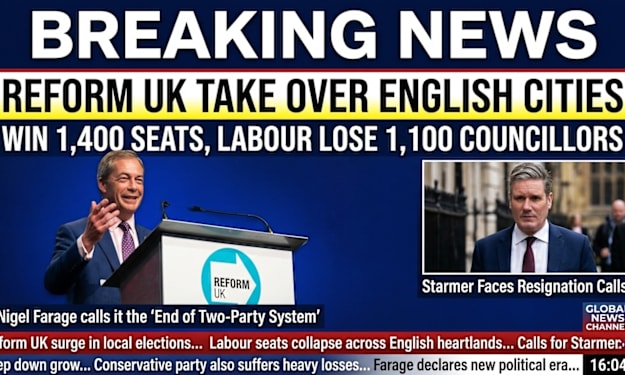
Reform UK Just Won 1,400 Seats and Took Over English Cities. Labour Lost 1,100 Councillors. Keir Starmer Is Facing Calls to Resign — and Nigel Farage Is Calling It the End of the Two-Party System.
The results of the United Kingdom's May 7, 2026 local elections — which have been trickling in and analysed through the weekend — represent the most significant realignment of British local politics in at least a generation, and possibly since Thatcherism reshaped the political landscape in the 1980s. The headline numbers are stark. Reform UK gained more than 1,400 seats across England, while Labour lost more than 1,100 councillors it had previously held. The Conservative Party also performed badly, losing over 500 seats. Simultaneously, the Green Party gained more than 300 seats and the Liberal Democrats more than 150 seats. The result: a British local political landscape that no longer resembles the two-party system that has structured British democracy for more than a century, and that sends every sitting national politician an unmistakable message about the public's relationship with established parties.
By Gideon Polycarp6 months ago in Journal
Plagiarism and Copyright
An Introduction The image above is from Slideshare Here There has been a lot posted about plagiarism recently and it is quite right that it is brought to the forefront and action taken where it occurs. The thing is that it has made me feel like the world’s biggest plagiarist because of the nature of my writing and has made me feel like I should drop out of the various Facebook Vocal groups because I am an effective writing criminal, though I will not leave unless asked to go or am actually removed. So here are a couple of definitions that I will work within this article which hopefully doesn’t get reported for plagiarism itself
By Mike Singleton 💜 Mikeydred 6 months ago in Journal
Authorship vs Refinement
Much of the confusion surrounding artificial intelligence and writing comes from a failure to distinguish between two fundamentally different acts: originating ideas and refining their expression. These acts are often treated as interchangeable, as though whoever touches the final form must also be the source of the thought itself. That assumption does not reflect how writing has ever worked, nor does it reflect how human thinking actually unfolds.
By Peter Thwing - Host of the FST Podcast6 months ago in Journal
Institutions Fear Inference More Than Lies
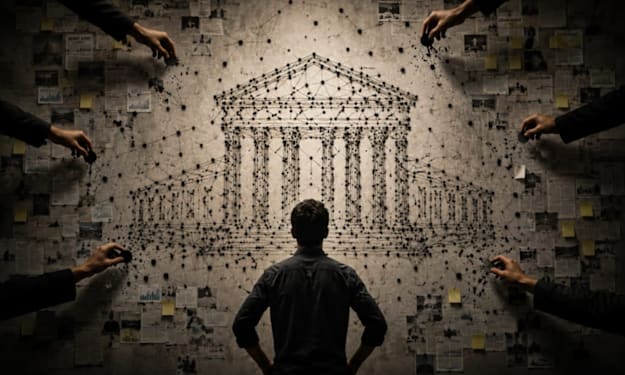
Institutions are often willing to tolerate isolated falsehoods, minor inaccuracies, selective framing, and even outright contradictions. A single lie can be corrected, buried, explained away, or isolated from the larger structure. What institutions consistently resist is not merely factual disagreement. They resist inference. They resist the moment when separate observations are connected into a pattern, and the pattern begins to imply responsibility.
By Peter Thwing - Host of the FST Podcast6 months ago in Journal
Immunity and Practical Unaccountability
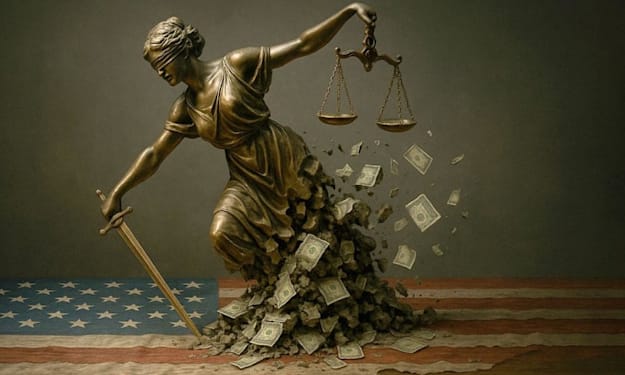
In theory, no one is above the law. This phrase is repeated often enough that it functions as a civic mantra, a reassurance that power is ultimately constrained and that authority remains accountable to the same moral and legal standards imposed on everyone else. On paper, police officers, prosecutors, and government agents are subject to the law just like any citizen. They can be investigated, disciplined, sued, or prosecuted when misconduct occurs.
By Peter Thwing - Host of the FST Podcast6 months ago in Journal
Writing as Journal, Not Just Product
Not everything that matters begins as something meant for an audience. Much of what shapes a person most deeply starts as private wrestling, unfinished realization, unresolved tension, or a question that has not yet settled into a firm position. Treating writing only as a product meant for consumption misunderstands one of its most essential functions. Before writing becomes communication, it is often orientation.
By Peter Thwing - Host of the FST Podcast6 months ago in Journal
Every Alternative Is an Admission
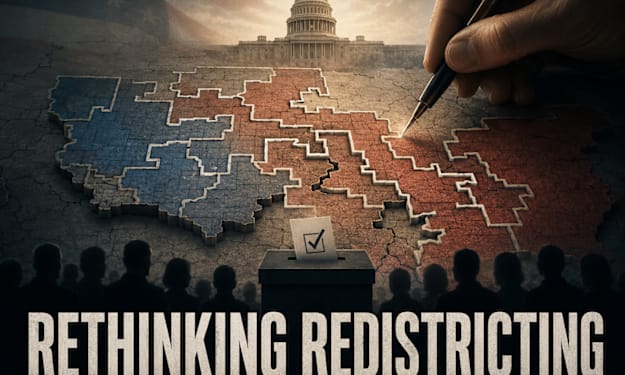
The Current System Should Not Be Treated as the Neutral Baseline The current redistricting system is often treated as the normal starting point, while every alternative is treated as an experiment that must justify itself. That framing is backwards. The current system is already an experiment in political assignment. It already decides which voters belong together before they vote. It already gives enormous power to whoever controls the boundaries. It already allows voters to be packed, cracked, attached, diluted, concentrated, divided, or rearranged while still maintaining the appearance of legal process. The familiar system should not receive moral credit merely because people are used to it.
By Peter Thwing - Host of the FST Podcast6 months ago in Journal
Why This Conversation Has to Happen Now
This Is Not an Abstract Exercise Brainstorming alternatives to redistricting can sound theoretical until the country enters a moment when the map itself becomes one of the main weapons of national power. At that point, the question stops being academic. It becomes immediate. If congressional control can be altered not mainly by persuading voters, but by changing the containers those voters are placed into, then redistricting is not a procedural side issue. It is one of the most consequential political powers in the country.
By Peter Thwing - Host of the FST Podcast6 months ago in Journal
🚨 BREAKING: The Government Is Taking Passports From Parents Who Skip Child Support — And the List Is About to Get Much Longer
There are laws that exist on paper but rarely in practice. The kind that get passed with good intentions, signed with fanfare, and then quietly shelved because the enforcement machinery is too complicated, the political will too thin, or the problem too thorny to address head-on. For three decades, a provision buried inside the Personal Responsibility and Work Opportunity Reconciliation Act of 1996 was exactly that kind of law.
By Gideon Polycarp6 months ago in Journal
One Year Ago Today, India Launched Missiles Into Pakistan. Both Sides Had Nuclear Weapons. Nobody Stopped Them. Here Is What Operation Sindoor Really Taught the World.
Exactly one year ago today — on the night of May 6-7, 2025 — India launched a series of air and missile strikes against targets in Pakistan and Pakistan-administered Kashmir. The operation, named "Operation Sindoor," targeted nine locations identified as command centres and training facilities linked to the terrorist groups Jaish-e-Mohammed and Lashkar-e-Taiba, both of which India holds responsible for the April 22, 2025 attack in Pahalgam, Kashmir, that killed 26 civilians — 25 Indian nationals and one Nepali national, all male, most of them Hindu tourists. Pakistan retaliated the following day. What followed was four days of drone strikes, missile exchanges, fighter jet engagements, and cross-border artillery fire between two nuclear-armed nations — the most dangerous bilateral military confrontation in South Asia since 1971. It ended with a ceasefire on May 10, brokered in significant part by U.S. Secretary of State Marco Rubio's urgent phone diplomacy.
By Gideon Polycarp6 months ago in Journal
Ted Turner Is Dead at 87. The Man Who Invented 24-Hour News, Built CNN from Nothing, and Warned the World About Nuclear War — Before Anyone Was Listening.
Ted Turner died peacefully on Wednesday, May 6, 2026, surrounded by his family at his home in Atlanta. He was 87. Turner Enterprises confirmed the death in a formal statement. CNN Chairman and CEO Mark Thompson, in a tribute that was both institutional and deeply personal, said: "Ted was an intensely involved and committed leader, intrepid, fearless and always willing to back a hunch and trust his own judgment. He was and always will be the presiding spirit of CNN." The network Turner founded — which has been broadcasting continuously for 46 years — paused its regular programming to air a memorial broadcast. The man who invented the news cycle is now part of it.
By Gideon Polycarp6 months ago in Journal