
🚨 BREAKING: The Government Is Taking Passports From Parents Who Skip Child Support — And the List Is About to Get Much Longer
For thirty years, a federal law sat on the books largely ignored. Starting this week, that changes — and the consequences will reach far beyond the first group being targeted.
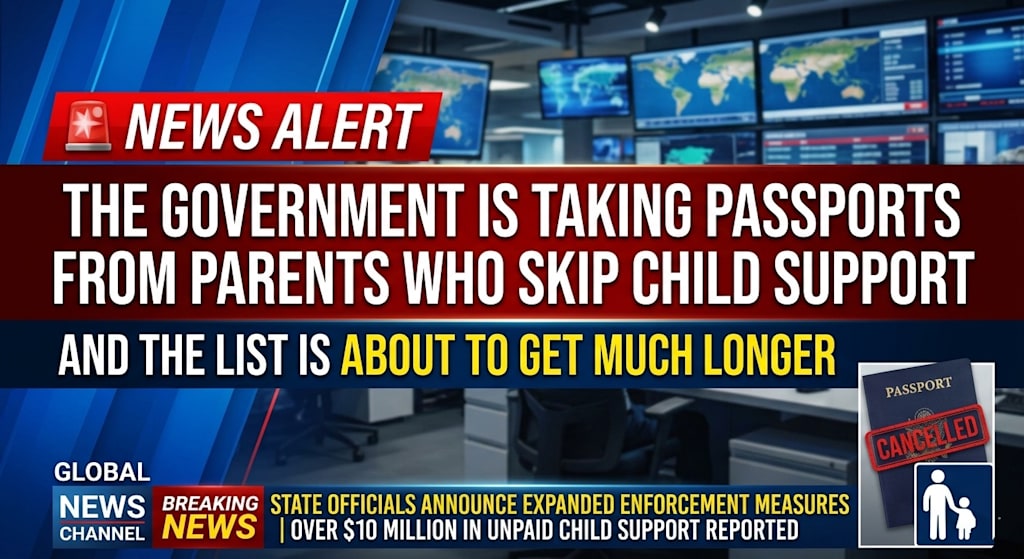
There are laws that exist on paper but rarely in practice. The kind that get passed with good intentions, signed with fanfare, and then quietly shelved because the enforcement machinery is too complicated, the political will too thin, or the problem too thorny to address head-on. For three decades, a provision buried inside the Personal Responsibility and Work Opportunity Reconciliation Act of 1996 was exactly that kind of law.
It gave the federal government the authority to revoke the U.S. passport of any American who owed more than $2,500 in unpaid child support. Not to deny new applications — to revoke passports that had already been issued. It was a serious measure with a serious purpose: ensuring that parents who had abandoned their financial obligations to their own children could not simply travel the world while those children went without.
For most of its existence, though, the law functioned as barely a speed bump. The State Department only moved against deadbeats who came to it voluntarily — people applying to renew a passport or seeking some other consular service. Stay away from government offices, hold onto your existing document, and the law had no reach. Millions of Americans did exactly that.
That arrangement ended this week.
On Thursday, May 7, the State Department confirmed to the Associated Press that it will begin proactively revoking the passports of parents who owe unpaid child support — without waiting for those parents to request any government service. Starting Friday, the first group to lose their documents will be those who owe $100,000 or more. About 2,700 passport holders fall into that category, according to data compiled by the Department of Health and Human Services and shared with State.
The policy will soon expand dramatically. The $2,500 threshold written into the 1996 law will eventually govern the program, meaning any parent who owes more than that amount in arrears — and holds a valid U.S. passport — could find themselves stripped of travel privileges. HHS is still gathering data from state child support agencies to determine the full scope of that population. Officials have not provided a final number, but they have been candid that it will be large.
What has changed is not the law. What has changed is the decision to actually enforce it.
The scale of unpaid child support in America is staggering. Nationally, child support arrears have accumulated to more than $113 billion. There are over 15 million active cases involving some amount of past-due payment. Less than half of non-custodial parents are in full compliance with their court-ordered obligations. About 30 percent of custodial parents who are legally owed support receive absolutely nothing — not partial payments, not irregular amounts, nothing.
For most of the people owed that money, the failure to receive it is not a minor inconvenience. It is a financial emergency that repeats every month. The average child support order amounts to around $460 monthly. For a single parent working a modest job and trying to keep children housed, fed, and in school, that $460 is the difference between stability and crisis. Studies have consistently found that children in households where support goes unpaid face significantly higher rates of poverty, food insecurity, and housing instability than those in households where payments arrive reliably.
About 80 percent of custodial parents in the United States are women. Many of them are navigating parenting alone while also managing careers, childcare costs, and the ordinary financial pressures of modern life. When the other parent disappears financially — sometimes across state lines, sometimes abroad — the court order they hold becomes a piece of paper with no practical force. The enforcement mechanisms that exist, including wage garnishment and tax refund interception, depend on the delinquent parent having identifiable income or tax filings. Parents who work under the table, who are self-employed, or who simply move frequently can remain difficult to collect from through those channels.
A passport, though, is different. It belongs to everyone who has one, regardless of employment status, income, or geography.
The passport denial program has a track record worth examining. Since it began operating in earnest in 1998, states have collected approximately $657 million in child support arrears that officials attribute, at least in part, to the threat of passport consequences. More than $156 million of that amount came in over 24,000 individual lump-sum payments just in the past five years. The program has also recorded nine separate cases in which a single parent paid more than $300,000 in a single transaction to resolve their debt and preserve their passport. These are parents who had the money, who had been withholding it, and who chose to pay when a concrete personal consequence arrived.
Since the AP reported in February that the program would be expanded, hundreds of parents reportedly contacted state agencies and resolved their arrears before a single passport was actually revoked. The announcement alone moved the needle.
Mora Namdar, the Assistant Secretary of State for Consular Affairs, framed the policy plainly in a statement this week. The department, she said, was “expanding a commonsense practice that has been proven effective at getting those who owe child support to pay their debt.” She added: “Once these parents resolve their debts, they can once again enjoy the privilege of a U.S. passport.”
The word privilege carries weight in that sentence. The department is making an explicit argument: international travel is not a right that exists independently of one’s obligations to society and to one’s own children. It is a benefit the government extends — and can withdraw.
There are legitimate complications the policy will have to navigate. Critics have pointed out that the bulk of unpaid child support in the United States is owed by low-income parents — often men who are unemployed or working poverty-wage jobs and who genuinely cannot pay, rather than choosing not to. An analysis cited by multiple sources found that roughly 70 percent of parents in arrears were unemployed or low-income at the time of their delinquency. The median annual income of parents with significant arrears in one large state study was barely above $6,000. Revoking the passport of someone in that situation does not collect money that does not exist — it simply adds one more legal burden to a life already shaped by financial precarity.
The policy’s architects appear to be focused, at least initially, on cases where willful non-payment is more plausible. Owing $100,000 or more in child support — the threshold for this week’s initial revocations — suggests either years of deliberate avoidance or, in some cases, the kind of financial resources that make non-payment a choice rather than a necessity. The expansion toward the $2,500 threshold will bring a far more economically diverse population into the program’s reach, and how enforcement agencies handle cases of genuine inability to pay will likely become one of the program’s defining debates in the months ahead.
For parents who are currently abroad when their passport is revoked, the State Department has outlined a specific process: they must contact a U.S. embassy or consulate, which can issue a limited emergency document allowing return to the United States. That document does not restore full passport privileges — it is a one-way ticket home. From there, restoring full travel rights requires resolving the child support debt with the relevant state agency and applying for a new passport once arrears are confirmed as cleared or a satisfactory payment arrangement has been established.
The broader significance of this week’s announcement is less about the 2,700 people facing immediate revocations than about the signal it sends about the direction of federal enforcement going forward. For three decades, the gap between what the law permitted and what the government actually did was wide enough to drive a truck through. Parents who knew about the passport provision could simply keep their documents current, avoid consular offices, and operate as though the law did not apply to them.
That gap is closing. The infrastructure now being built — in which HHS proactively shares child support debt data with the State Department, which then cross-references that data against passport records and initiates revocations without waiting for any triggering application — represents a qualitative shift in how the federal government approaches enforcement. It is systematic in a way the previous approach never was.
Whether it produces the results its architects intend, and whether it does so equitably across the wide economic spectrum of parents who owe child support, will play out over the coming months as the program scales up. What is already clear is that a dormant law has been given teeth — and for the custodial parents who have been watching court orders go unanswered for years, that may be the most significant development in child support enforcement in a generation.
Reporting based on statements from the U.S. State Department and Department of Health and Human Services, as reported by the Associated Press. Published May 7, 2026.
About the Creator
Enjoyed the story? Support the Creator.
Subscribe for free to receive all their stories in your feed.
Comments
There are no comments for this story
Be the first to respond and start the conversation.