
One Year Ago Today, India Launched Missiles Into Pakistan. Both Sides Had Nuclear Weapons. Nobody Stopped Them. Here Is What Operation Sindoor Really Taught the World.
On the night of May 6-7, 2025, India launched Operation Sindoor — striking terrorist infrastructure in Pakistan and Pakistan-administered Kashmir after the Pahalgam massacre killed 26 civilians. Four days of nuclear-armed brinkmanship followed. A ceasefire held. Barely. Here is what the anniversary means — and why the risk isn't over.
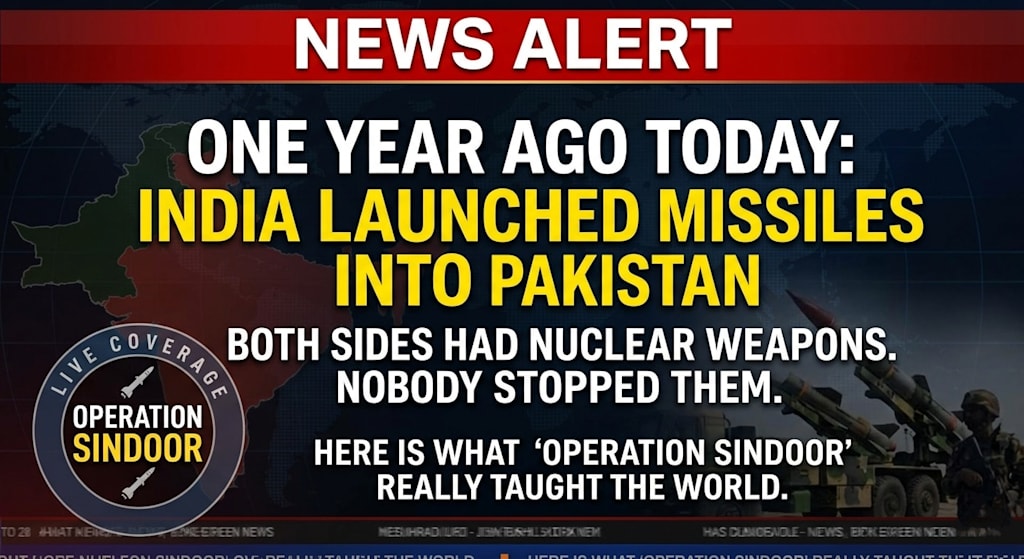
Exactly one year ago today — on the night of May 6-7, 2025 — India launched a series of air and missile strikes against targets in Pakistan and Pakistan-administered Kashmir. The operation, named "Operation Sindoor," targeted nine locations identified as command centres and training facilities linked to the terrorist groups Jaish-e-Mohammed and Lashkar-e-Taiba, both of which India holds responsible for the April 22, 2025 attack in Pahalgam, Kashmir, that killed 26 civilians — 25 Indian nationals and one Nepali national, all male, most of them Hindu tourists. Pakistan retaliated the following day. What followed was four days of drone strikes, missile exchanges, fighter jet engagements, and cross-border artillery fire between two nuclear-armed nations — the most dangerous bilateral military confrontation in South Asia since 1971. It ended with a ceasefire on May 10, brokered in significant part by U.S. Secretary of State Marco Rubio's urgent phone diplomacy.
India's Defence Minister Rajnath Singh marked the anniversary on Thursday with a statement on X, saluting the "valour and sacrifices" of the Indian Armed Forces and issuing what he described as a "stern warning to Pakistan and terror outfits." Indian military statements claimed that over 100 terrorists were killed in the initial strikes and that 95 to 98 percent of Pakistan's retaliatory missiles and drones were intercepted by India's air defense systems. Austrian aerial warfare analyst Tom Cooper, in a detailed pre-anniversary assessment, described India's response as "a clear-cut military victory," saying India "outmatched Pakistan" and sent a message: "We can hit whatever we want in Pakistan, and you cannot stop us."
"The core issues have not been fully resolved. This means we should expect similar situations in the future." — Aerial warfare analyst Tom Cooper, May 2026, on the aftermath of Operation Sindoor
Pakistan's account of the same events is entirely different, and it matters that both accounts exist. Pakistan's military described its retaliatory operation — "Bunyan-un-Marsoos," meaning "Unbreakable Wall" — as a measured but decisive response to Indian aggression that successfully defended Pakistani territory. Dawn newspaper, Pakistan's leading English-language publication, recounted the conflict on its anniversary as a period when Pakistan "dealt the boastful neighbour an internationally recognised clear setback." Pakistan has maintained that Indian strikes killed at least 31 civilians, including women and children, and that India provided no verified evidence linking Pakistan's state apparatus to the Pahalgam attack — only to groups it claimed were operating from Pakistani territory, which Pakistan denies harbouring.
What both sides agree on, and what the anniversary makes unavoidably clear, is that two nations possessing a combined arsenal of approximately 300 nuclear warheads exchanged live missiles, drones, and guided bombs for four days — and came within a miscalculation's distance of something far worse. The International Crisis Group, which monitors conflict situations globally, has noted that both sides remain on "high alert" one year later. The Indus Waters Treaty — a decades-old agreement that shares river water essential to Pakistan's agriculture — remains suspended by India. Trade is still severed. Diplomatic ties remain downgraded. The Washington Post's assessment on the anniversary's eve was blunt: India and Pakistan are "technically at peace — in the way that two people who once threw furniture at each other are technically peaceful roommates."
The deeper lesson of Operation Sindoor is one that the nuclear deterrence theory community has been quietly wrestling with since May 10, 2025: classical deterrence — the idea that two nuclear-armed states will never allow a conventional conflict to approach nuclear thresholds — was tested in South Asia and held by the narrowest of margins. The conflict escalated through multiple rounds of retaliation before external pressure and backchannel communication arrested it. There was no formal hotline between Indian and Pakistani leaders. There was no standing protocol for managing nuclear-armed drone warfare. The crisis was resolved by improvisation, luck, and the intervention of a third party — the United States — that Trump himself had initially suggested might stay out of it.
The underlying causes of the conflict — Kashmir's unresolved status, Pakistan's relationship with militant groups operating on its soil, India's increasingly muscular counterterrorism posture, and the absence of trusted communication channels between the two governments — are all exactly as they were on May 6, 2025. Tom Cooper's warning bears repeating: "We should expect similar situations in the future." The world narrowly avoided a nuclear crisis one year ago today. The conditions that produced it have not been removed. They have been quietly accumulating while the world watches Iran.
About the Creator
Enjoyed the story? Support the Creator.
Subscribe for free to receive all their stories in your feed.
Comments
There are no comments for this story
Be the first to respond and start the conversation.