
Ted Turner Is Dead at 87. The Man Who Invented 24-Hour News, Built CNN from Nothing, and Warned the World About Nuclear War — Before Anyone Was Listening.
He was called "The Mouth of the South," a billionaire sailor, a bison rancher, a philanthropist, and a media revolutionary. He founded CNN on June 1, 1980, when everyone told him it was a terrible idea. It changed how the world understands itself. Here is the full, extraordinary life of Ted Turner.
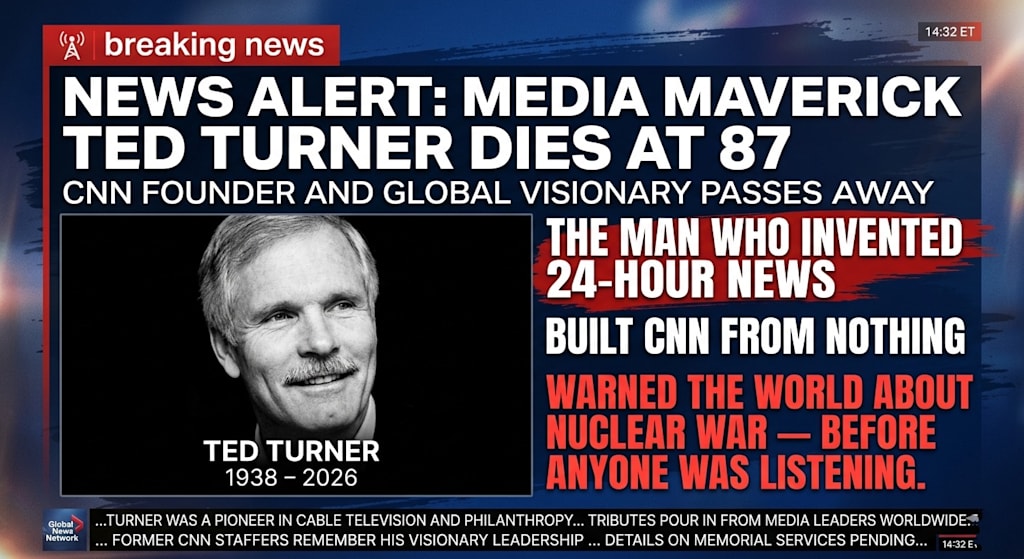
Ted Turner died peacefully on Wednesday, May 6, 2026, surrounded by his family at his home in Atlanta. He was 87. Turner Enterprises confirmed the death in a formal statement. CNN Chairman and CEO Mark Thompson, in a tribute that was both institutional and deeply personal, said: "Ted was an intensely involved and committed leader, intrepid, fearless and always willing to back a hunch and trust his own judgment. He was and always will be the presiding spirit of CNN." The network Turner founded — which has been broadcasting continuously for 46 years — paused its regular programming to air a memorial broadcast. The man who invented the news cycle is now part of it.
Robert Edward Turner III was born on November 19, 1938, in Cincinnati, Ohio, and grew up in Savannah, Georgia. His father was a billboard advertising entrepreneur who killed himself when Ted was 24 — a loss that marked Turner profoundly and, by his own account, drove him to build something his father could never have imagined. He took over the family billboard business, expanded it, and then made a leap of audacious vision: he purchased a UHF television station in Atlanta in 1970 and transformed it into what would eventually become TBS — the first television "superstation," broadcasting via satellite to cable systems across America.
"I worked until 7 o'clock, and when I got home the news was over. So I missed television news completely. And I figured there were lots of people like me." — Ted Turner, explaining why he founded CNN
On June 1, 1980, Turner launched CNN — the Cable News Network — from a converted Jewish country club in Atlanta. The idea was radical: a network that broadcast news twenty-four hours a day, seven days a week, with no other programming. The established broadcast networks laughed. ABC, CBS, and NBC could not imagine why anyone would want constant news. Turner could. He had noticed something simple and obvious that no one else had acted on: people worked late, lived in different time zones, cared about different things at different hours. "I worked until 7 o'clock, and when I got home the news was over," he once said. "So I missed television news completely. And I figured there were lots of people like me." He was right. CNN was a financial disaster in its early years and an editorial revolution that never stopped. It changed the relationship between journalism and time, between events and audiences, between the world and itself.
Turner's media empire expanded dramatically through the 1980s and 1990s. He added CNN2 (later HLN) in 1982 and CNN International in 1985, taking his model of continuous news to the world. He acquired MGM's film library, giving his networks an ocean of classic content. He launched TNT, Turner Classic Movies, and Cartoon Network — channels that shaped the cultural childhoods of multiple generations. He purchased the Atlanta Braves and the Atlanta Hawks. He won the America's Cup in 1977, skippered by himself, and became one of the world's most celebrated competitive yachtsmen. He married Jane Fonda in 1991 in a union that became one of the most watched and discussed partnerships of the decade. He gave $1 billion — a billion dollars, at a single moment — to the United Nations Foundation, the largest philanthropic donation by a living American to that date.
In his later years, Turner was one of the world's most vocal advocates for nuclear disarmament and environmental conservation. He co-founded the Nuclear Threat Initiative with former Senator Sam Nunn in 2001 — an organisation dedicated to reducing the global threat from nuclear, chemical, and biological weapons. He became one of the largest private landowners in the United States, accumulating nearly two million acres of land across the American West, which he converted to bison ranching and habitat conservation. He was diagnosed with Lewy Body Dementia just before his 80th birthday — a degenerative disease that causes dementia and muscle failure — and disclosed it publicly with characteristic honesty.
Ted Turner died on the same day that Iran's nuclear program dominated the global headlines — a subject he had spent years trying to bring to the world's attention before the attention arrived. The man who created the infrastructure through which the world learned about wars, disasters, elections, and revolutions, died while the most consequential war since the Cold War played out on the network he built. He would have had something to say about all of it. He always did. The world is quieter without him. And the screens he lit up are still on — covering the war he warned was coming, on the network he built to make sure no one missed it.
About the Creator
Enjoyed the story? Support the Creator.
Subscribe for free to receive all their stories in your feed.
Comments
There are no comments for this story
Be the first to respond and start the conversation.