
Reform UK Just Won 1,400 Seats and Took Over English Cities. Labour Lost 1,100 Councillors. Keir Starmer Is Facing Calls to Resign — and Nigel Farage Is Calling It the End of the Two-Party System.
The most dramatic local election results in a generation landed last week. Reform UK swept north, south, and east. Labour collapsed in its heartlands. Greens took London strongholds. Conservatives hemorrhaged votes. And a former UKIP leader is now the dominant force in British local politics. Here is what it means for 2029.
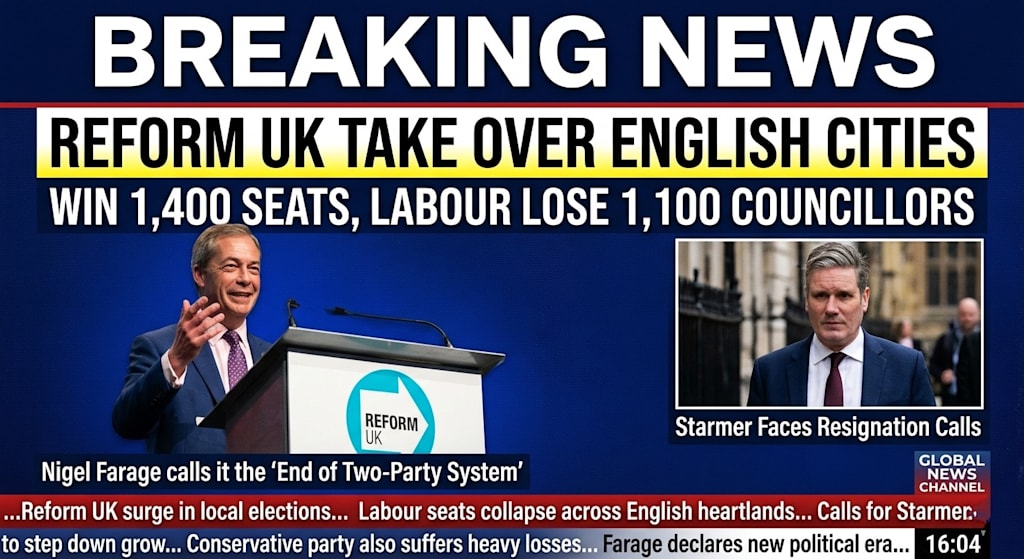
The results of the United Kingdom's May 7, 2026 local elections — which have been trickling in and analysed through the weekend — represent the most significant realignment of British local politics in at least a generation, and possibly since Thatcherism reshaped the political landscape in the 1980s. The headline numbers are stark. Reform UK gained more than 1,400 seats across England, while Labour lost more than 1,100 councillors it had previously held. The Conservative Party also performed badly, losing over 500 seats. Simultaneously, the Green Party gained more than 300 seats and the Liberal Democrats more than 150 seats. The result: a British local political landscape that no longer resembles the two-party system that has structured British democracy for more than a century, and that sends every sitting national politician an unmistakable message about the public's relationship with established parties.
Reform UK's victories were geographically and socially sweeping. Reform recorded victories across the country, taking over Essex county council in the south, Havering — its first London local authority — and the northern English city of Sunderland. In Gateshead, another northeastern English city long considered a Labour fortress, Reform gained 38 seats to take control of the council — with Labour losing 36 seats and dropping to third place behind the Liberal Democrats. In Wales — a Labour heartland for decades, the country of coal mines and working-class solidarity — the Labour vote collapsed and it was the Plaid Cymru party who won the most seats across Wales. In Scotland, the Scottish National Party won the most seats for the fifth election in a row, while Labour again performed poorly. The breadth of Labour's losses — north, south, Wales, Scotland, English cities, English counties — makes it impossible to attribute the results to regional factors. The collapse is national.
"This is the end of the old establishment's two-party system." — Reform UK leader Nigel Farage, newspaper column, May 10, 2026
Prime Minister Keir Starmer, who swept to power in a landslide Labour general election victory in July 2024, less than two years ago, took personal responsibility for the results on Sunday. "Let me be clear, these are really tough results, I'm not going to sugar-coat it," Starmer said. That measured, accountable language was immediately tested by the public response from within his own party. Influential Labour figure Angela Rayner, who was previously deputy leader of the party under Starmer, posted on X that Labour needed to take "immediate action to cut costs for households and put money back into the everyday economy." "What we are doing isn't working, and it needs to change," she wrote. "This may be our last chance." Multiple Labour MPs have called on Starmer to resign. His spokesperson has confirmed he will not.
The reasons for Labour's collapse are multiple and interlocking. The British economy, weakened by the Iran war's energy price shocks, the residual effects of Brexit, and a government budget that raised taxes on working people while attempting to stabilise public finances, has produced a cost-of-living crisis that voters are attributing directly to the party in power. A separate scandal — the appointment of an ambassador with ties to Jeffrey Epstein — generated weeks of negative headlines. A government-declared "national emergency" on antisemitism, issued after a surge in incidents following the ongoing Israel-Gaza conflict, alienated Muslim communities without fully satisfying Jewish ones. And a perception that the Labour government has governed from the centre-right rather than the centre-left has driven its traditional working-class and progressive vote toward Reform and the Greens respectively.
For Nigel Farage, who has spent three decades building toward a moment like this, the results are both vindication and a launching pad. Reform UK won 26 to 27 percent of the vote nationally, while most other major parties hovered around 20 to 16 percent. No party commands a majority of the public. The political landscape is fragmented, volatile, and available for reshaping. Farage's column declaring "the end of the old establishment's two-party system" is not wrong. What replaces that system — and whether the replacement is an improvement for the millions of British people whose economic anxiety is driving these results — is the question that will define British politics through 2029 and the next general election.
About the Creator
Enjoyed the story? Support the Creator.
Subscribe for free to receive all their stories in your feed.
Comments
There are no comments for this story
Be the first to respond and start the conversation.