
MIRRORS:
HAUNTED HISTORIES, WITCHCRAFT, AND THE FEAR OF WHAT STARES BACK

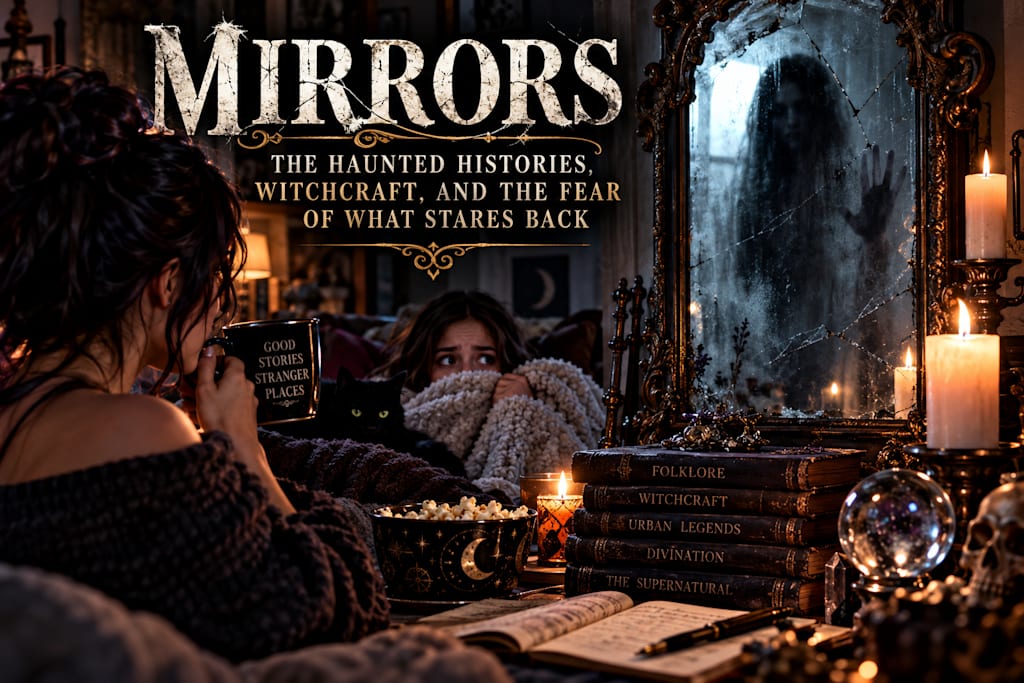
MIRRORS: THE HAUNTED HISTORIES, WITCHCRAFT, AND THE FEAR OF WHAT STARES BACK
By Miss Lil | Lily Writes
Let's talk about mirrors.
Go ahead and look at the one in your bathroom. Nothing unusual there, right? It's a piece of glass that shows you what you look like. You use it to brush your hair, put on makeup, pick food out of your teeth, or wonder when those extra wrinkles decided to move in without paying rent.
Pretty ordinary stuff.
But what happens when we take that everyday object and look at the stories people have told about it for hundreds, even thousands, of years?
Suddenly, mirrors get a whole lot more interesting.
There are legends about spirits appearing in them, stories of witches using them to see the future, and old traditions involving covering mirrors after someone dies. Then Hollywood came along and decided that bathrooms were apparently the most dangerous rooms in any haunted house.
And honestly? I can understand why mirrors have inspired so many creepy stories.
I also have a rather personal reason for finding this subject interesting.
In my house, we have exactly two mirrors. One is behind the television in my room, and the other is in the bathroom. That's it. Two mirrors for an entire household.
Why so few?
My younger sister is genuinely afraid of mirrors.
Now, I could make a whole comedy routine out of that. Believe me, there is material there. But the truth is, her fear is real, and living with someone who is frightened by something most people barely notice has made me think about the subject differently.
For most of us, a mirror is just another household object. We walk past one without a second thought. We might even have several in the same room.
My sister doesn't have that luxury of indifference. Something that seems perfectly harmless to me makes her uncomfortable enough that we keep mirrors to a minimum in our home.
And before anyone starts rolling their eyes, let me say something.
Fear doesn't always make sense to the person who isn't experiencing it. You can explain something logically, point out that it has never harmed anyone, and still not make that fear disappear. Knowing something is harmless and feeling that it is harmless aren't always the same thing.
I'm not claiming my sister's fear proves anything supernatural about mirrors. It doesn't. But it does make me appreciate how differently two people can experience the same ordinary object.
And since I happen to love digging into the strange, the creepy, and the downright unsettling, I decided it was time to investigate the history behind these things we hang on our walls.
So grab your coffee or tea, find something to snack on, and settle in.
We're going to talk about witches, spirits, old superstitions, Bloody Mary, and why people have spent centuries wondering whether the reflection staring back at them is really as innocent as it looks.
And no, I will not be conducting any bathroom experiments in the name of journalism.
I've got enough problems.
BEFORE GLASS MIRRORS, THERE WAS MAGIC
We tend to think of mirrors as modern conveniences, but humans have been fascinated by reflections for thousands of years.
Long before people could pop into a store and buy a mirror with a decorative frame, they used polished stones, obsidian, and metal to create reflective surfaces.
Some of these objects served practical purposes, while others had religious or ceremonial significance.
In certain ancient cultures, mirrors were associated with power, status, and communication with the supernatural. Archaeological discoveries from ancient Mesoamerica, for example, have revealed mirrors connected with ritual practices and beliefs about the spiritual world.
And that brings us to one of the oldest and most intriguing uses of reflective surfaces: scrying.
If you've ever watched a movie where a witch gazes into a dark mirror and announces that she sees something terrible coming, you've already encountered the basic idea.
Scrying is a form of divination in which someone gazes into a reflective or translucent surface in the hope of receiving visions, impressions, or hidden knowledge. The surface might be a dark mirror, a crystal, or even a bowl of water.
Depending on the tradition, a practitioner might seek answers about the future, investigate a question about the present, or attempt to uncover something believed to be hidden.
Did these practices actually reveal supernatural information? There is no reliable scientific evidence that they can predict the future.
But people have believed in their power for centuries, and that belief has left quite a trail through history.
One fascinating example comes from John Dee, an English scholar who lived during the sixteenth century. Dee studied mathematics, astronomy, and other subjects, but he was also deeply interested in occult philosophy and attempts to communicate with angels.
He used a polished black obsidian mirror in his spiritual and divinatory pursuits.
Imagine living in that period. The world was full of unanswered questions, scientific understanding was still developing, and religious and supernatural beliefs influenced how people understood their surroundings.
A dark mirror that supposedly offered access to hidden knowledge must have been an extraordinary object.
Of course, I would have questions.
What exactly did people believe they were seeing? Were they looking for answers, reassurance, warnings, or a glimpse of something they couldn't explain?
And here's the question that gets me: if someone truly believed a mirror could reveal their future, would they actually want to know what was coming?
I have trouble checking my bank balance some mornings. I'm not sure I need a supernatural preview of the next twenty years.
WITCHES AND THEIR DARK MIRRORS
Mirrors and witchcraft have been connected in folklore for a very long time, and it's easy to see why the idea has stuck around.
A darkened room. A candle flickering in the corner. Someone sitting quietly in front of a reflective surface, hoping to see something beyond the ordinary world.
It's practically a horror writer's dream.
In some forms of modern witchcraft and occult practice, mirrors are used for scrying, meditation, or spiritual reflection. Practitioners may focus on a question and interpret whatever images, feelings, or impressions arise during the experience.
Not everyone approaches the practice in the same way. Some understand it spiritually, while others see it as a form of contemplation or a way of exploring their own thoughts.
And, to be fair, there's a difference between describing a belief and claiming that the belief has been scientifically proven.
We can acknowledge that people practice mirror divination without pretending that mirrors have demonstrated supernatural abilities.
Still, the history is fascinating.
Think about how strange a mirror can look when the lighting changes. In a bright room, your reflection is familiar. You recognize every little detail.
Dim the lights, stare for a while, and suddenly your face might seem unfamiliar. Shadows obscure features. Your eyes begin searching for details. Your brain tries to make sense of what you're seeing.
Now imagine that experience through the eyes of someone who believes the mirror is a doorway to hidden knowledge.
Wouldn't it be tempting to interpret an unusual image as a message?
That's one reason I find the history of witchcraft and mirrors so interesting. It sits right at the intersection of human belief, perception, and our endless desire to understand things we cannot easily explain.
And if you grew up hearing stories about witches, spirits, and enchanted objects, you can probably understand why a dark mirror might have seemed like something worth approaching cautiously.
Personally, I think I'd rather ask my questions in daylight.
Preferably with coffee.
Lots of coffee.
WHY DO PEOPLE COVER MIRRORS WHEN SOMEONE DIES?
This is one of the mirror traditions that has always caught my attention.
In some communities, mirrors are covered after a person dies. The practice is particularly familiar in Jewish mourning customs, including the period of mourning known as shiva, although traditions and explanations vary.
One explanation is that mourners should focus on grieving rather than their appearance. Covering mirrors helps change the atmosphere of the home and separates ordinary routines from the work of mourning.
Other explanations come from folklore and supernatural beliefs.
Some traditions suggest that mirrors might trap or retain a departing soul. Others associate them with spirits or believe that reflective surfaces could create an unsettling connection between the living and the dead.
There isn't one universal explanation for the custom, and it's important not to treat every cultural tradition as though it comes from the same belief.
But let's talk about why the idea is so compelling.
Death changes a home.
Anyone who has lost someone they love knows how strange ordinary things can become afterward. A favorite chair sits empty. A familiar voice is gone. You walk into a room and, for one brief moment, expect to find someone exactly where they always used to be.
Grief has a way of making the absence of a person feel almost physical.
Now imagine looking into a mirror during that time.
You see yourself, but perhaps you're thinking about the person you've lost. Perhaps you remember them standing beside you, or you find yourself wishing you could see their face one more time.
In that moment, the mirror becomes more than a piece of glass. It becomes a reminder of who is still here and who is missing.
That doesn't mean the mirror contains a soul or that a spirit might appear in it. There is no reliable evidence for those claims.
But it does help explain why mirrors have become wrapped up in beliefs about death and the afterlife.
Humans have always struggled with the things we cannot control. Death is the biggest one of all. Across cultures, people have developed rituals to help them cope with loss, express respect for the dead, and make sense of an experience that can turn their entire world upside down.
Some of those rituals have supernatural explanations attached to them. Others are rooted in religious practice, symbolism, or the emotional needs of the living.
And sometimes, a custom can carry meaning even when its origins are uncertain.
I think that's worth remembering before we dismiss an old tradition as nothing more than superstition.
BLOODY MARY: WHO THOUGHT THIS WAS A GOOD IDEA?
All right, let's move on to something a little more familiar.
Bloody Mary.
If you grew up hearing urban legends, chances are good you've encountered this one. Maybe you even tried it at a sleepover, because apparently children sometimes consider frightening themselves half to death a perfectly reasonable way to spend a Friday night.
The rules vary depending on who tells the story, but the basic idea is usually the same.
You enter a dark bathroom, stand in front of a mirror, and repeat the name Bloody Mary several times.
Then you wait for something to happen.
In some versions, a woman's face appears in the mirror. In others, she screams, attacks the person who summoned her, or delivers a terrifying vision.
The details change from one version to another, which is typical of urban legends. People retell them, add their own details, and pass them along to the next generation.
But who is Bloody Mary supposed to be?
That's where things get messy.
Some versions attempt to connect her to historical figures, including Mary I of England. Others claim she was a murdered woman, a witch, or a spirit with no clear identity.
There isn't a single, firmly established origin that explains every version of the legend.
And honestly, I think that uncertainty is part of what makes it so effective.
The story doesn't require an elaborate haunted house or an abandoned cemetery. It requires a bathroom, a mirror, and someone willing to stand there in the dark while their imagination runs wild.
That's it.
The setting does half the work.
Our brains are very good at recognizing faces, but our perception can become less reliable under dim lighting, especially when we stare at a reflection for an extended period. Features may seem to change, and shadows can become difficult to interpret.
Add a frightening story to the mix, and every little visual oddity suddenly feels significant.
Was that a shadow?
Did something move?
Was someone standing behind me?
And why did my friends suddenly decide they needed to wait outside?
I can appreciate a good urban legend, but I have no desire to test this one.
My younger sister already isn't a fan of mirrors. I can only imagine how well a midnight Bloody Mary experiment would go over in our house.
Actually, no. I don't need to imagine it.
I value my peace and quiet.
SEVEN YEARS OF BAD LUCK
We've made it through witches and bathroom ghosts, so let's talk about another superstition most of us have heard at some point.
Break a mirror, and you'll have seven years of bad luck.
Seven years!
Apparently, a little accident with a piece of glass is supposed to come with a punishment that lasts longer than some relationships.
Where did this idea come from?
The superstition is often linked to ancient Roman beliefs about reflections and a person's well-being. One popular explanation suggests that the Romans believed life renewed itself in seven-year cycles, meaning the misfortune would last until the next cycle.
The exact historical path from ancient beliefs to the modern superstition isn't entirely clear, so that explanation should be treated cautiously rather than as settled fact.
Still, the underlying idea makes sense within the history of mirror folklore.
If people believed a reflection represented something more than physical appearance, breaking a mirror could be interpreted as damaging something connected to the self.
Today, of course, breaking a mirror usually means sweeping up dangerous shards and figuring out how much a replacement will cost.
Although, if you've ever broken an expensive mirror, you might feel the curse has already started.
First comes the glass. Then comes the bill.
Seven years of bad luck? I would settle for seven years without an unexpected household expense.
Unfortunately, the universe doesn't seem to offer that particular warranty.
The superstition has survived because people enjoy finding meaning in unexpected events. When something goes wrong after an accident, it's easy to connect the two, even when there is no actual relationship between them.
That's one of the reasons superstitions are so persistent. They give people a way to explain uncertainty, even when the explanation doesn't stand up to scrutiny.
So, if you break a mirror, please be careful cleaning it up.
You don't need seven years of bad luck to deal with. Broken glass is quite enough.
WHAT IF YOUR REFLECTION ISN'T YOU?
Now we're getting into the part of mirror folklore that horror movies have absolutely run into the ground.
The mirror as a portal.
We've all seen the basic premise. Someone looks into a mirror, and something on the other side doesn't behave quite right. Maybe a ghost appears behind them. Maybe the reflection moves independently. Maybe the mirror reveals an entirely different world.
It's a simple idea, but it's remarkably effective.
Why?
Because mirrors are supposed to be predictable.
You move, and your reflection moves. You raise your hand, and the image raises its hand. You step away, and the reflected figure follows.
We don't question any of this because we understand how mirrors work.
Now imagine a story in which that familiar pattern suddenly breaks.
You raise your hand.
Your reflection doesn't.
You step away.
It stays where it is.
Tell me that wouldn't make your stomach drop.
The fear comes from watching something ordinary violate a rule we trust. We know what a reflection is supposed to do, so the moment it behaves differently, the entire situation becomes unsettling.
That is a big part of what makes mirrors such effective props in supernatural stories.
They give us a familiar object and then ask us to imagine something impossible happening to it.
Across folklore and fiction, mirrors have been portrayed as gateways, prisons for spirits, and windows into alternate realities. These stories don't all come from the same cultural tradition, and there is no reliable evidence that ordinary mirrors function as supernatural doorways.
But the idea keeps returning because it plays on a very human fear: what if the world isn't quite what we think it is?
We rely on our senses to understand what's around us. We trust what we see, even though we know perception can be misleading.
A story that makes us question something as familiar as our own reflection can be more unsettling than one involving a monster we've never seen before.
And the best part for a horror writer?
You don't even have to show the monster.
Sometimes, all you need is a mirror and a reason for the audience to wonder whether the reflection is behaving normally.
WHY MIRRORS CAN CREEP US OUT WITHOUT ANYTHING SUPERNATURAL
Here's where we put the folklore books down for a moment and talk about how our brains work.
Human perception is not a perfect recording of reality. Our brains interpret visual information, recognize patterns, and fill in missing details.
That usually works in our favor. It helps us recognize faces, navigate rooms, and make sense of the world around us.
But under certain conditions, it can also lead to unusual experiences.
Stare at your reflection for a long time in dim lighting, and your face may begin to look strange or unfamiliar. Shadows can make features harder to distinguish, and the brain may struggle to interpret what the eyes are seeing.
Not everyone experiences this, and it doesn't mean anything supernatural is happening.
But it helps explain why mirrors have become such a reliable source of horror.
Think about the difference between looking at yourself in a brightly lit bathroom in the morning and staring into a mirror in a dark room at midnight.
Same mirror. Same face.
Very different atmosphere.
Now add a story about a ghost appearing behind you, and suddenly you're paying attention to every shadow.
That's the power of suggestion.
When we expect something frightening, we tend to notice details that support that expectation. A harmless shadow becomes suspicious. A reflection that looks a little strange becomes something worth worrying about.
And once fear enters the picture, it's easy for the imagination to take over.
This doesn't mean people who experience fear are foolish or weak. Fear is a normal human response, and it doesn't always wait for us to finish a logical explanation before making itself known.
Which brings me back to my sister.
I can read about the psychology of mirror-related fear. I can understand how perception works and recognize that there is no reliable evidence of supernatural activity in ordinary mirrors.
That knowledge doesn't mean I should expect everyone else to react to mirrors the way I do.
And I certainly don't need to make someone uncomfortable in their own home just because I think their fear is unusual.
Sometimes, understanding a fear is more useful than arguing with it.
LIVING WITH A FEAR THAT OTHER PEOPLE DON'T UNDERSTAND
This is the part of the subject that hits a little closer to home for me.
My younger sister's fear of mirrors has affected something most people never even think about when they decorate a house.
We have two mirrors. One behind the television in my room, and one in the bathroom.
No mirrors hanging in every bedroom. No decorative mirror collection scattered through the hallways. No casually adding another one because it would look nice on a wall.
Just two.
And yes, I can find humor in that. Families have their quirks, and ours happens to include a very limited mirror inventory.
But there's a difference between laughing about a situation and laughing at the person experiencing it.
I don't need to share my sister's fear to respect it.
I don't have to believe mirrors are haunted to understand that something about them genuinely makes her uncomfortable. And I don't have to agree with every fear someone has before I can treat that person with kindness.
We all have things that get under our skin.
For one person, it's spiders. For another, it's heights. Someone else might be perfectly comfortable in a dark house but unable to tolerate being trapped in a crowded elevator.
Some fears have obvious explanations. Others are harder to pin down.
And sometimes, the people around us won't understand why something bothers us so much.
That doesn't automatically make the fear silly.
I think it's easy to dismiss what we don't personally experience. If something doesn't scare us, we assume it shouldn't scare anyone else. We treat our own reaction as the standard everyone ought to follow.
But that's not how people work.
My sister and I can look at the same mirror and have entirely different reactions. I can become fascinated by the history, the folklore, and the stories surrounding it. She can prefer not to have them scattered throughout the house.
Neither reaction requires us to turn the other person into the enemy.
So, we make a little room for each other.
We keep the mirrors to a minimum, and I get to indulge my curiosity about the strange history behind them.
Honestly, that seems like a perfectly reasonable arrangement.
And if researching haunted mirrors gives me something interesting to write about, all the better.
Although I suspect my sister would prefer I investigate haunted spoons next.
I'll consider it.
SO, ARE MIRRORS REALLY HAUNTED?
After all these stories, it's worth asking the obvious question.
Are mirrors actually supernatural objects?
There is no reliable scientific evidence that ordinary mirrors trap souls, predict the future, summon spirits, or provide access to other worlds.
A reflection is an optical phenomenon, and the unusual experiences people sometimes report can have explanations involving lighting, perception, expectation, and the way the human brain processes visual information.
But that doesn't make the history of mirrors any less fascinating.
For centuries, people have used reflective surfaces in religious ceremonies, divination practices, and cultural traditions. Mirrors have inspired superstitions about luck, stories about the dead, and legends about mysterious figures appearing in the glass.
They have become symbols of identity, mortality, uncertainty, and everything we cannot easily explain.
And I think that's why they remain so effective in horror stories.
A mirror is ordinary enough to be found in almost any home, but the stories surrounding it invite us to imagine something extraordinary.
We know what a reflection is supposed to do. We know how mirrors work.
Yet when the lights go down and someone tells us a story about what might appear in the glass, that familiar object can suddenly feel different.
The mirror hasn't changed.
Our thoughts about it have.
And sometimes, that's all a good ghost story needs.
As for my house, we'll continue with our grand total of two mirrors. I'll continue reading about witches, folklore, and strange historical beliefs, and my younger sister can continue avoiding the things that make her uncomfortable.
Nobody needs to win an argument about it.
Because here's what I've learned from exploring this subject: curiosity and respect can exist side by side. We can investigate a frightening story without automatically believing it, and we can acknowledge someone's fear without insisting we must feel the same way.
So, the next time you walk past a mirror, remember that the object itself is only part of the story.
The rest comes from history, culture, imagination, and the very human desire to understand the things that make us uneasy.
And if you happen to catch your reflection in the bathroom at midnight?
Well, it's probably just you.
Probably.
I'm kidding.
Mostly.
Now, if you'll excuse me, my coffee is getting cold, and I have absolutely no intention of conducting further experiments tonight.
I've got enough to worry about without staring into a mirror until my own face starts looking suspicious.
Until next time, keep asking questions, keep your mind open, and don't believe every spooky thing someone tells you without looking into it first.
But maybe leave the bathroom light on if it makes you feel better.
I'm not judging.
Miss Lil has left the building. The coffee is empty, the snacks are gone, and the mirrors are somebody else's problem. ☕🪞
COME JOIN ME FOR MORE DEEP DIVES!
If you enjoy digging into the strange, the disturbing, the mysterious, and the stories that make us question what we think we know, I'd love for you to join me on my writing journey.
Come find me in the Lily Writes Facebook group, where we can talk about articles, swap ideas, and decide which rabbit hole deserves our attention next.
Join Lily Writes on Facebook:
https://www.facebook.com/groups/2155720388491578
For my full-length articles covering true crime, paranormal mysteries, history, and the uncomfortable corners of the human experience, visit my author page on Vocal Media and subscribe to follow my work.
Read my articles on Vocal Media:
https://vocal.media/authors/lilithea-adasia
Every read, share, and subscription helps my work reach new readers, and I genuinely appreciate everyone who takes the time to read what I write.
There's always another story to investigate, another mystery to explore, and another uncomfortable question worth asking.
Bring your curiosity. I'll bring the coffee.
See you at the next deep dive.
Miss Lil 🖤
About the Creator
Lilithea Adasia
I dig where others look away. 🖤 True crime, paranormal mysteries, uncomfortable truths, and the beautifully broken human experience. I chase the stories others bury and ask the questions others avoid. Come curious. Leave questioning.
Enjoyed the story? Support the Creator.
Subscribe for free to receive all their stories in your feed.
Comments