
Mummu's Simple Dinner
He promised one pot and one pan. Guests arrived to seven dishes and a pizza cooling on the bench.

My neighbour Mr. Mummu waved me over from his driveway last Saturday, holding a guilty-looking shopping bag with coriander poking out and a sack of rice under his arm. He said he was hosting a simple dinner for a couple of neighbours, no fuss, and I was invited.
"One pot, one pan," he said, and he looked proud of the sentence, as if he had invented a new kind of weekend.
Accepting was easy. I like him. I've lived next door long enough to know that when Mummu uses the word simple, he means an intention, not a menu.
The plan over the fence
His plan, told over the fence, was a pot of sambar, rice, and maybe coconut chutney if he had time. Vegetarian and warm, enough for four. We would eat at seven and be done before the late news.
Auckland had other weather in mind. A fine grey rain soaked my sleeves as I walked down with a jar of pickle he had asked to borrow "just in case someone wants something sharp," which should have been my first clue.
Already the kitchen smelled like mustard seeds hitting hot oil. One pot was on. One pan was warming. A sticky note saying SIMPLE DINNER curled in the steam on the rangehood.
Then just in case
He lifted the lid and frowned at the sambar, as if it might still disappoint a visitor. "What if someone is hungry early?" he asked.
That was the only question the afternoon needed, and I didn't even ask it. He did.
Before I could say people can wait, he was mixing batter for vegetable pakoras. "Starter," he said. "This is temporary." Potatoes and spinach went into the pan he had promised to use only once.
Stopping him seemed worth a try. I suggested he leave it there.
Nodding as if I had said something wise, he opened the fridge. Someone might not like sambar, he said, softly, like a confession. That is how a second pot gets born. He started a dry potato and pea curry in a saucepan that had not been part of the treaty.
Rice was already soaking, which should have been plenty. It was not. He decided we also needed dosas, because batter in the fridge would sulk if ignored. The tawa came out. The one-pan rule left the building without packing.
Salad appeared next, "for freshness," with cucumber, tomato, and the extra coriander. Then the chutneys, which he argued were insurance, not dishes: coconut, tomato, and a green one he kept tasting as if the evening depended on the heat.
Dessert was "just a small sweet." He made a bright orange kesari in a third pot I'm fairly sure he borrowed from a cupboard marked Last Resort. The sticky note on the rangehood had fallen into the sink.
The pizza that waited
Around five he wiped his hands and looked at benches lost under lids and spoons. For a moment we both thought he might be done.
Then he picked up his phone.
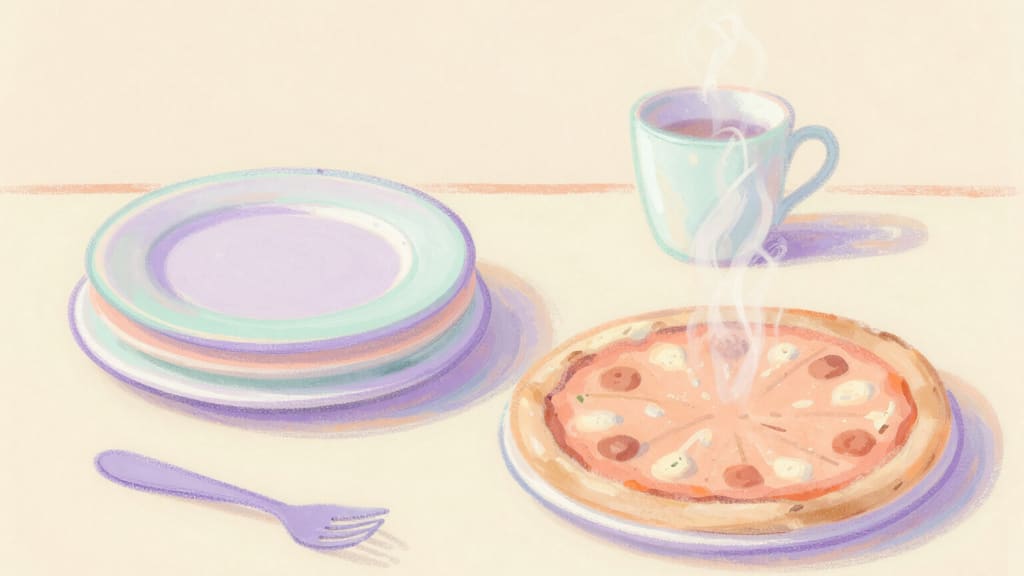
"In case it all goes wrong," he said, and ordered a large vegetarian pizza from the shop down the road. No olives, extra mushroom, though nobody had mentioned olives.
Delivery came at twenty past six. The box sat on the bench, cooling in a polite, cardboard way, like a firefighter invited to the party and asked to wait in the hallway.
Labelling the box BACKUP with a marker seemed to calm him. He said it would only come out if the rest collapsed.
Counting became unavoidable by seven. Pakoras, sambar, potato curry, dosas, rice, salad, kesari, plus a chutney committee and a pizza losing its last heat. Seven dishes. One backup. A kitchen that had become an emergency wearing an apron.
What the guests walked into
Down the street, the couple arrived on time, damp from the fine rain, holding sparkling water and the smile of people told not to bring anything.
Watching their faces, I saw the polite calculation. This did not look like no fuss. This looked like a Saturday that had put on its festival clothes by accident.
Beaming, Mummu said, "Simple dinner. Sit, sit. Start with the pakoras, unless you would rather start with the pizza, but the pizza is only if something fails."
Nothing failed. We sat at his small table and passed bowls until there was no room left. The sambar was good. The curry was good. The dosas vanished faster than the theory that we might not be hungry. Coconut chutney went on everything I could reach, including, briefly, a corner of kesari, which I don't recommend and also don't regret enough.
Unused, the pizza stayed in its box. Every so often someone glanced at it, the way you glance at an umbrella after the sky has already cleared.
Later, when the plates slowed, the woman who had come down the street thanked him for the feast. Mummu looked genuinely puzzled.
"It was simple," he said. "I only wanted nobody to leave hungry or wishing they had stayed home and made toast."
Leftovers went into containers without anyone asking. Each lid got a piece of tape. Two labels said Sambar, and one of those was the kesari. He crossed it out and wrote Sweet, orange, trust me.
Walking home, I carried a warm container and a slice of untouched pizza he insisted I take "so the backup does not feel left out." The footpath shone. My fridge gained a new resident that will, if I know myself, still be there on Tuesday, pretending to be temporary.
The note in the sink
Covering every possible preference does not produce simple as a leftover. You decide on simple early, then keep deciding when the fear shows up. The fear sounds helpful. It talks you into extra dishes and a pizza waiting in case care was not enough.
Hospitality that tries to prevent every disappointment becomes a kitchen emergency. You stop cooking a meal and start managing risk nobody asked you to manage. The guests would have been happy with the sambar, the rice, and the host sitting down before eight.
Eventually Mummu did sit down, a dosa in one hand and a look of surprised peace, as if the food had forgiven him for doubting it. The pizza went cold on purpose. Nobody minded.
Honesty requires a confession. I've added a dish "just in case" more times than I can count. I've confused care with coverage. Coverage feels like kindness until you are standing in steam at twenty to seven, wondering whether cucumber salad can save a night that was never in danger.
Next time he hosts, I may tape the sticky note back up before the coriander comes home. Sit down. Eat. Trust the first pot.
Odds are he will still call the shop. Some backups arrive for one night and then move in.
So that is that. Love does not get clearer when you plate it seven ways. It gets clearer when you choose one warm thing and trust people to say if they need more.
About the Creator
Gautam Atmakuri
I once spent seven days blindfolded, silent and without food to see what my senses were hiding. I write about that, my baby boy, barefoot running, Tirupati to Auckland life, and the business, marketing and tech I build at AumnI digital.
Enjoyed the story? Support the Creator.
Subscribe for free to receive all their stories in your feed. You could also become a paid subscriber, letting them know you appreciate their work.
Comments
There are no comments for this story
Be the first to respond and start the conversation.