
Your Snapchat Planets: A Cosmic Friendship Guide or Just Digital Astrology?
What Do the Planets Mean on Snapchat? A Guide to Your Friendship Solar System

Let's get straight to the point. People usually love Snapchat, hate it, or feel completely confused by half of its features. For years, it has been a wild, ever-changing platform in the social media world, constantly throwing curveballs at its users. One of its most fascinating recent additions is the "Snapchat Planets" feature.
You have probably seen it: that mysterious, astrology-like system that appears when you tap on a friend’s profile. You see little celestial bodies orbiting, seemingly revealing something deep about your connection. The truth is, this is not just a cute graphic. Snapchat Planets are a clever—though slightly confusing—way the app measures and ranks your friendships.
What Exactly Are Snapchat Planets?
First things first: what are these planets? Essentially, Snapchat Planets are a personalized friendship ranking system. They appear next to your friends' names in a specific order, with each planet representing a different level of closeness and interaction on the app. It is Snapchat's unique take on a "best friends" list, but with a space theme. Think of it as your own digital solar system where you are the Sun, and your closest friends are the planets orbiting around you.
You will not see this for every single person on your friend list. This cosmic display only works with your Best Friends. How do you become a Best Friend on Snapchat? It is simple: you send a lot of snaps to each other consistently. If you are wondering why you do not have a full galaxy of planets yet, it is likely because you are not snapping certain people enough.
Let's be very clear: you only see your friends' planets based on your friendship with them. You cannot see their entire solar system, which means you cannot spy on how close they are to other people. It is entirely based on your perspective and your bond. This keeps things a bit more private and less dramatic, which is rare for social media.
The Planetary Lineup: Who is Who in Your Snapchat Galaxy?
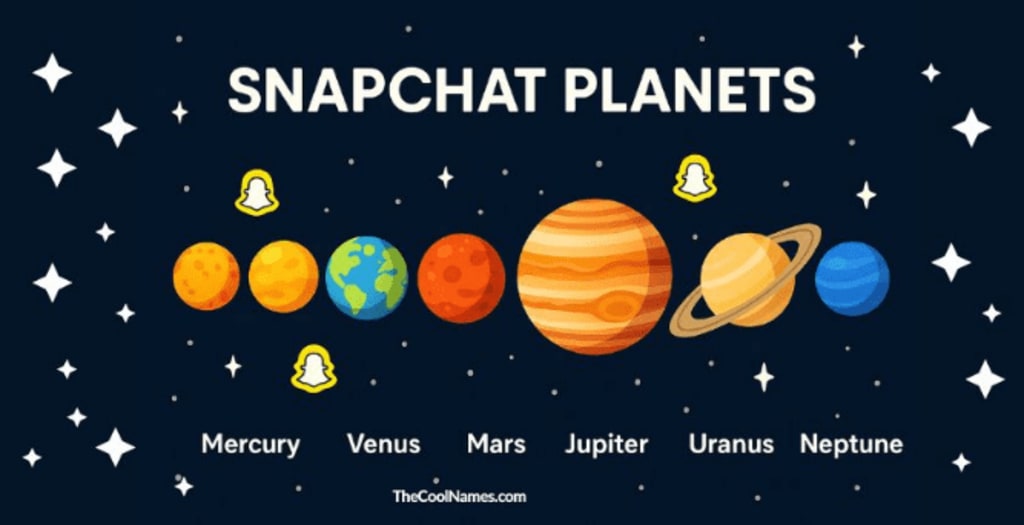
This is where it gets interesting. Each planet holds a specific spot in the "orbit" around you, showing a different degree of friendship. In order from closest to furthest, they are: Mercury, Venus, Earth, Mars, Jupiter, Saturn, Uranus, Neptune, and Pluto. Yes, even Pluto gets a spot!
Here is a breakdown of what each planet actually means:
1. Mercury (Closest Friend): This is your ultimate Snapchat partner. They are the person you send the most snaps to, and who sends the most back to you. They orbit you tighter than anyone else. If someone is your Mercury, you are probably in constant communication. Seeing that Mercury next to someone’s name is a great feeling because it confirms you are each other’s primary digital best friend.
2. Venus (Second Closest Friend): Venus represents a friend who is still super close, just slightly further out than Mercury. This is your second-best Snapchat buddy. You interact a lot, often keeping Snapstreaks alive, even if it is not quite as intense as your Mercury relationship.
3. Earth (Third Closest Friend): Earth is your third-closest friend. Since our own planet is so important, this shows a very strong connection. You share a healthy amount of interaction with this person, making them a solid, daily presence in your life.
4. Mars (Fourth Closest Friend): The Red Planet signifies your fourth closest friend. You are still sending plenty of snaps to keep the connection warm. Mars is a reliable part of your Snapchat universe, even if you do not chat with them every single waking hour.
5. Jupiter (Fifth Closest Friend): Jupiter is the biggest planet in our real solar system, and here it represents your fifth closest friend. This indicates a robust, consistent friendship. They are a highly valued contact in your digital world.
6. Saturn (Sixth Closest Friend): Saturn, known for its rings, takes the sixth spot. This person is definitely still a "Best Friend" in the app's algorithm. You might not snap them constantly, but when you do, the interaction is always great.
7. Uranus (Seventh Closest Friend): Uranus is your seventh closest friend. The interactions are frequent enough to keep them on the Best Friends list, but the relationship is less intense than with your inner circle. It is a consistent connection.
8. Neptune (Eighth Closest Friend): Neptune, the distant blue giant, is your eighth closest friend. You are still connected, but this is toward the outer edge of your friendship circle. You exchange snaps, but probably not every day.
9. Pluto (Ninth Closest Friend): Finally, Pluto is your ninth closest friend. Even though many astronomers no longer consider it a planet, Snapchat still includes it! This person is the furthest away in terms of interaction frequency. It is like a friend you do not see often, but you still keep in touch with on the app.
How Do You See Your Planets and "Level Up"?
Checking your planets is incredibly easy. Here is how you do it:
Open the Snapchat app.
Go to your chat screen.
Tap on a friend's Bitmoji or profile icon.
A new screen will pop up showing their Snapscore and Bitmoji. If they are one of your Best Friends, you will see a tiny planet icon next to their name.
It is very simple, and honestly, a little addictive. You might find yourself tapping on everyone's profile to see where they rank in your universe.
If you want to "level up" your planets like moving a crush or a real-life best friend up to Mercury it all comes down to one thing: snapping more. The system is driven entirely by interaction. The more snaps you send and receive, the higher their rank will go. To move someone from Saturn to Venus, you have to put in the work by sending more photos, videos, and chats. Keep those streaks alive! It is a game-like way to encourage you to use the app, and it definitely works.
Why Did Snapchat Create This? The Psychology Behind the Planets
Why would a massive tech company spend time on something like this? It is not just for fun. Here is the strategy behind it:
Pure Engagement: Snapchat thrives on user engagement. Features like streaks, trophies, and planets are designed to keep you opening the app and interacting with friends. Humans naturally love connection and a little friendly competition, so this gives users a clear incentive to snap more.
Gamifying Friendship: Adding game-like elements to social interactions makes them feel more rewarding. Earning a "Mercury" status taps into our human desire for achievement. It makes sending a simple photo feel like you are progressing in a game.
Visualizing Intimacy: Before the planets, you only had emojis (like the yellow or pink hearts) to know who your best friends were. The planets take this a step further, offering a highly visual, detailed map of your most active relationships on the platform.
Mystery and Discovery: Snapchat loves rolling out hidden features. Just like the Snap Map or Bitmojis in the past, the planets are something you stumble upon, figure out, and talk about with friends. This sense of discovery keeps the app feeling fresh and exciting.
The Verdict: Genius or Gimmick?
Honestly, it is a bit of both, but it leans heavily toward genius.
On one hand, it is just an algorithm. It does not dictate who your real-life best friend is. Your Snapchat Mercury might just be someone you send funny memes to, not the person you would call in an emergency. However, it does accurately reflect your digital interactions.
When you see "Mercury" next to a close friend, it gives you a warm feeling. But if you see a good friend listed as "Saturn," it makes you realize you probably do not snap them as often as you text them elsewhere. It forces you to think about your digital communication habits. This is a massive win for Snapchat. It is a clever, harmless gimmick that adds depth to the app and keeps users swiping and snapping.
Potential Pitfalls: Do Not Let the Planets Mess with Your Head
Like any gamified social feature, there is a flip side. It can lead to overthinking:
Friendship Anxiety: It is easy to stress if a friend drops from Venus to Mars. Remember, these are just app-based rankings. Real-life friendships are much more complex than the number of snaps you send.
Competitive Snapping: You might find yourself sending snaps just to maintain a planet ranking rather than actually wanting to talk. This forced interaction can take the fun out of the app.
Misinterpretation: You might view someone as your Mercury, but they only see you as their Jupiter. This can cause awkwardness, so it is usually best to just enjoy your planets quietly.
Ultimately, you should take Snapchat Planets with a grain of salt. They are a fun, quirky addition a digital horoscope for your friendships. Enjoy the novelty and use it as a reminder to connect with people, but do not let it control your emotions. Real friends will pick up the phone, not just keep a Snapstreak going.
Go ahead and explore your Snapchat galaxy. See who is orbiting where, and maybe send a few extra snaps to move someone closer to your digital sun. Just remember that your most important connections exist far beyond the screen.
About the Creator
Amir Husen
I am Amir Husen, an SEO Expert and content strategist with over seven years of experience. I specialize in transforming complex concepts into engaging, human-led stories that audiences genuinely want to read.
Enjoyed the story? Support the Creator.
Subscribe for free to receive all their stories in your feed.
Comments
There are no comments for this story
Be the first to respond and start the conversation.