
Your Girlfriend’s Best Friend Says You Don’t Deserve Her. Here’s What She Didn’t Hear.
A fight, a crying confession, and a friend who only got half the story can turn a private argument into a public verdict. Here’s how boyfriends, girlfriends, and the friends caught in the middle can stop the loop without turning love into a trial.
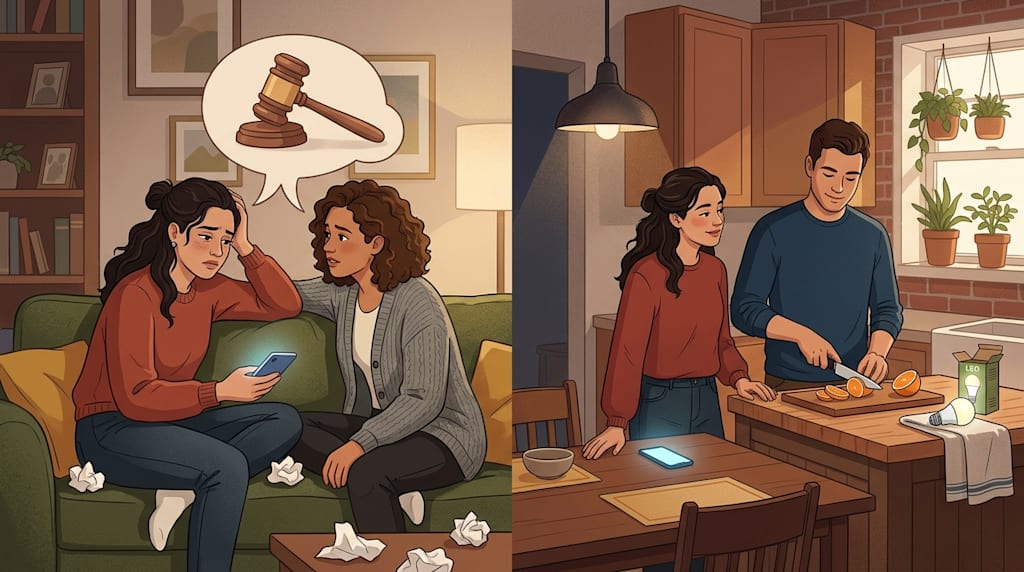
She sat on her best friend’s couch, tissues balled up, three or four already piled beside her. Her phone lit up with a message from her boyfriend: “Did you get home okay?” She turned the screen off and kept talking.
“He doesn’t care about me at all. The day I had a fever, he was still working late and just replied, ‘Drink more hot water.’ Tell me, isn’t that kind of guy incredibly selfish?”
Her friend handed her a glass of warm water and said, “You’re so good. He doesn’t deserve you.”
She didn’t mention that after work that night he had gone to three pharmacies to buy fever patches. She didn’t mention that he had been in the kitchen at two in the morning cooking plain rice porridge. She only mentioned those five words: “Drink more hot water.”
A few days later, she and her boyfriend made up. Lying in his arms, in that playful, cute tone, she said, “XX says you don’t deserve me. You’d better cherish me.”
The guy was cutting fruit. The knife paused for a moment, then kept going. He pushed the cut orange toward her and said, “I understand your friend feels for you. But I don’t accept this kind of talk coming up again and again.”
That sentence is what this essay is about.
1. One-sided venting creates a biased picture
In any relationship, when one person tells only the part that favors them, the listener forms a biased picture.
After a fight, she goes to a friend and confides. The friend hears “she was wronged.” The friend does not see the whole picture of how you interact, nor does the friend see her own problems in the conflict. The friend’s sympathy is real, but the judgment that comes out of that sympathy is not necessarily objective. The friend has never heard that you once bought her medicine in the middle of the night, never heard that you once canceled plans just to see her, never heard how sweet she is when you two make up. What the friend sees is a crying girl and a boyfriend described as utterly worthless.
So the first thing a man should understand is this: your girlfriend’s friend saying you don’t deserve her does not mean you actually don’t deserve her. That sentence is very likely a friend’s reaction to one-sided information in a specific emotional moment. You don’t have to treat every “doesn’t deserve” as an objective verdict, and you certainly don’t have to hate her friends because of it.
But understanding it does not mean accepting it wholesale. The second point is this: do not accept repeated use of third-party evaluations to belittle you or pressure you. An occasional emotional moment can be talked through. If “XX says you don’t deserve me” keeps appearing, and even becomes a bargaining chip for affection after you make up, then it is not cute. It is disrespect inside the relationship.
You can understand the bias behind it, but you can also say clearly: “I know your friend only heard your side, so that’s why she said that. But I don’t accept this kind of talk coming up again and again. Next time we have a problem, tell me directly. Don’t bring a third party’s evaluation in to pressure me.”
Setting that boundary is reasonable.
2. The best friend is not a troublemaker, but she should not be dragged onto the judge’s bench
In this situation, the person most easily misunderstood is the best friend. Men easily think: it’s you friends stirring things up behind my back. Female friends also easily feel wronged: I sympathize with her, and in the end I’m the one who can’t win either way.
Most friends are not deliberately trying to destroy your relationship. They are simply pulled into a conversation that presents only half the facts. The problem is not that the best friend is bad. The couple keeps outsourcing communication, and the friend becomes an emotional dump and a free judge.
The best position for a friend is to listen and ask questions, not to evaluate the boyfriend’s character, urge a breakup, or say “he doesn’t deserve you.” For example, one could say: “I feel for you, but I don’t know the whole picture, so it’s not appropriate for me to judge whether he deserves you. What do you most want to solve right now? Do you need me to listen, or do you want to think together about how to communicate with him?”
That way, you show empathy without taking sides, and you won’t put yourself in an awkward position after they make up.
3. Men can be rational without rationalizing belittlement
Some men go to the other extreme: since I know it’s caused by one-sided venting, I’ll just endure it. She’s only being playful.
Over time, this pattern wears down the relationship. The sentence “Other people say you don’t deserve me, so you’d better cherish me” uses an outside evaluation to raise one person’s price while putting the other in a position of being examined and compared.
To understand the sentence is to see where it comes from. To accept it is to agree to be belittled. You can do the first without doing the second.
You can be gentle, but you must have boundaries. You can say: “I understand your friend feels for you. But our business is for the two of us to solve. You can tell me directly what makes you uncomfortable, but don’t use ‘so-and-so says you don’t deserve me’ like that.”
If she is willing to adjust, then this is an upgrade in communication. If she repeatedly does this, and even after you express discomfort still thinks it is just a joke, then you need to assess: is this her long-term communication pattern? In a relationship, occasional emotional moments can be tolerated. Repeated belittlement and using outside pressure cannot be fixed by “seeing it rationally” alone.
4. Female friends, don’t be the thankless emotional dump
Finally, I also want to say something to all female friends: if you realize that you are the one who is always on call as an emotional dump, set a boundary in time.
Every time she fights with him, she comes to you. She tells you only the bad things about him. You feel for her, curse him for her, analyze for her, tell her “you deserve better.” But a few days later they make up. She lies in his arms acting cute, and may even use your words as bargaining chips: “XX says you don’t deserve me.”
And you become the person who can’t win either way. She may feel embarrassed to face you, guilty, and pull away. If you are also colleagues, you may even be inexplicably isolated and labeled as someone who loves to stir up trouble.
This is not to say friends cannot listen. Friends can certainly keep each other company, but do not be the judge. Do not make relationship judgments for her. Do not pour unlimited time and energy into it. You can say: “I feel for you, but it’s not appropriate for me to judge whether he deserves you. If you want to talk, I’ll listen. If you want to solve it, let’s think about how to communicate.”
If the other person repeatedly only vents, does not change, and distances herself from you after making up, then reducing your deep involvement is self-protection, not coldness.
5. What needs fixing is direct communication between partners
The center of this matter has never been “the best friend destroying pure love.” It is whether the partners have direct communication and a sense of boundaries.
Men need to recognize the loop of one-sided venting, third-party belittlement, and making up with a raised price. Understand the bias, but do not accept belittlement.
Women need to avoid using friends as emotional weapons. After a fight, you can confide, but do not turn a one-sided narrative into a trial of your partner, and do not use your friend’s words as a bargaining chip after making up.
Friends should empathize, but not take sides, not act as free judges, and not be on-call emotional dumps for the wronged.
Only when all three sides have boundaries will they avoid consuming one another.
That night, after the guy pushed the orange toward her, she did not continue acting cute as usual. She picked up a piece of orange, took a bite, and said, “Actually, my friend has never seen you buy me medicine in the middle of the night.”
He said, “Next time you talk to her, you can mention that too.”
She smiled and did not answer. Her phone lit up again. It was her best friend: “Why didn’t you come vent today?”
She replied with three words: “Eating oranges.”
Her friend sent a question mark.
She turned the phone over and put it face down on the table. The orange was sweet. The knife was still on the cutting board. The kitchen light was a little dim. He said, “Tomorrow I’ll go change the bulb to a brighter one.”
She said, “Okay.”
There is no lesson tacked on at the end. Just a piece of orange, a light bulb, and a “see you tomorrow.” Something was moving in a better direction.
About the Creator
Jin
Writer of reamstories
https://reamstories.com/jin
Enjoyed the story? Support the Creator.
Subscribe for free to receive all their stories in your feed. You could also become a paid subscriber, letting them know you appreciate their work.
Comments
There are no comments for this story
Be the first to respond and start the conversation.