
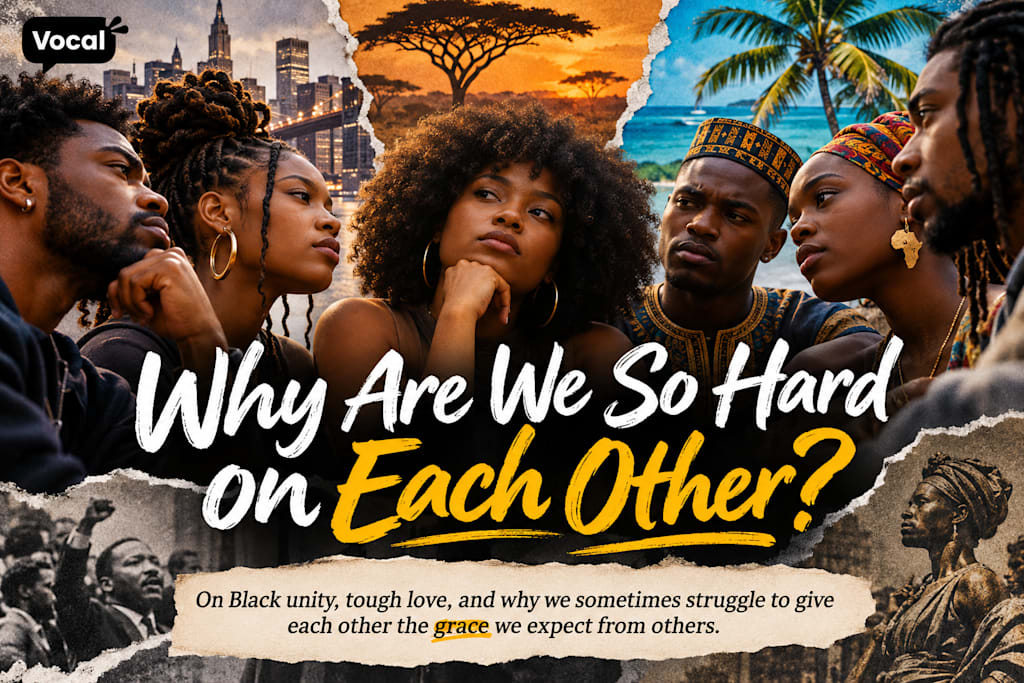
Why Are We So Hard on Each Other?
On Black unity, tough love, and why we sometimes struggle to give each other the grace we expect from others.

A while back, I made a post on Spill that apparently rubbed a few people the wrong way.
It was a simple question:
“Black folks can I ask y’all a question? Why don’t we like each other?”
Now, I knew it was a provocative question. I wasn’t expecting everybody to agree with me, but I also wasn’t expecting some of the responses I got.
Some people genuinely wanted to know why I felt that way. Others responded with GIFs, sarcastic remarks, or simply told me how much they loved Black people. One person even suggested that I was looking for engagement and that my post hadn’t gotten the reaction I wanted.
That one was funny to me because I wasn’t trying to go viral in the first place.
I wasn’t sitting around thinking, Oh, this is gonna be the one. This post is about to take off!
I was expressing something I’d been thinking about for years.
And when I explained why I asked the question, somebody interpreted that as me backtracking. Apparently, explaining your opinion means you’re trying to save face now.
But I wasn’t backtracking. I meant what I said, and the post is still up.
Looking back, I understand why some people took offense. It’s a broad question, and not everybody has had the same experiences I’ve had.
But I still think it’s worth asking.
We Talk About Black Love, But What About Black Treatment?
Over the years, I’ve noticed something about the way we sometimes treat one another. And I’m speaking from my own experiences here, not claiming to represent every Black person on the planet.
Sometimes I feel like we’re quicker to criticize, judge, or dismiss another Black person than somebody outside our community.
I remember experiencing what felt like that kind of double standard with certain teachers when I was younger. Things that other students could get away with seemed to become an issue when I did them.
Could that have been something personal rather than racial? Absolutely. I’m not going to pretend I know what was going through those teachers’ minds.
But those experiences stayed with me, and as I got older, I encountered other situations that made me question how we treat each other.
We talk about Black love, Black excellence, supporting Black businesses, and uplifting our people.
And I believe in those things.
But I sometimes wonder how much of that love we’re extending to the Black people we encounter in everyday life.
Because saying you love Black people is one thing.
How you treat them is another.
When Tough Love Becomes Something Else
One explanation I’ve heard for why we’re sometimes so critical of one another is that we expect more from our own people.
We want each other to succeed. We want excellence. We want better for the next generation.
I understand that.
But I also think that mentality can get dangerously close to respectability politics.
You know the sayings.
You have to work twice as hard to get half as far.
You have to be twice as good.
You can’t afford to make the same mistakes other people make.
I understand where those ideas come from. Generations of Black people have had to navigate a society where they weren’t given the same opportunities or benefit of the doubt.
But at what point does preparing people for discrimination turn into putting even more pressure on them?
Why do we have to be exceptional all the time?
Why can’t we just be ordinary sometimes?
One Black person does something embarrassing, and suddenly people are talking about how they’re making the whole race look bad.
How?
That person is responsible for their own behavior. They don’t represent millions of other people simply because they share the same skin color.
We love saying that Black people aren’t a monolith. And we’re not. Yet sometimes we turn around and treat each other as though we are.
And I particularly dislike the idea that we have to behave a certain way to make ourselves acceptable to white society.
I’m not interested in being somebody’s version of a respectable Black person just so they’ll feel more comfortable around me.
Respect shouldn’t require a performance.
Sometimes I wonder whether some of this harshness comes from internalized anti-Blackness. Not every disagreement or criticism, obviously. But when people consistently seem more willing to extend patience to outsiders, I think it’s reasonable to question where that difference comes from.
Maybe it’s the pressure we’ve inherited. Maybe it’s stereotypes we’ve absorbed. Maybe sometimes it’s simply personality or circumstance.
I don’t think there’s one explanation.
But I also don’t think we should automatically call every harsh judgment tough love and leave it at that.
And Then There Are the Diaspora Wars
If you spend enough time on social media, you’ve probably come across what people call the diaspora wars.
Black Americans arguing with Africans. Africans arguing with Black Americans. Caribbean people getting pulled into the conversation. Everybody defending their culture, their history, and their identity.
And sometimes it gets downright ugly.
What really gets on my nerves isn’t even the disagreements themselves.
It’s that nobody seems interested in listening to anybody else.
I’ve encountered commentary from people of African or Caribbean backgrounds that looks down on Black Americans, often relying on stereotypes about our culture, behavior, or history.
And I’ve seen Black Americans respond with their own dismissive attitudes.
The whole “We’ve been here. Where have y’all been?” mentality.
Or treating immigrants as though they’re coming here to take something that belongs exclusively to us.
Neither attitude sits right with me.
I understand being proud of your culture. I understand defending your history, especially when you feel somebody is dismissing it.
But when did pride in where you come from become a reason to look down on somebody else?
There’s also something particularly troubling about the attitude of “We’re Black, but we’re not like those Black people.”
As though distancing yourself from another Black community somehow makes you better.
Better in whose eyes?
Because somebody who genuinely dislikes Black people because of their race isn’t necessarily going to care whether you’re Nigerian, Jamaican, Haitian, Ghanaian, or African American.
Now, our cultural differences absolutely matter. We have different histories, traditions, and experiences. And those distinctions deserve recognition.
But they shouldn’t automatically become reasons to disrespect one another.
Our Histories Shouldn’t Be a Competition
Another part of these diaspora arguments that bothers me is how easily history becomes ammunition.
As a Black American, I believe the contributions Black Americans have made to this country deserve acknowledgment, particularly through the Civil Rights Movement.
People fought, protested, organized, and sacrificed to challenge systems that denied them basic rights.
And the changes that came from those struggles didn’t benefit Black Americans alone. They helped open doors for many others, including immigrants who came to the United States afterward.
So I can understand why it would be frustrating to hear somebody disparage Black Americans while enjoying opportunities that earlier generations helped make possible.
But I also don’t think that gives Black Americans the right to dismiss the histories or contributions of Africans and Caribbean people.
Those communities have their own histories of colonialism, resistance, independence movements, and struggles for freedom.
Why can’t we recognize all of that?
Why does one group’s history have to cancel out another’s?
Sometimes these arguments sound like people trying to win a competition nobody should be having in the first place.
We’re so busy proving who’s contributed more, who’s suffered more, or who’s supposedly better that we miss the opportunity to learn from one another.
Social Media Didn’t Create This, But It Sure Doesn’t Help
I don’t believe these tensions suddenly appeared because somebody downloaded an app.
A lot of these attitudes and stereotypes existed long before social media.
But social media has given people a place to say things they might have previously kept to themselves.
People are saying the quiet parts out loud.
One person makes an insulting comment about Black Americans, and somebody responds by insulting Africans generally. Then somebody else joins in, and before long, an argument between a handful of people starts sounding like an international conflict.
Meanwhile, plenty of people from these communities are getting along just fine.
And I know that camaraderie exists.
I’ve seen Black people from different backgrounds supporting, celebrating, and collaborating with one another through media and online communities.
I just wish I’d witnessed more of that solidarity in my own everyday experiences.
Because sometimes the hostility seems so much louder.
So, Do We Actually Like Each Other?
Looking back at my Spill post, I still stand by the question.
Not because I believe Black people are incapable of loving or supporting one another. I know that’s not true.
And not because I think my experiences represent everybody else’s.
But because I believe loving your community doesn’t mean pretending everything within it is wonderful.
Sometimes it means being willing to question the things that bother you about it.
We talk about Black pride, Black love, and Black unity. But I wonder how often we stop to consider whether the way we treat one another actually reflects those things.
I’m not asking us to agree on everything. I’m asking us to extend some of the grace and understanding we expect from everybody else.
So I’ll ask again:
Why are we so hard on each other?
About the Creator
Travis Johnson
Aspiring actor and writer, Pop Culture lover and alien. With a penchant for beef jerky, gotta have that jerky.
Follow me if you’d like https://www.instagram.com/sivetoblake/ and Substack https://travisj.substack.com/subscribe
Enjoyed the story? Support the Creator.
Subscribe for free to receive all their stories in your feed.
Comments
There are no comments for this story
Be the first to respond and start the conversation.