
Where Is LGBTQ Marriage Legal? Global Guide 2026
A global overview of countries where same-sex marriage is legal, still restricted, and how laws are evolving worldwide.
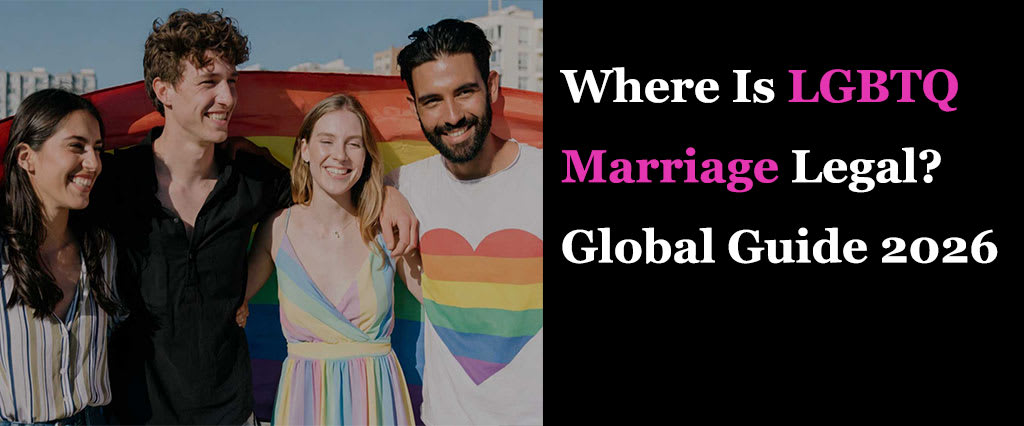
In many parts of the world, the idea of marriage is still evolving. For LGBTQ+ individuals, where you live can shape not only your rights, but also your relationships and future plans.
So where is LGBTQ+ marriage actually legal today—and how is that changing?LGBTQ+ marriage legalization refers to the legal recognition of same-sex couples, allowing them to marry and enjoy the same rights as heterosexual couples. These rights typically include property inheritance, medical decision-making, tax benefits, and parental rights.
1. What Does LGBTQ+ Marriage Legalization Mean?
In some countries, same-sex marriage is not yet fully legalized, but alternative legal frameworks such as civil unions or registered partnerships are available. While these arrangements offer certain legal protections, they often do not provide the full range of rights that come with marriage.
Over the past two decades, the legal status of LGBTQ+ marriage has changed significantly around the world. More countries are recognizing marriage equality, reflecting both legal progress and a broader shift toward inclusivity and diversity in modern societies.
2. Which Countries Have Legalized LGBTQ+ Marriage?
Today, dozens of countries have legalized same-sex marriage, with most located in Europe, the Americas, and parts of the Asia-Pacific region.
In Europe, Netherlands became the first country in the world to legalize same-sex marriage. Since then, countries such as Spain, France, and Germany have followed, making Europe one of the most progressive regions in terms of marriage equality.
In the Americas, United States and Canada were among the early adopters of nationwide legalization. In the United States, same-sex marriage became legal nationwide in 2015 following the landmark Supreme Court decision Obergefell v. Hodges. Additionally, countries like Brazil and Argentina have also played a leading role in advancing marriage equality in Latin America.
In the Asia-Pacific region, Taiwan became the first place in Asia to legalize same-sex marriage in 2019. Meanwhile, Australia and New Zealand have also fully recognized same-sex marriage.
In Africa, South Africa remains one of the few countries where same-sex marriage is legal.
As marriage equality expands across more countries, many LGBTQ+ individuals are also exploring connections beyond their local regions. Some LGBTQ+ platforms, such as Queer, are designed to help people connect across cultures, especially for those living in places where marriage laws may still be evolving.
In reality, while LGBTQ+ marriage legalization continues to expand globally, the pace of progress still varies significantly across different regions.
3. Where Is LGBTQ+ Marriage Still Not Legal?
Although more countries around the world have legalized same-sex marriage, many regions still do not legally recognize LGBTQ+ marriages. These areas are mainly concentrated in the Middle East, parts of Asia, and much of Africa.
In many Middle Eastern countries, legal systems are closely tied to religious traditions, and same-sex marriage is generally not recognized. In some cases, same-sex relationships may also face strict legal restrictions. Across Asia, while certain places have made progress in LGBTQ+ rights, most countries have yet to legalize same-sex marriage. Similarly, in Africa, with the exception of South Africa, most nations do not currently recognize same-sex unions.
It is important to note that legal frameworks, cultural values, and social attitudes vary significantly from one country to another. These differences play a major role in shaping how quickly marriage equality develops in each region. Some countries have begun discussions around LGBTQ+ rights and partnership recognition, indicating that future changes remain possible.
What’s interesting is, the global progress of LGBTQ+ marriage legalization is uneven, but as social attitudes continue to evolve, the conversation around marriage equality is steadily advancing.
4. How Are LGBTQ+ Marriage Trends Changing?
In recent years, LGBTQ+ marriage equality has continued to expand globally. As younger generations become more open to diverse identities and relationships, more countries are re-evaluating their legal frameworks and social policies around same-sex marriage. Even in traditionally conservative regions, discussions around partnership rights and marriage equality are gradually emerging.
At the same time, the rise of the internet has transformed how people build relationships. Geographic boundaries are no longer the primary limitation, and cross-border, cross-cultural connections are becoming increasingly common. For many LGBTQ+ individuals, even in countries where same-sex marriage is not yet legal, it is still possible to meet like-minded people and form meaningful relationships online.
In this context, inclusive dating platforms are playing an increasingly important role by helping people connect across borders and cultures.
Overall, LGBTQ+ marriage is not only a legal issue, but also closely linked to social attitudes, technological change, and the evolving ways people connect with one another.
5. What Does LGBTQ+ Marriage Mean for Modern Dating?
As marriage equality continues to develop worldwide, it is also reshaping how LGBTQ+ individuals approach dating and relationships. Some people choose to move to or settle in countries where same-sex marriage is legally recognized, seeking greater stability and legal protection. Others are becoming more open to cross-cultural relationships and long-distance connections.
At the same time, online dating has become increasingly important. Compared to traditional offline interactions, digital platforms offer more opportunities to meet new people and build long-term relationships—especially in places where local LGBTQ+ communities may be limited.
As a result, more users are turning to inclusive dating platforms to find partners who share similar values, rather than limiting themselves to local or cultural boundaries. No matter where they are, people are exploring relationships in more open and flexible ways.
In many ways, the legalization of LGBTQ+ marriage is not only transforming legal systems, but also reshaping modern dating behaviors and relationship choices.
About the Creator
Enjoyed the story? Support the Creator.
Subscribe for free to receive all their stories in your feed.
Comments
There are no comments for this story
Be the first to respond and start the conversation.