
When the Phone Rings, My Chest Tightens: The Work Call Anxiety Nobody Talks About
A ringtone can feel like a summons. Here’s why work calls hijack your nervous system, and how to set boundaries without guilt.
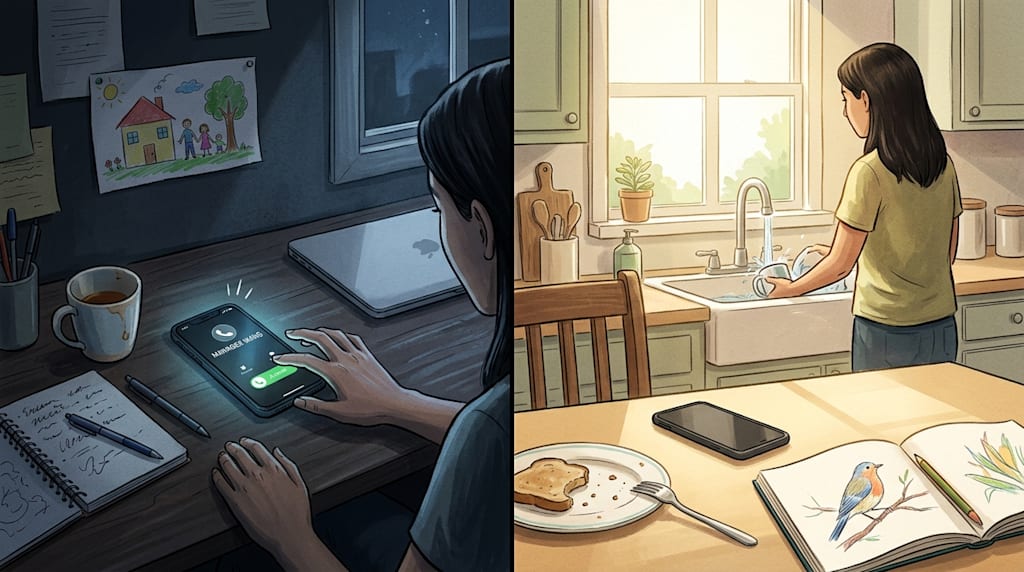
The phone screen lights up. Caller ID: Manager Wang. Your thumb hovers over the answer button. You press mute instead. The screen goes dark. Then it lights up again. Your stomach clenches. You stare at the number like a door someone just knocked on. If you don’t open it, they’ll knock again. If you do, you don’t know who’s standing outside.
This isn’t drama. People’s Daily Health Client calls “telephone phobia” an extension of social anxiety. Professor Tang Yonglong from Southwest University’s School of Psychology listed the signs: keeping your phone on mute, pretending not to see calls, texting without trouble but tensing up at a ringtone, never calling when WeChat works, never sending voice when text works. Each one sounds like it was copied from your phone settings.
Text gives you control. You can think slowly. You can reply when ready. You can delete, rewrite, add an emoji to soften the tone. A call is immediate and cannot be taken back. The ringtone pulls you into a room where you have to answer now. No time to weigh words, check facts, or confirm you heard correctly. In the few seconds before the call connects, your mind runs a disaster movie: Did something happen? Will I have to work overtime? Did I do something wrong?
But the fear isn’t about the phone.
The phone is an entrance. What you fear is what comes through it: a sudden task, overtime you can’t refuse, an interrogation you didn’t prepare for, the helplessness of a boundary being broken.
One commenter took a morning off and got work calls the whole time. They didn’t get any extra sleep. Another counted seventeen or eighteen work calls on a day of parental leave. The leave felt like a joke. Muting the phone, pretending not to see it, panicking at an incoming call: this is the body trying to protect itself. I need a little space that isn’t interrupted.
Someone else said, “I have WeChat anxiety now.” Anxiety doesn’t belong only to phone calls. Any instant messaging tool can become a new source of anxiety when it carries the pressure of “must respond immediately.” Phone calls are just the most typical one.
In the comments, there was another voice. Someone said: “No. If there’s a problem, talk about the problem. If you can solve it, solve it. If you can’t, go to your boss. Don’t make things hard on yourself. No anxiety!” Another wrote: “Treat work with boundaries. Many people are too forceful with work, give without limits, worry about every gain and loss, and end up exhausting themselves. Investment without boundaries is internal friction from the start.”
These words sound simple. They’re hard to do. People who aren’t anxious aren’t born strong. They’ve put work back in its proper place: work is part of life, not the whole of it. When a call comes, if you can take it, take it. If you can handle it, handle it. If you can’t, report it, ask for help, or set it aside. They don’t treat every call as a test of their competence. They don’t treat every mistake as an unforgivable crime.
One commenter joked with BaZi astrology: “In BaZi terms, why are people whose ‘Officer and Seven Killings’ are strong and unfavorable easily isolated? Because they unconsciously give off negative energy. For example, when a new task arrives at work, everyone else eats and drinks as usual, but the one with especially strong Officer and Seven Killings keeps worrying and fretting over the task, making themselves extremely anxious and tangled up.” Over-worrying makes people keep their distance. People move toward benefit and away from harm.
With work matters, doing your best is enough. You don’t have to mortgage all your emotions.
People’s Daily Health Client suggests easing “telephone phobia” from several directions. First, realize that phone communication is only one of many ways to communicate. Even small mistakes aren’t irreversible. Change how you think about phone calls.
Here are methods to try.
Downgrade the phone. For non-urgent matters, send a message first, then decide whether a call is needed. Agree with colleagues: “If text works, don’t send voice. If voice works, don’t call.” This is choosing a communication style that suits you better. It is not avoidance.
Set boundaries. When on leave, set an auto-reply and make clear who the emergency contact is. After work, turn on Do Not Disturb and leave work calls for work hours. Boundaries keep work sustainable. They are not coldness.
Practice desensitization. Start with short calls to colleagues you know. Write down your key points beforehand. After the call, give yourself positive feedback. Every small success weakens the fear the ringtone brings.
Patch things up after the call. After hanging up, send a quick message to confirm: “About the things we just discussed, my understanding is… is that right?” This reduces omissions and eases the worry of saying the wrong thing.
Accept the anxiety. If phone anxiety is already seriously affecting work and life, seeking professional psychological help is not shameful. Some people need long-term medication. Some need counseling. Admitting you’re not comfortable is the first step in taking care of yourself.
The phone is a tool. It shouldn’t be the background noise of life, much less a remote control for your emotions. We can’t eliminate every incoming call. We can’t turn all work into text. But we can practice: when the ringtone sounds, take a deep breath, glance at the caller ID, and decide. Answer or not. Answer now or later. After you answer, put it down.
Life isn’t only work. There’s sunlight, children, paper a brush has painted halfway, a meal no one interrupts. As that commenter said: “I can’t let work affect my mood for a whole day. Life isn’t only work.”
The phone lights up again. You turn it over, screen down. The ringing stops. The vibration still buzzes against the table. You stand up and go to the kitchen. You wash a cup. The sound of water covers the vibration.
There will be more calls tomorrow. But today, the cup is washed.
About the Creator
Jin
Writer of reamstories
https://reamstories.com/jin
Enjoyed the story? Support the Creator.
Subscribe for free to receive all their stories in your feed. You could also become a paid subscriber, letting them know you appreciate their work.
Comments
There are no comments for this story
Be the first to respond and start the conversation.