
We’re Not the Only Animals That Feel Shame
But We’re the Only Ones Who Turn It Into a Moral Prison
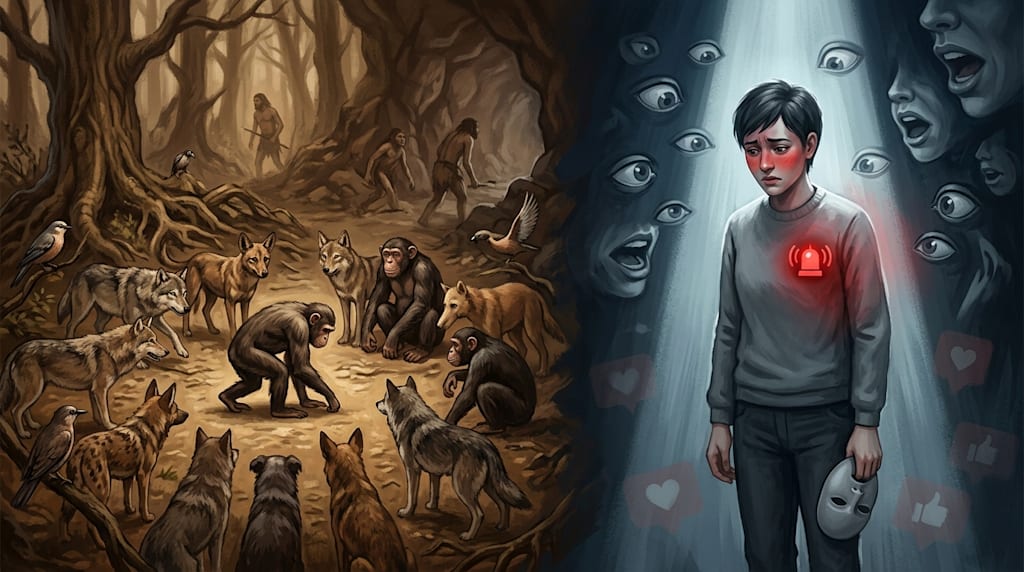
The Animal Origins of Shame
We tend to treat shame as proof of humanity. Animals go naked without blushing. Humans lower their heads over their bodies, desires, failures, origins, and intimate relationships. So the question seems natural: why did only humans evolve shame?
The premise is flawed. Humans are animals. Human emotions share ancient biological foundations with the emotions of many other animals. Shame did not appear as a brand-new organ. It is better understood as a stitching together of older capacities: fear, submission, social pain, status anxiety, reputation management, and self-narration. Animals are not missing all the parts. They simply do not assemble them into the kind of moralized, self-conscious shame that humans experience. It is not that only humans evolved shame. It is that humans turned an ancient group signal into a complex, cultural, and moral form of self-judgment.
1. Shame Works as a Social Signal
First, separate two categories.
Mammals have several basic emotions: anger, fear, sadness, and disgust. These have autonomic nervous system correlates. They link to specific reflexes and simple behaviors. They tend to fade when the stimulus is removed. They are not uniquely human. Dogs, cats, rats, monkeys, and chimpanzees have them to varying degrees.
Social emotions are different. Hope, disappointment, pride, alienation, guilt, and shame lack a single, clearly bounded neural circuit. They are learned composites. They require social interaction, cognitive development, language, and culture. Shame is not mere fear. It is not mere obedience. It is the pain that arises when my value, belonging, and reputation as a social being are under threat.
So the center of shame is not a specific behavior. It is the internalization of social evaluation. Guilt says, “I did something bad.” Shame says, “I am bad, low, dirty, ridiculous, unworthy, or unwanted.” Guilt is about the act. Shame is about the self. Guilt wants repair. Shame wants disappearance.
2. Animals Have the Parts of Shame, Not the Whole Machine
To say animals have no shame at all is too crude. Many social animals display behaviors that serve similar functions.
A dog scolded by its owner may lower its head, tuck its tail, and flatten its ears. It looks ashamed. It is more likely a mix of fear, submission, and appeasement. These signals say, “I am not a threat.” Primates have more complex reconciliation, alliance, and status strategies. A low-ranking individual threatened by a higher-ranking one may avoid, submit, or seek allies. In group-living mammals, rejection by the group often means losing protection, food, and reproductive opportunities. Being negatively evaluated is itself a survival threat.
These behaviors are continuous with human shame. They may not involve the same experience. Human shame requires several capacities: self-awareness, theory of mind, imagining how others see you, internalizing social norms, and narrating who I am. Animals may fear being bitten, driven away, or demoted. Humans can rehearse being abandoned and then judge themselves on behalf of the group.
So animals have the parts of shame, not necessarily the whole machine. Humans are not the only animals that lower their heads. We are the only ones who feel ashamed of lowering them.
3. Why Humans Amplified Shame
Because humans are highly social animals.
Human quality of life, offspring survival, security, and reproductive opportunity depend heavily on cooperation. We did not survive by going solo. We survived through groups, division of labor, alliances, reciprocity, reputation, and punishment. Whoever is liked by the group is more likely to receive help. Whoever is despised by the group has a harder time surviving and reproducing.
Under these conditions, reputation becomes a practical resource. Shame is the signal that sounds when reputation is damaged. It drives people to avoid being devalued by the group. It pushes them to submit, apologize, repair relationships after transgression, or at least hide the behavior. Self-esteem is something like a person’s estimate of their own social standing. Shame and self-esteem are linked. When self-esteem is high, one feels accepted. When shame strikes, one feels demoted, excluded, and looked down upon.
The prefrontal cortex’s inhibition of the limbic system consumes glucose and cognitive resources. So although people can control the intensity and target of shame, that control is not unlimited. Culture can teach people what to be ashamed of, toward whom, and in what situations. Once social evaluation has been internalized, shame can fire automatically, like pain.
4. What Humans Are Ashamed Of
The objects of human shame seem endlessly varied: sex, the body, poverty, failure, dependence, accent, origin, family, desire, rejection, being seen. Underneath, they tend to point toward the same thing: the survival of the social self.
What we fear is not simply “I did something.” It is “I will be seen as a certain kind of person.” We fear being seen as promiscuous, stupid, weak, dirty, lowly, ridiculous, unlovable, or unfit for cooperation. Shame is a kind of social pain. It is an alarm for belonging. It tells you that you are losing your place in the group.
This also explains why shame so easily attaches to things beyond a person’s control: the body, birth, family, desire. These things cannot easily be changed. Society still assigns them high or low value. Shame can therefore maintain cooperation. It can also become an instrument of oppression. It can keep people in line. It can make people hate themselves for being poor, for their gender, for their sexuality, or for their physical features.
5. Sexual Shame: The Most Instinct-Like, and the Most Cultural
Sexual shame is often mistaken for something natural. Sex itself is not inherently shameful. Different cultures vary enormously in how much shame they attach to nudity, masturbation, childhood sexual activity, and extramarital sex. This shows that sexual shame is not primarily instinct. It is largely assembled by cultural memes.
One powerful explanation is the cooperative maintenance hypothesis. It proposes that humans and some other social animals conceal mating from the senses of conspecifics. We can call this concealed mating. This can reduce jealousy and mate competition among other group members who discover that there is a currently available mating partner, and I want to mate but cannot. Concealment helps maintain cooperation, avoid conflict, and preserve mating control over the current partner.
Concealed mating is not limited to humans. It is not limited to socially monogamous species. The Arabian babbler conceals mating. Common marmosets live in socially monogamous, polygynous, and polyandrous groups. They cooperatively raise offspring and mate relatively concealed. Gibbons are mostly socially monogamous, occasionally polygynous. They do not cooperatively raise offspring, and they do not conceal mating. So concealed mating is linked to cooperative breeding, mating control, and group stability. It is not simply a sexual instinct of shame.
Anthropologists have described hundreds of human cultures. Most have more or less concealed mating behavior, even if their technology was often insufficient to hide it completely. There are also cultures with very open attitudes toward sex. The Mbuti and Khoi in Africa, the Lesu in Oceania, and the Canela and Huaorani in South America have social norms that permit extramarital sex and do not strictly conceal mating. The Lesu are also one of the few human cultures without shame about female masturbation. Girls around six years old may do it near others. No one opposes or punishes them. Adults talk about it openly. Pukapukans in Polynesia do not interfere with children’s sexual activity. Their minors masturbate in public. The Trobriand Islanders ignore or encourage children’s sexual activity. About twenty cultures practice public sex under certain circumstances, mainly for religious rituals and sexual training.
These examples show that sexual shame comes from the group’s gaze. Sex itself is not the source. In an extreme criminal scenario, a group of male offenders gang-raping a female victim may not conceal the act from one another. This suggests that shame targets not being seen by conspecifics in general, but being seen and devalued by a particular moral community. Only after cultural norms are internalized do people judge themselves on behalf of the group.
6. Clothes, Lice, and the History of Bare Bottoms
People often bind clothing to sexual shame. Clothing’s original functions were more likely protection, warmth, and decoration. Research on the divergence of head lice and body lice suggests that regular clothing use by a relatively large number of people may be no more than 170,000 years old. Homo sapiens is about 300,000 years old. The history of humans chasing wild animals with bare bottoms is over 1.6 million years.
This means that for a very long time, human ancestors did not feel shame about nudity. We rarely see contemporary art or scientific illustrations correctly depict Homo sapiens adolescents hunting and gathering with bare bottoms 200,000 years ago. People almost always add fur skirts or grass skirts. That is not history. It is cultural imagination. Clothing came first. Sexual shame came later. More precisely, clothing’s functions were gradually reinterpreted by culture and then linked to shame.
7. Shame Is a Malleable Tool of Cooperation
Shame is neither pure instinct nor pure cultural invention. It is built on ancient social pain, fear, submission, and reputation management. It is continually shaped by language, norms, religion, family, education, and media. It can help people maintain status, repair relationships, and restrain transgression. It can also be used to control bodies, oppress women, humiliate the poor, and punish minorities.
Packaging sexual shame as health wisdom has no physiological basis. The claim that one drop of semen equals ten drops of blood grossly ignores women’s sexual experience. About thirty grams of pork head meat is more than enough to replace the calories of one ejaculation. Eaten as a drinking snack, it will probably make a man gain weight. Such claims are not science. They are mutated cultural memes, linguistic residue from shame used to discipline the body.
The better question is why humans turned an ancient group signal into such a fine-grained form of self-judgment.
The answer is our sociality. We need each other too much. We care too much about reputation. We are too good at imagining how others see us. We depend too heavily on cooperation to survive and reproduce. Animals may fear being abandoned by the group. Humans can rehearse abandonment and then judge themselves on behalf of the group. What humans are ultimately ashamed of is the survival of the social self. I fear being seen, being looked down upon, being excluded, losing belonging, status, and opportunities for cooperation.
We are not the only animals that lower our heads. We are the only ones who feel ashamed of lowering them. That shame can make us better cooperators. It can also make us deeper prisoners.
About the Creator
Jin
Writer of reamstories
https://reamstories.com/jin
Enjoyed the story? Support the Creator.
Subscribe for free to receive all their stories in your feed. You could also become a paid subscriber, letting them know you appreciate their work.
Comments
There are no comments for this story
Be the first to respond and start the conversation.