
The Woman Who Kept a Nobel Laureate in Her Wallet
How a failed trivia date taught me that memorized facts are just armor we wear to avoid being known
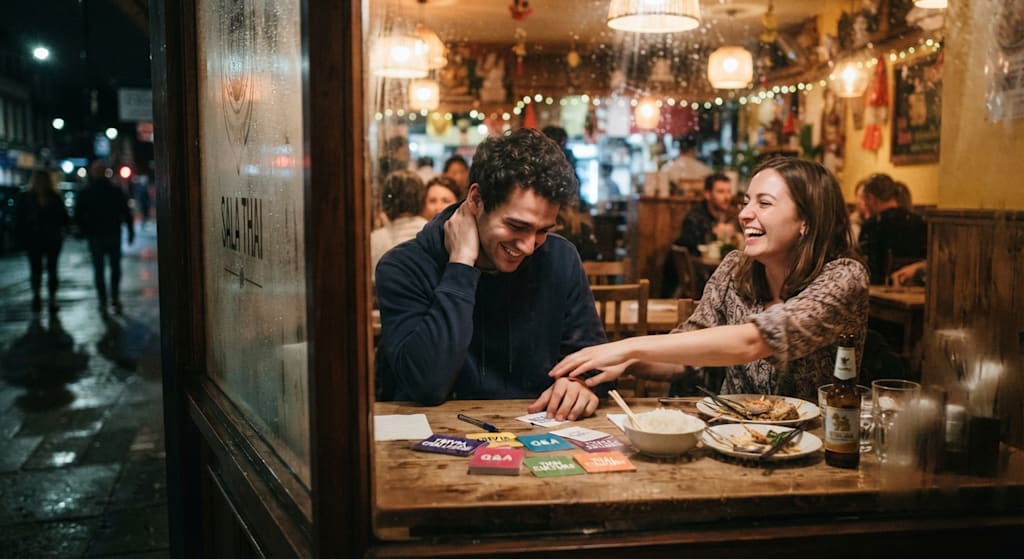
She sat across from me at a Thai restaurant, twirling pad see ew around her fork, and said the thing that would eventually end us: "Tell me something true."
Not "tell me about yourself." Not "what do you do." Something true. As if truth were a thing you could pull from a pocket and place on the table between the fish sauce and the napkins.
I panicked. I'd prepared for this date the way I prepare for everything—by memorizing. My brain, that traitorous archive, offered up: The word "husband" originally referred to a eunuch. Not what she asked for, but it was something. A fact. True-ish. Historically accurate, anyway.
She laughed. Not the polite laugh I'd been expecting, but a real one, surprised out of her. "Why do you know that?"
"I know a lot of things," I said, and it came out wrong—defensive, maybe. Like a warning label.
She tilted her head. "Do you know why you know them?"
Here's what I didn't tell her that night, what I wouldn't tell her for months: I collect facts the way other people collect grudges or ex-lovers or therapy appointments. My father left when I was seven, and my mother filled the silence with encyclopedias. Every dinner, she'd open a volume at random and read aloud. Did you know that bananas brown faster in the refrigerator? Did you know that the inventor of the treadmill was trying to reform prisoners, not help people exercise? I learned early that knowledge could fill a room when love couldn't.
By the time I met June, I had thousands of these facts. They were my conversational currency, my armor, my way of never having to say anything that might require vulnerability in return. I could talk for hours about the mating habits of anglerfish or the history of the QWERTY keyboard. I could not talk about why I flinched when someone touched my shoulder unexpectedly.
June saw through it. She saw through everything.
The second date, she tested me. "Okay," she said, "tell me a fact that has nothing to do with anything."
I thought for a moment. "When you sneeze, your eyes close involuntarily. It's a reflex. If they didn't close, the pressure could damage your eyeballs."
She nodded slowly. "And what does that have to do with you?"
"Nothing. That was the point."
"No," she said. "The point was to see if you could tell me something about yourself without the disguise."
I ordered another drink.
We dated for eight months. In that time, I learned about her: she was a pediatric nurse, she had a scar on her knee from a childhood bike accident, she cried at commercials but not at funerals, she believed that the way you treat waiters revealed everything about your soul. She learned about me: that I knew a surprising amount about the history of the Nobel Prize ceremony, that I could explain why high-speed trains don't allow umbrellas on platforms, that I had memorized the phone numbers for China Mobile customer service in case of emergencies.
What she didn't learn—what I made sure she didn't learn—was why I needed to fill every silence with trivia. Why being asked to sit quietly with my own thoughts felt like being asked to sit in a room with a slow leak of poison gas.
The breakup happened in a parking lot. Of course it did. Parking lots are where relationships go to die—they're liminal spaces, all concrete and fluorescent light, nowhere to hide.
"I can't do this anymore," she said. "I feel like I'm dating a search engine."
"Search engines are useful," I said, which was the wrong thing to say, and I knew it even as I said it.
"You're not useful. You're guarded. You're a fortress made of trivia, and I keep knocking on the door, and you keep sliding fact cards under it."
I wanted to tell her that I loved her. I wanted to tell her that the reason I couldn't tell her anything true was that the last person who knew my truths had left, and I'd spent twenty years building a version of myself who couldn't be left again. But what came out was:
"Did you know that the average human body fat percentage for a white pig is about fifteen percent? It's basically supermodel territory."
She stared at me for a long moment. Then she got in her car and drove away.
The months after were quiet in a way I had never allowed myself to experience before. I moved through my days without the protective shield of facts. I didn't fill silences at work. I didn't memorize new information just to have it ready. I let conversations die natural deaths and sat with the discomfort of having nothing clever to say.
It was, to be honest, awful at first. Then it became something else. Almost restful.
I started noticing things I'd never let myself notice before. The way my mother's hands shook when she poured coffee. The way the barista at the corner always said "have a good one" in a tone that suggested she genuinely hoped I would. The way silence could be a gift rather than a threat.
I called June six months after the parking lot. I didn't prepare anything. I didn't have a single fact queued up. My hands were shaking—not from cold, but from the terrifying vulnerability of standing in front of someone without a shield.
She met me at the same Thai restaurant. Same table, even. The universe likes symmetry, apparently.
"I want to tell you something true," I said.
She waited. She didn't fill the silence for me. That was always her gift—she could sit in the void while I panicked.
"When my father left," I said, "I used to sit by the window for hours, waiting for his car to come back. My mother would read to me to distract me. Facts. Things that had nothing to do with us. I learned that if I could keep talking, I wouldn't have to feel anything. So I became someone who could talk about anything and feel nothing."
Her eyes were wet. "Why are you telling me this now?"
"Because I realized something. Something true."
"What?"
"The 'husband' thing—that wasn't an accident. When I told you that, I was already trying to tell you something. That I was afraid of becoming someone's husband. That I didn't know how to be that close to someone without losing myself. So I made a joke out of it. A fact. A shield."
She reached across the table and took my hand. Her fingers were warm.
"Tell me another fact," she said.
"The Nobel Prize ceremony allows winners to bring fourteen guests," I said. "But it used to be unlimited. Then a Spanish writer named Camilo José Cela brought sixty-eight people to the dinner, and they had to change the rule."
She laughed. That real laugh, the one I'd been chasing for months.
"And what does that have to do with you?"
I squeezed her hand. "Nothing. And everything. I'm learning to let the facts mean something other than themselves."
We're still together. I still know things. But now I know the difference between using facts to connect and using them to hide. The truth is, we're all just collections of information—memories, trivia, half-remembered song lyrics, phone numbers we'll never call. The question isn't whether you have facts. The question is whether you'll let someone see the empty space between them.
June eventually told me her own secret: she'd been testing me that first night. She had a habit of asking people to tell her something true because she wanted to see if they'd reveal themselves or recite something memorized. I'd failed the test and passed it simultaneously—I'd revealed myself by trying to hide.
"But why did you stay?" I asked her once.
She shrugged. "I saw something in the space between your facts. A person who was trying, badly, to be known. That's all anyone can do, really. Try badly, and then try better."
There's a fact I learned recently: when you hug someone for twenty seconds, oxytocin is released in both people's brains. It's the bonding hormone. It makes you feel closer to the person you're holding. It works whether you're in love or not.
I used to think that fact was interesting. Now I think it's just true, and that's enough.
The woman who kept a Nobel laureate in her wallet—that was June, by the way. She kept a picture of Cela, the writer who brought sixty-eight people to the ceremony. She said it reminded her that some things are worth bringing everyone you love to the table. I keep it now, too, in my own wallet. Not because I need another fact, but because sometimes a fact is a promise.
A fact is a promise that someone will be there, when you finally stop hiding.
About the Creator
Jin
Writer of reamstories
https://reamstories.com/jin
Enjoyed the story? Support the Creator.
Subscribe for free to receive all their stories in your feed. You could also become a paid subscriber or give them a one-off tip, letting them know you appreciate their work.
Comments
There are no comments for this story
Be the first to respond and start the conversation.