
The Man Who Could Sell Anything and Run Nothing
A former partner’s explosive posts reveal why Luo Yonghao’s companies kept collapsing, and why the people who worked for him stayed silent.
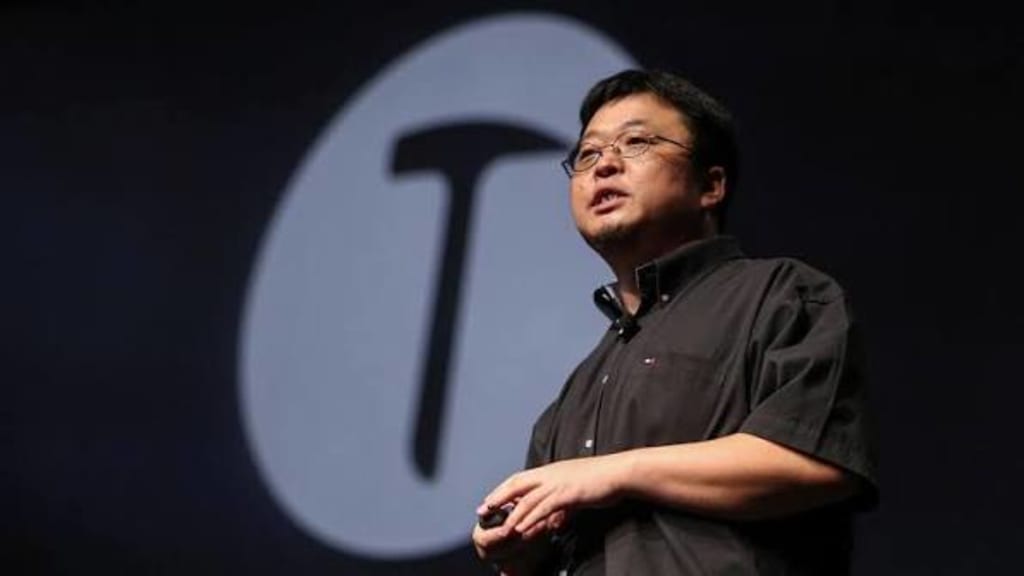
One Hammer, Two Lives: Luo Yonghao’s Control and His Incompetence
Huang Bin posted his first Weibo. Luo Yonghao did not respond.
Second post. Nothing.
Third. Still nothing.
Then Huang Bin wrote about the detail: “Li Yanhong and Yu Minhong are close, so they must be ganging up on me.” Luo Yonghao finally appeared. He said this Huang Bin was not that Huang Bin. He said the man’s career and life were both failures. He said he was emotionally unstable. Huang Bin posted again. Luo Yonghao never said another word.
This is a man who built his reputation on his mouth. He used debate as a weapon. He spent more than a decade fighting people on Weibo. Then he faced an old partner who held his cards, and he shut up. That silence carries more information than the thousands of words Huang Bin wrote.
I
Huang Bin kept returning to one phrase: chicken feathers and garlic skins.
He said Luo Yonghao “took pleasure in these bizarre things all day long, tormenting the entire company over trivial, chicken-feather-and-garlic-skin matters.” He said employees rarely spoke about it publicly because “he could actually do those things, but you would be too embarrassed to say them out loud.”
That sounds like an eccentric boss. Spend time inside an organization and you learn that chicken feathers and garlic skins are never just chicken feathers and garlic skins.
A CEO has no say in strategic direction. He cannot weigh in on technical judgments. He cannot read a financial statement. Where does he find the feeling of “I am the one who decides”? In the areas that require no professional expertise. The spacing of a single pixel. The wording of one line of copy. The seating arrangement at a meeting. The font size on a product launch slide.
Someone inside Smartisan once said, “Arguments over a single pixel happened constantly inside the company.” The word that matters is “constantly.” A man who should have been thinking about next year’s supply chain was spending enormous amounts of time deciding whether an icon should move one pixel to the left. The entire company had to move it with him.
The issue is power structure. When a person has no voice in the areas that matter, he will frantically exercise his voice in every area that does not. Every “this pixel is wrong” is a miniature confirmation of power. He does not need the correct answer about the pixel. He needs everyone to confirm that his answer is the answer.
II
Huang Bin’s example is worth repeating.
The English-training school had no training license when it started. It borrowed someone else’s. Baidu said training ads required the company name on the webpage to match the name on the training license. Otherwise the ad could not go live. That was the whole issue.
Luo Yonghao ranted in the office every day. He pounded the table and glared at the person in charge of marketing. He could not accept the rule. Finally he told Huang Bin: I think there must be a conspiracy here. Li Yanhong and Yu Minhong are close. They must be targeting me.
Huang Bin said he felt thunder roll through his skull. Twenty years later, the image was still in front of his eyes.
The founder of a startup that did not own its own license was imagining himself as a tragic hero besieged by two giants. That imagination is a gift in a novel. In business management, it is a disaster.
The thought itself matters less than why he had it. A normal person, when Baidu rejects an ad, first thinks, “Let’s change the license,” or “Let’s change the name.” Luo Yonghao’s first thought was, “Li Yanhong and Yu Minhong are targeting me.” His reaction shows a cognitive framework where every setback is “someone is out to get me” and every rule is “aimed at me.” In an ordinary employee, that pattern is a victim mentality. In a CEO, it is systemic risk.
III
Luo Yonghao never went to university. He dropped out in his second year of high school. The only experience in his life that had anything to do with technology was working as a laborer in a factory in South Korea.
This is a problem of knowledge structure, not credentialism. A founder who does not understand technology, managing a technology company, starts from a position of unequal knowledge power relative to his CTO. Qian Chen came from Motorola. He understood basebands, radio frequency, supply chains. What did Luo Yonghao understand? Launch events. PowerPoint. How to make the audience applaud.
That inequality breeds a typical behavioral pattern: compliance testing. I do not understand technology, but I can decide whether your proposal is used. I do not understand supply chains, but I can decide whether your tone with a supplier is correct. I do not understand product, but I can decide whether this icon moves left or right.
Qian Chen eventually left. Smartisan’s technical team turned over again and again. The “bizarre chicken-feather-and-garlic-skin matters” Huang Bin described were the aftershocks of this unequal power struggle. Luo Yonghao tormented the whole company over those trivialities. Those trivialities did not matter. That was the only battlefield on which he could win.
IV
Luo Yonghao has said the label “the industry’s death lamp” lacks logical support. Huang Bin offered a simpler explanation: a man this unreliable, no matter what he does, fails at one thing after another. That is perfectly normal.
Luo Yonghao’s entrepreneurial trajectory follows a clear pattern. He catches the right wave, then fails to close the loop. English training caught the study-abroad boom. Bullog caught the blog wave. Smartisan caught the smartphone explosion. E-cigarettes caught the trend. Livestreaming caught the e-commerce livestreaming wave. Every time, he entered early. Every time, he raised money. Every time, he built up noise and attention.
Every time, he fell down in the same place: execution.
At the 2018 Bird’s Nest launch event, the TNT display took up most of the time. Luo Yonghao wanted to use the concept of “turning a phone into an office computer” to redefine a product category. The live demo failed repeatedly. The launch became a disaster. TNT later became the last straw that broke Smartisan. The product did not fail from a lack of imagination. It failed because imagination ran ahead of engineering capability, supply-chain preparation, and market validation. Luo Yonghao could not tolerate anyone telling him that.
V
The only commercial practice of Luo Yonghao’s that is widely recognized as successful is livestreaming e-commerce.
Huang Bin said the business “was not led by him; he was just acting on stage.”
That is harsh, but not entirely wrong. From its first day, Jiaogepengyou was working to remove Luo Yonghao from the center. In 2021, Luo Yonghao himself said his share of the livestream’s GMV had fallen to 20 percent. His personal livestreaming time was capped at less than 3 percent of the total. Jiaogepengyou’s revenue and profit were still growing overall.
The implication is that the livestreaming business succeeded because Luo Yonghao was the one being managed, not the manager. He provided traffic, topics, and that face. Product selection, supply chain, operations, fulfillment. Those links determine whether livestreaming e-commerce succeeds or fails. They were run by another management logic. In that logic, no one pounded the table because “one pixel is wrong.”
What Luo Yonghao does best is stand in front of the stage. When he tries to extend front-stage ability into backstage management, things spin out of control. Livestreaming worked because he managed less.
VI
Few people who have worked with Luo Yonghao speak about it online.
Huang Bin’s answer was, “He could actually do those things, but you would be too embarrassed to say them out loud.” Behind that sentence is a colder mechanism. Luo Yonghao’s managerial incompetence manifests in a way that makes its victims reluctant to speak.
A company goes under because of a strategic misjudgment. Former employees can confidently say, “The boss made a wrong decision.” A company’s daily life is made up of countless absurd moments like “Li Yanhong and Yu Minhong are ganging up on me.” Then the critic gets stuck. You either recount these trivialities and risk being seen as small-minded or petty, or you stay silent and let the absurdity ferment in private.
There is another layer. Luo Yonghao has traffic. His fan base is large and fiercely loyal. Public criticism can be drowned out by waves of “clout-chasing,” “freeloading,” and “losers are jealous of successful people.” Huang Bin dared to speak because he stopped depending on Luo Yonghao for a living long ago. Former employees still trying to make a living in the industry face a cost that far exceeds the benefit.
People stay silent because telling the stories costs more than the stories can bring. The stories exist.
VII
Luo Yonghao has a rare gift: making people believe in him.
That gift took him from the New Oriental podium to Bullog, to Smartisan launch events, to the livestreaming room. Every time, he attracted enough people willing to bet on him.
Making people believe in you and making people work for you are two different things. The first relies on narrative. The second relies on systems.
Luo Yonghao’s tragedy is his failure to understand the gap between those two things. Again and again, in the name of idealism, he placed personal will above organizational logic. What Huang Bin called bizarre is the continuous crushing of organizational rationality by personal will.
At the end of his attack, Huang Bin wrote one sentence: “This is a terminal illness. Drink more hot water.”
The cruelty of that sentence lies in its implication of incurability. For a man in his fifties, his knowledge structure, cognitive framework, and management habits are already fixed. Xiang Ligang put it more bluntly: “His knowledge is scattered and fragmentary. His understanding of technology is taken for granted. The whole architecture is right there. It is not enough to support him in starting a business.”
Luo Yonghao’s “true repayment” saga earned him a kind of moral capital. A man who owed 600 million and paid it back through livestreaming is far more respectable than entrepreneurs who run away. The ability to repay debt and the ability to run a business are two different virtues. The first tests personal resilience and credibility. The second tests the systemic ability to turn a group of people’s collaboration into sustainable output.
Luo Yonghao proved he has the first. With twenty years of entrepreneurial history, he has repeatedly proved that between himself and the second stands a threshold called management. He has never crossed it.
About the Creator
Jin
Writer of reamstories
https://reamstories.com/jin
Enjoyed the story? Support the Creator.
Subscribe for free to receive all their stories in your feed. You could also become a paid subscriber, letting them know you appreciate their work.
Comments
There are no comments for this story
Be the first to respond and start the conversation.