
The Ledger That Conquered Rome
Caesar didn’t win with swords. He won with a grain-store clerk, a misrecorded tally, and the coldest arithmetic the Republic had ever seen.
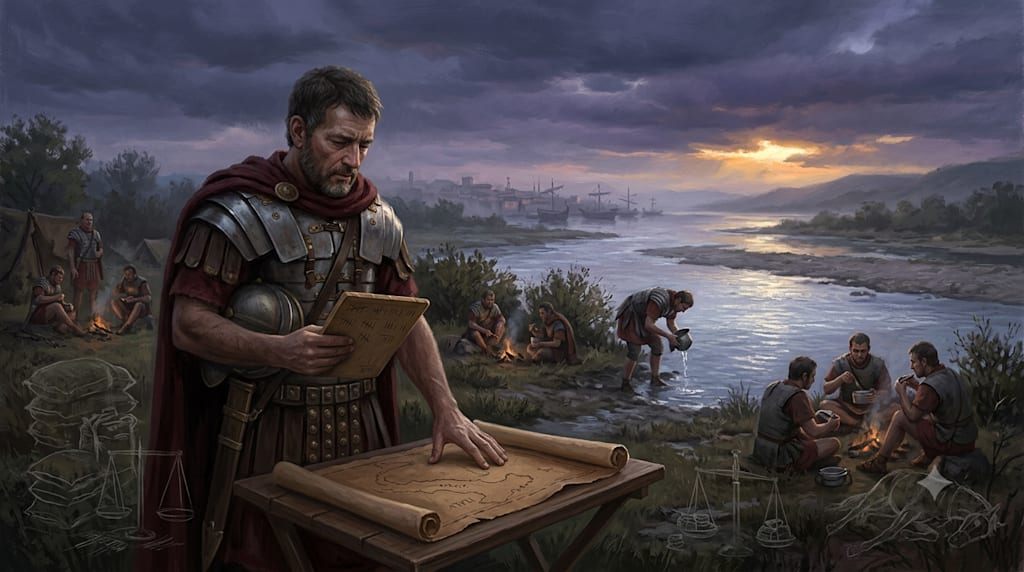
When Caesar fell from his horse, the Tenth Legion that had crossed the Rubicon with him was waiting on the other side of the river.
The horse had stepped on a stone less than three hundred paces from the bank. It was no warhorse, just the old mount he had brought back from Gaul, its left front shoe worn thin. He had spent seven days in Ravenna, and not a single person had reminded him to replace it. When he tumbled from the saddle, his helmet struck the ground and rolled away, coming to rest in a patch of grass caked with dry mud. A few centurions ran over to help him up. He waved them off, turned onto his back, and lay in the grass watching the clouds drift down from the north.
The clouds were moving fast. At this time of year, the north wind poured through the Alps and, by the time it reached the Rubicon valley, carried almost no moisture, dry and cold. He stared at those clouds, and in his mind he was studying the most precise ledger he had ever seen.
Pompey’s ledger.
Not the kind written on papyrus. The kind carved into every campaign Pompey had ever fought. Caesar had known Pompey for fourteen years, since the days when he himself was a debt-ridden aedile, and Pompey was already the most powerful man in Rome. He had watched Pompey hold council. He had watched Pompey review his troops. He had watched Pompey sit in the Senate while Cato jabbed a finger in his face, that calm expression never leaving his features. That calm was not good breeding. It was calculation. Pompey knew that Cato could rant all he wanted, but when the vote came, Cato would still have to stand with him, because Cato needed Pompey’s veterans more than he needed to fight Clodius’s street mobs. That arithmetic was not hard. What was hard was holding your tongue while being shouted at, long enough to finish the sums.
Pompey always finished the sums.
Caesar lay on the ground and began to calculate Pompey’s anchor points from scratch.
Where did Pompey repeatedly invest his time and energy? Grain. Not the legions. Not the governorships of provinces. Not the endless votes in the Senate. Grain. Fifteen years earlier, when Pompey had wiped out the Mediterranean pirates, everyone thought it was a naval campaign. In truth it was a logistics campaign. He divided the entire sea into thirteen zones, assigned a grain depot to each, and then blockaded every port simultaneously. The pirates were not defeated in battle; they were starved into surrender. A decade later, when he subdued the Kingdom of Pontus, he used the same method: choking off the Black Sea grain routes. Mithridates’ cavalry dissolved before they even reached the front lines, because their horses had gone three days without barley.
Pompey won every war of his life on the same point: he starved his opponent. What a man protects first under pressure is what he absolutely cannot afford to lose. For Pompey, that thing was not the city of Rome. It was not his seat in the Senate. It was his ability to control the grain supply. That was the source of his power. The moment someone cut those supply lines, he would no longer be Pompey the Great. He would just be a retired veteran.
Caesar kept calculating.
The part Pompey protected first under pressure had already been made clear in the political struggles of recent years. Two years ago, when the Senate demanded he surrender his military command in Spain, he surrendered it, but he clung to the grain commission with a death grip. He even allowed Caesar to keep the governorship of Gaul just to ensure the Senate would not touch his grain post. The full title of that post was long, but what it really controlled was the grain supply from Sicily, Sardinia, and Africa. Without it, any faction in the Senate could be destroyed by an opponent wielding grain prices during a famine. Pompey understood this too well. He would rather let Caesar remain governor for another year than lose control over a single sack of wheat.
That was his anchor point. And that was his inertia.
A man under pressure will only repeat the path he has already tested. The path Pompey had tested was waiting. Waiting for the enemy to starve. Waiting for mutiny to break out in their ranks. Waiting for them to make the first wrong move. He was so good at it that everyone mistook it for tactics. It was muscle memory. The problem is that muscle memory can be anticipated. When a boxer always drops his right shoulder before throwing a left hook, that left hook ceases to be a threat.
Caesar pushed himself up off the ground and brushed the dirt from his breastplate. His second-in-command, Labienus, was riding toward him from the far bank, the sound of hooves crisp as they struck the shallow water. The river was not deep. At this season the Rubicon was only a wide stream; a horse could walk across without swimming. But what crossing meant, every centurion standing on that bank understood it perfectly.
“What are you doing?” Labienus shouted.
Caesar did not answer. He was working on another ledger.
His own.
He had only one legion. The Thirteenth. Six thousand men on paper, but more than two hundred had been lost on the march back from Gaul; his effective strength was under fifty-eight hundred. Pompey had seven legions on Italian soil, two of them freshly recalled from Spain, fully manned, supply lines intact. The Senate stood with Pompey. Or, to put it more precisely, Pompey stood with the Senate. The distinction mattered. Pompey did not control the Senate. Pompey was held hostage by the men in the Senate. Cato, Scipio, Lentulus, Marcellus, these men were not allies. They were deadweight. Each of them had his own little ledger, each of them using Pompey as a shield, and after using him they complained that he hadn’t kept the shield polished enough.
Caesar had seen this dynamic before in the Senate. Cato would rise to speak and spend half an hour denouncing Caesar as a traitor, then spend the other half hinting that Pompey ought to be more aggressive. Pompey would sit in his chair, fingers drumming on the armrest, the expression on his face like a man adding figures. He knew exactly what Cato meant: You fight the war for me, but the credit still belongs to the Senate. He knew, and he still swallowed it. Because he needed the Senate’s legitimacy as much as the Senate needed his legions.
There lay his constraint.
Pompey’s authority was not measured by how many legions he commanded. It was measured by whether he kept the Senate satisfied. His fallback was not Spain. It was his reputation. He was the richest man in Rome, the greatest general, the recipient of three triumphs; he could not afford to be called a coward. That constraint weighed more than all seven of his legions combined. Seven legions could fight a battle, but the label “coward” could destroy thirty years of political capital.
Caesar understood this intimately.
Because Caesar was also a Roman. He knew how Romans judged a general: not by how many battles he won, but by how straight he stood in the face of the enemy. Pompey could lose, but Pompey could not retreat. Especially not in front of Caesar. Twenty years earlier, when they were still allies, Pompey had repeatedly made sure he was ranked first in Crassus’s eyes. After Crassus died, he needed to be ranked first in Caesar’s eyes. Now Caesar was standing at the Rubicon with a single legion, and all of Italy was watching. If Pompey retreated now, what would the graffiti poets in the Forum write? “Pompey ran.” Four words would be enough. Forty years of glory, undone by four words.
So Pompey would not retreat.
That is the flaw of the proud man. The proud man reveals his weakness when he feels he is being slighted. Pompey would not admit he was afraid of Caesar, so he would not choose the optimal solution. And what was his optimal solution? Withdraw south. Not a flight, a strategic redeployment. The Italian peninsula was not the place for a decisive battle. Pompey should take the Senate and every available legion south to Brundisium and cross the sea to Greece. In Greece he had his fleet. He had reinforcements from Spain. He had the grain of the East. Once in Greece, he could seal off the Adriatic and trap Caesar on the Italian peninsula. Caesar had no fleet. Building one would take at least a year, and long before that year was out, his supplies would be gone. By then, without a fight, Caesar would have to sue for peace.
That was the optimal solution. Pompey’s mind was more than capable of working out this calculation. He had fought for thirty years; logistics and withdrawal were his stock-in-trade. He must have run the numbers.
But he would not choose it.
Because the Senate would not let him choose it. Scipio’s house was in Rome. Cato’s family tombs were in Rome. Lentulus’s estate lay barely ten miles outside the city walls. Ask them to abandon Rome? That was asking them to admit they were betraying the altars of their ancestors. These men would stand up, point at Pompey’s chest, and say: You are Pompey the Great. You have seven legions. Caesar has one. Why are you retreating?
Pompey could ignore Caesar’s provocations, but he could not ignore the reproaches of his own side. His power rested on the Senate’s support, and the Senate’s support rested on the physical ground of the city of Rome. Leave Rome, and the Senate would cease to be the Senate. It would become a band of refugees in purple-bordered togas. At that moment, Pompey’s legitimacy would begin flaking off him like dried mud.
Caesar had worked out the arithmetic.
Pompey would not retreat. He would stay in Rome, at least long enough to prove he was no coward. And that span of time was Caesar’s only window.
How long?
Caesar’s supply lines ran back to Gaul. The harvest in Gaul had been poor that year, and the tribal chieftains were watching and waiting. He could requisition grain, but not for long. Push too hard and the tribes would revolt. His time window was two months at best. Within those two months, he had to make Pompey change his mind. Not force him to change it, but make him change it himself.
How?
Corfinium.
Pompey’s troop deployment in central Italy looked like this: two legions in the suburbs of Rome, one at Capua, two at Brundisium waiting for ships, and one scattered in garrisons along the line from Luca to Corfinium. The force stationed at Corfinium was commanded by Domitius Ahenobarbus, a textbook senatorial aristocrat. His father had been consul; he himself had run for the office and lost. A man like that did not go to war to fight. He went to accumulate political capital. His soldiers were not his soldiers; they were his campaign chips. He would not squat behind fortifications for three months. He wanted a battle that would make headlines.
A man like that was the weakest point in the entire deployment.
Caesar did not need to take Rome. He only needed to take Corfinium. Once Corfinium fell, Pompey’s ledger would have to be recalculated. Resources: available manpower reduced by a seventh. Authority: the most aggressive hawks in the Senate would fall silent, because they would finally smell real war, not just speeches in the Forum. Time window: Caesar’s marching speed was twice what they expected, which meant the risk of other strongpoints being picked off one by one shot upward. Fallback: Greece was still there. The ships were still there. The port of Brundisium was still there. The optimal solution would float back to the surface: withdraw to Greece.
When that happened, Pompey would go on his own.
Caesar did not need to push him. He only needed to make the arithmetic at Corfinium point toward that answer.
Labienus had reached him. His horse was blowing hard, Labienus’s face red from the north wind, his eyes complicated. He was an old friend of Pompey’s; the two had fought together against Sertorius in Spain and shared the same tent. But he was also Caesar’s legate, and he had fought at Caesar’s side through nine years of the Gallic campaigns. In those nine years, he had seen with his own eyes how Caesar, besieged at Alesia, had calculated the arrival time of the Germanic relief force. The margin of error had been less than two days.
“Do you intend to cross?” Labienus asked.
Caesar looked at the far bank. The soldiers of the Thirteenth Legion were sitting on the grass, eating. One man was scooping river water with his helmet. He drank, wiped his mouth, and clapped the wet helmet back onto his head. His name was Lucius. He was the youngest standard-bearer in the legion, just nineteen, from a village in Umbria. He had followed Caesar over the Alps. He had held the line in the snow at Alesia for seventeen days and lost two toes to frostbite. Now he sat there drinking water, not knowing the name of this river. All he knew was that Caesar had not yet mounted, so he had to wait.
“The die is cast,” Caesar said.
He did not explain what the words meant. Labienus took it for a slogan, and later, when he wrote his memoirs, he put the line in, describing Caesar’s expression as resolute, as though possessed by a god. But the truth was that when Caesar spoke those words, what he was thinking about was the grain-store clerk at Corfinium. The man’s name was Gaius. Caesar had planted him there during the Gallic years. Gaius’s assignment had been simple: do your job diligently, keep the books in order, do nothing to draw suspicion. Then, on the day he received his instructions, add an extra thirty sacks to the previous quarter’s wheat outbound records.
Just thirty sacks.
In the garrison granary at Corfinium, thirty sacks of wheat was no great sum. But once the tallies didn’t match, the quartermaster would begin investigating, and once the quartermaster started looking, he would uncover far more, not because Gaius had meddled, but because the quartermaster had been stealing grain all along. The quartermaster’s own books were padded; every month he inflated the spoilage reports and sold the surplus wheat to the city’s bakeries. The garrison commander, Domitius, knew nothing of this. But his deputy knew. The deputy had not been given his cut, and the resentment had been festering.
Gaius needed only to misrecord the outbound tally by thirty sacks. The quartermaster would panic. The deputy would seize the chance to inform. The soldiers would realize that the sour bread they had been eating for three months was the result of someone stealing their rations. After that, Caesar did not need to give any orders. Hungry men know what to do.
A ledger entry is not a weapon. A ledger entry is a switch.
On the thirteenth day after Caesar crossed the Rubicon, the Thirteenth Legion arrived outside the walls of Corfinium. Caesar did not assault the city. He pitched camp on a low hill to the north, had his men dig a shallow trench, and sat down to wait.
The first day, the walls were thick with defenders, their standards arrayed in perfect order. Domitius even sent men out to hurl insults, calling Caesar a traitor, swearing that the great Pompey was already on the march with seven legions to grind them into dust. Caesar listened to the translation, nodded, and told his soldiers to keep digging.
The second day, the insults grew fewer. The standards on the wall were just as many, but the men’s armor was buckled a little looser.
On the evening of the third day, the gates of Corfinium opened.
They were not battered open. They were pushed open from the inside. A knot of soldiers dragged Commander Domitius out, bound hand and foot, his purple-bordered cloak half torn away, the other half trailing in the mud. When the soldiers shoved Domitius before Caesar, Domitius was still shouting. He was not shouting at Caesar. He was shouting at his own quartermaster.
“That thief! He stole our grain!”
Caesar looked down at Domitius. Domitius’s face was flushed crimson, like a chicken held upside down. His fury was genuine. He truly believed the problem lay with the quartermaster. He had no inkling of the thirty-sack discrepancy, no thought of that quiet grain-store clerk Gaius, and certainly no suspicion that from the very beginning none of this had been an accident.
Caesar told him to stand up. He handed him back the remaining half of his cloak and said, “Go back to Rome.”
Domitius stood there, stunned. He had expected execution, or at least to be held as a hostage. Caesar not only refused to kill him; he let him go. What did that mean? In the political code of Rome, clemency signaled magnanimity, and magnanimity signaled legitimacy. Caesar was not fighting a war. Caesar was announcing to all of Italy: I am not your enemy. I did not even kill Domitius. What are you afraid of?
The news traveled faster than cavalry.
Four days after the fall of Corfinium, a courier rode his horse into the Senate chamber in Rome. The man’s tunic was caked with mud; sweat and dust were smeared across his face. In his hand he clutched a letter written on a wax tablet. The Senate was in session. Cato was standing in the center of the floor, delivering his second anti-Caesar oration of the day. He had been speaking for nearly an hour. His central argument was that Pompey should immediately march north with his full strength, block Caesar at the passes of the Apennines, and end the war in a single blow.
Pompey sat in the consul’s chair, his chin propped on his right hand, listening.
The courier handed him the wax tablet. Pompey took it, read it once. Then read it a second time.
Cato was still speaking. He said Caesar’s army had come a long way, was exhausted, its supply lines stretched too thin. All Pompey needed to do was strike decisively, and he would duplicate the glory he had won in Spain wiping out Sertorius. He drew out the word “glory,” and some senator pounded the bench in approval.
Pompey set the tablet on his knee and waited for Cato to finish.
At last Cato concluded. He stood there breathing hard, looking at Pompey, waiting for his response. The whole chamber fell silent.
Pompey rose. He handed the wax tablet to Scipio, who was seated beside him, and said a single sentence. His voice was not loud, but every man in the hall heard it.
“Corfinium has gone over to the enemy.”
There were two beats of silence. Then the chamber erupted like boiling water thrown into cold oil. Everyone began talking at once; no one listened to anyone else. Someone sprang up shouting that they must levy troops immediately. Someone else was demanding to know whether Domitius was a traitor. Others were calculating how many days’ march Caesar’s forces now stood from Rome; the distance was easy enough to compute. The road from Corfinium to Rome, on a fast horse, took two and a half days.
Cato’s face went white. Just for a moment. Then he recovered that trademark stubborn expression, chin slightly lifted, lips pressed thin. But he said nothing. He sat back down and gathered his toga about him.
Pompey looked at each man in the room. Scipio was trembling, from anger or fear, it was impossible to tell. Lentulus was dabbing the sweat from his forehead with a corner of his toga; he wiped, and it ran again. Marcellus was staring fixedly at the mosaic pattern on the floor as if the solution was written there.
Pompey knew he had been handed his moment.
Before Cato had stood up, Pompey could not even pronounce the word “withdrawal.” To utter it would be cowardice. To utter it would be admitting he was lesser than Caesar. But now he did not need to utter it. Corfinium had uttered it for him. The fall of that city was a signal too clear to ignore: Caesar’s speed was nothing like what they had imagined, and Caesar’s tactics were nothing like what they had imagined. This war could not be fought in Italy. Not that it couldn’t be won, but winning in Italy was still losing. The grain would be burned. The cities would be besieged. The common people in the Roman Forum would batter down the Senate doors when hunger came. Pompey had fought for thirty years, and he knew one truth better than anyone: hunger does not distinguish between patrician and plebeian.
“We need to go to Greece,” Pompey said.
This time, nobody objected.
Not because he had persuaded them. But because they had finally begun to run their own calculations. Cato’s calculation: if he stayed in Rome and Caesar advanced, his estates and farmland (all of it in Tuscany) would lie directly in the line of march. Lentulus’s calculation: he owed six million sesterces in debts; if war broke out, his creditors would surely use the chaos to squeeze him. Scipio’s calculation: Pompey’s fleet was at Brundisium. Once they reached Greece, they could use that fleet to blockade Italy and starve Caesar on the peninsula. Then he, Scipio, could return to Rome as a victor and stand for consul the following year. Every man was calculating, and every man’s calculation pointed the optimal solution toward the same direction: Greece.
Pompey did not persuade them. Pompey simply let them persuade themselves.
When Pompey left the Senate that day, his expression was calm. He rose from his chair, fastened his cloak, and walked across the mosaic floor at the center of the hall. That floor depicted Romulus killing Remus, brother murdering brother, the founding myth of Rome. His boots passed over Remus’s face; his stride was steady. He did not look back at anyone.
Outside the Curia, his horse was waiting. It was a pure-black Spanish stallion, mane combed neat, bronze studs set into the saddle. Pompey swung into the saddle with a clean motion that did not belong to a man nearing sixty. His staff officers mounted behind him, and the hooves clattered on the stone pavement in a broken rhythm.
The road south was long. From Rome to Brundisium, by the Appian Way, the distance was roughly three hundred and sixty Roman miles. A normal march would take twelve days. Pompey’s column stretched long: cavalry at the van, Pompey himself and a handful of close aides in the middle, and behind them a baggage train half a street long. The carts carried more ledgers than weapons: provincial tax records, grain requisition lists, resettlement rosters for discharged veterans. To anyone else, they were waste paper. To Pompey, they were the skeleton of power. He would not burn them any more than a swordsman would break his own blade.
On the march, passing Capua, a centurion from the garrison ran out and caught his bridle. The centurion was in his forties, hair cropped short, a scar running across his left cheek. He stood there holding the rein, looking up at Pompey.
“General, when do we come back?”
Pompey looked down at him. He had seen that face many times, in Spain, in Greece, in Pontus. He could not remember the name, but he remembered the scar. An arrow wound, from the pirate campaigns.
“Soon,” Pompey said.
The centurion released the rein, stepped back, and saluted. His eyes never left Pompey’s face, as if he was searching for some familiar expression. Pompey returned the salute, nudged his horse’s belly, and rode on.
From the saddle, he never once turned his head. He rode at the very front, back held perfectly straight, his cloak billowing and collapsing in the wind. In the distance the Apennines were a gray smear; the snow line had not yet fully receded, like a dirty white cloth. The fields on either side of the road were harvested wheatland. At this season nothing remained but dry stalks jutting crookedly from the earth.
What he did not know was that from the moment the grain ledgers went wrong at Corfinium, every decision he would make had already been anticipated.
Gaius, the grain-store clerk, left Corfinium after his task was complete. He traveled north for two days and met Caesar’s advance cavalry at Ariminum. He handed over the granary transfer documents. Caesar’s adjutant took them, glanced at them, asked no questions, and paid him three hundred denarii. Gaius took the money, counted it, tucked it into his tunic, and asked, “Does the general require anything else?” The adjutant shook his head. Gaius left. He went home to his village in Umbria, bought a plot of land, and planted olives. To the day he died, he never knew what his act had to do with the Rubicon, with Greece, with Pharsalus. All he knew was that someone had paid him three hundred denarii to misrecord thirty sacks of wheat. He thought it a fair price.
Caesar stayed outside Corfinium for two more days. After he released Domitius, he also freed every captured senator, down to the last man. Someone urged him to at least hold Cato’s son-in-law as a hostage. Caesar smiled and said hostages were useless. Let them go.
Let them go.
Because Caesar had calculated this clearly. He was not after prisoners. He was after information. Every freed captive who returned to Rome carried the same signal: Caesar had not come to slaughter the nobility. Caesar had come to restore order. That signal would reach Pompey’s ears. It would reach the ears of the Italian towns that were still watching and waiting. It would reach the ears of the moneylenders, the grain merchants, the discharged veterans. They would recalculate. They would discover that standing with Caesar was not, after all, impossible.
And Pompey, marching south with the Senate and the baggage train, was being devoured by his own ledger.
Three hundred and sixty Roman miles. After seven days of marching, the column began running short of food. Not because they had failed to bring enough, but because the organization had collapsed. The senators had brought too much baggage. Scipio alone traveled with six mule-carts, loaded not with grain but with furniture: his bronze bathtub, his ivory dining table, his two cabinets of Greek manuscripts. Lentulus brought three cooks and a full set of banquet silver, insisting that wherever he went, he must maintain the dignity of a consular. Their baggage devoured the cargo space meant for supplies. By the eighth day, the slaves attached to the column were going hungry. Hungry slaves stole. Thieving slaves were flogged. Flogged slaves ran. When they fled to the nearby villages, the villagers asked: What are you running from? And the slaves answered: Pompey’s army cannot even feed its own slaves. Who do you expect them to protect?
The words traveled to Capua, to Rome, to Ariminum, to Caesar’s ears.
Caesar heard the news while eating supper at his temporary headquarters in Ariminum. The supper was plain: wheat porridge and a piece of roast pork, no wine. His secretary handed him a roll of papyrus compiling the intelligence from every quarter. He chewed a mouthful of pork as he read. When he reached the passage about the slaves deserting Pompey’s column, he set down his spoon and read that line again.
Then he stood up, walked to the map of Italy on the wall, and traced the Appian Way with his finger from Rome to Brundisium. His finger paused at Capua, then continued to the port of Brundisium.
He tapped twice on that little dot.
“He will board the ships.”
Twelve days after he said those words, Pompey stepped onto a transport vessel moored in the harbor of Brundisium. It was a large trireme, its hull painted with blue waterproof sealant, its deck piled with chests of supplies not yet stowed. Pompey stood at the rail, one hand gripping a stay line, the other holding the corner of his cloak to keep the sea wind from whipping it into the water. Below deck, the oarsmen were already at their stations. The overseer’s mallet struck three times, and the blades plunged into the sea with a single splash.
The waterfront was packed with soldiers and civilians who had not yet boarded. Some were weeping. Some were shouting. Some stretched out their arms, trying to hand up small children, but the rail was too high. Pompey’s officers stood on the gangplanks trying to keep order, but they could not hold for long; hundreds more people were still pouring out of the town. Brundisium was a small harbor; at most it could berth thirty ships, and Pompey’s fleet, racing over from Greece, had brought only sixty in the first wave. There was not room for everyone.
Pompey stood at the rail and watched the crowd on the dock grow smaller. He spotted a centurion at the very end of a pier, holding the legion’s standard aloft and shouting something toward the ship. The sea wind was too loud; the words could not be heard.
The ship moved.
The oars beat with a steady, heavy rhythm. Once. Twice. Three times. The hull slid slowly out of the harbor; the lighthouse on the breakwater drew closer. Pompey turned and faced the direction of Greece. Behind him the Italian peninsula was shrinking into a gray line.
He did not know if he would ever return. He did not know that when he next touched Italian soil, he would be lying on a stretcher, carried off a small Egyptian boat.
But he knew one thing.
He knew he was heading to Greece because that was the optimal solution he had calculated. He was right. Greece was indeed the optimal solution. The problem was not a miscalculation. The problem was the premise on which he made the calculation: the premise that he still controlled his own time window. What he did not know was that Caesar’s entire plan had never been to keep him from Greece. Caesar planned to let him go to Greece, but at a moment of Caesar’s choosing.
On the day Pompey sailed from Italy, Caesar was standing in the square of Corfinium addressing the soldiers of the Thirteenth Legion. The sun was hot; the men’s helmets were baking to the touch. Caesar stood on a raised stone slab, his voice not loud, but every man could hear.
“Pompey has gone to Greece. He thinks we cannot follow him. And we will not follow him.”
The soldiers looked at one another.
“We go to Rome.”
The soldiers paused, then roared. They were not cheering for Rome; most of them had never even seen the city. They were cheering because they would not have to board ships. The Gallic troops dreaded ships; the storm in the English Channel had frightened them badly enough.
Caesar did not deceive them. He truly went to Rome. He marched into the city with a single legion. The senators who had not fled sat trembling in their seats, waiting for a blade to be set against their throats. When Caesar walked into the Senate chamber, he carried no weapon. He was not even wearing a military tunic. He wore the white toga of a senator, the purple border a little faded.
He stood for a moment at Cato’s place, ran his fingers over the armrest of that chair, then turned and said to the assembly:
“I do not want your lives. I want the key to the treasury.”
The treasury held thirteen million sesterces that Pompey had not had time to take. Caesar seized the money and poured every last coin into his war chest. He kept none of it for himself. Even his tavern debts in Ravenna were later paid off by his wife.
Five months later, Pompey had assembled eleven legions in Greece. He made a famous remark: “I have only to stamp my foot, and Italy will shake.” He spread his fleet across the Adriatic and bottled up Caesar’s transports inside the harbor of Brundisium. His ledger was whole again: he had grain, he had men, he had ships, he had time. He calculated and recalculated. Every number told him he would win.
Caesar remained trapped at Brundisium for an entire winter. His supplies were failing; dysentery was spreading through the legions. Every day the centurions came to ask when they could put to sea. Every day he said soon. He explained nothing. He simply waited for the storm season to end and for Pompey’s fleet to grow slack.
Then, on a night no one had predicted, he loaded half his army onto transports and crossed the Adriatic in a force-seven gale. When he landed at Palaeste and descended the ladder, his foot touched the sand of Greece, and his knee buckled, nearly dropping him. He straightened up, brushed the sand from his knee, and said to the centurion beside him:
“He knows I am coming. But he does not know I am coming now.”
Pompey indeed did not know.
Pompey was in his winter camp in the Candavian Mountains when the news of Caesar’s landing reached him. He was eating dinner. He put down his spoon, read the wax tablet three times, then rose and walked to the map. His finger touched the spot at Palaeste, then traced the valley toward Dyrrachium, and stopped.
He was calculating.
He was calculating Caesar’s supply lines. Caesar had no granaries in Greece, no allies, no port. He had thrust himself deep into enemy territory with the sea at his back, mountains ahead, and Pompey’s allies on both flanks. Pompey needed only to defend, as he had done for thirty years. Hold the grain routes. Hold the harbors. Let Caesar starve.
Every step of his calculation was correct.
But Caesar did not need him to miscalculate. Caesar only needed him to overlook one variable during his arithmetic: his own pride. When Pompey broke Caesar’s first siege lines at Dyrrachium, his troops had cheered wildly, falling to their knees and hailing him as “Pompey the Great.” Labienus, the same man who had asked Caesar at the Rubicon, “Do you intend to cross?” and who was now serving in Pompey’s camp, leapt onto his saddle and shouted to the whole army: “Caesar’s legions are finished! They’re running! Look at the faces of those fugitives!”
Pompey stood on the ridge and watched Caesar’s scattered troops falling back. A smile crossed his face.
He should have pursued.
He should have thrown his entire force onto Caesar’s shaken ranks before they could regroup, and driven the remnants into the sea. His cavalry commander had already drawn his sword; the warhorses were pawing the earth. Everyone was waiting for his order.
Pompey hesitated.
Only for a moment. But on a battlefield, a moment is enough.
It was not because he feared an ambush. It was because he did not want Labienus, Caesar’s former lieutenant, to steal the credit. If the pursuit succeeded, men would say: Look, it was Labienus who charged and broke Caesar. They would not say Pompey won. Pompey had fought for thirty years, celebrated three triumphs, and he would not permit anyone else to become the hero of his campaign. And that hero would not be him.
So he did not pursue.
He said, “Today is a day of victory. Let the men rest.”
Caesar retreated with his battered army to the plain of Pharsalus. He counted heads as he marched. He had lost fewer than a thousand dead, but many had fallen out along the way. By the time he reached Pharsalus, his army numbered roughly twenty-two thousand. Pompey had forty-seven thousand.
That night Caesar could not sleep. He sat outside his tent and scratched three circles into the earth with a stick. The first circle represented Pompey’s cavalry. The second, Pompey’s infantry. The third, Pompey’s reserves. He stared at the three circles for a long time. Then he crossed out the first circle and drew a single vertical line beside it.
That line was the only reserve he himself could deploy. Two thousand men, drawn from the veteran Gallic cohorts; every one of them had fought under him for at least five years. He knew who commanded Pompey’s cavalry. It was Labienus. Labienus would use the tactic Caesar himself had taught: mass all cavalry on the right wing, tear a breach, and let the infantry follow through. That was the standard maneuver Caesar had used in Gaul for nine years. Labienus would not change it, because it was the path he had tested. A man under pressure repeats the path he has tested. Labienus’s pressure was this: he had betrayed Caesar, so he had to prove he could beat Caesar at Caesar’s own battle.
Caesar finished his arithmetic.
The next day, at the Battle of Pharsalus, Pompey’s cavalry surged forward on the right wing exactly as predicted: seven thousand horsemen against one thousand. They came on like a moving wall. Caesar’s cavalry feigned retreat. As they fell back behind the infantry lines, the two thousand veterans who had been crouching in the tall grain stood up and locked their spears into a hedge. They did not stab the riders. They stabbed the horses. A horse’s face is its most vulnerable point. One thrust and the horse went down. A downed horse turned a cavalryman into an infantryman, lying in the dirt in forty pounds of armor, unable even to roll over.
The cavalry broke.
The moment Pompey saw his cavalry disintegrate from the rear, he rose from his chair. His body went rigid for an instant. Then he turned to the guards beside him and said a single sentence. No one heard what he said; the battlefield was too loud. But a Greek clerk who could read lips caught the words and remembered them. The words were: “How did this happen?”
How did this happen.
Because Caesar had not guessed what Pompey was thinking. Caesar had calculated the structure of Pompey’s interests. Pompey’s cavalry was his greatest strength, so he was certain to use it. Caesar’s cavalry was his greatest weakness, so Pompey would never expect Caesar to double down on that weakness. That was Pompey’s inertia. That was Labienus’s inertia. That was the inertia of the entire Roman military tradition. All Caesar had done was place a variable they had not accounted for into the spot where they calculated the optimal solution.
After the cavalry collapsed, Pompey did not order his infantry forward. He stood and watched his left wing being torn open strip by strip, watched the Gallic veterans using their entrenching spades to cave in the helmets of his horsemen, watched his allied infantry starting to run. Then he did something no one expected.
He turned and walked back into his tent.
He stripped off his general’s cloak, put on civilian clothes, mounted an unsaddled horse, and fled toward the coast. He rode fast; the hooves raised a chain of dry dust across the plain. No one pursued him. His own soldiers had not yet realized their commander was gone.
He reached Larisa, and from Larisa took ship to Egypt. On the Egyptian beach, he stepped off the boat and missed his footing, one foot sinking into the sand. When he pulled it out, his shoe came off. He bent down to retrieve it, and a Roman centurion who had deserted to the Egyptians stabbed him from behind.
He died face down on the sand, the hand that had reached for his shoe still stretched out in mid-air.
His blood soaked into the dry sand and was soon baked by the sun into a hard brown crust. The Egyptians hauled his body away, cut off his head, preserved it in salt, and packed it in a box to send to Caesar.
Caesar received that box in Alexandria, in Egypt. He opened it, looked inside, then closed the lid, stood, and walked to the window.
The afternoon sunlight was beautiful; the blue of the Mediterranean stung the eyes. Caesar stood there in silence for a long time. Then he turned to his secretary and said a single sentence.
“Burn all of Pompey’s letters. I do not need to know who his friends were.”
He said nothing more.
He did not need to. From the Rubicon to Pharsalus, he had not once guessed what Pompey was thinking. He had simply stood in Pompey’s place, seen clearly the chips Pompey held and the things he was trying to protect, and then calculated his optimal move. Every step Pompey took had been correct, inside his own ledger. But the boundaries of that ledger had never been the same as Caesar’s boundaries.
Pompey calculated the battlefield. Caesar calculated the man doing the calculating.
About the Creator
Jin
Writer of reamstories
https://reamstories.com/jin
Enjoyed the story? Support the Creator.
Subscribe for free to receive all their stories in your feed. You could also become a paid subscriber, letting them know you appreciate their work.
Comments
There are no comments for this story
Be the first to respond and start the conversation.