
The General Who Killed the Envoy — And Won the War Without a Siege
Everyone told Marcus Lucullus it was the stupidest thing he could do. They were wrong.
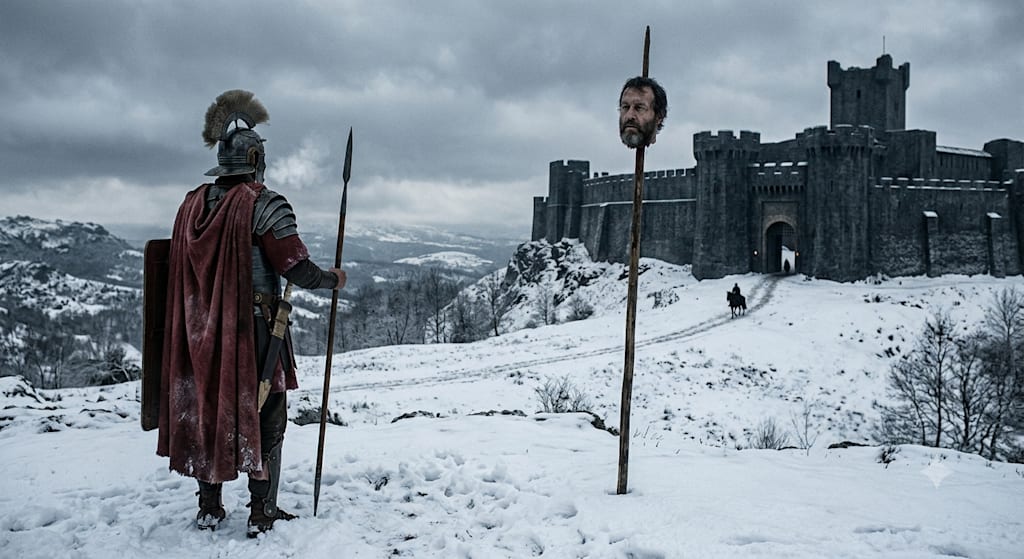
Marcus Lucullus wiped his dagger clean and slid it back into the leather sheath at his belt.
Outside the tent, his second-in-command Quintus had paced back and forth six times already. His boots beat an agitated rhythm into the frozen earth, each step saying the same thing: You've lost your mind.
"Let him in," Marcus said.
Quintus swept the tent flap aside. A gust of cold wind, laced with grains of snow, rushed in. "General, I must counsel you once more—"
"You're not here to counsel me." Marcus watched the pale light slowly bleaching the sky beyond the tent. "You're here to tell me what I've just done that I shouldn't have done."
"You cut off Severus's head."
"He was the rebels' envoy."
"That is precisely the problem." Quintus's voice dropped low, as if skirting the edges of a forbidden word. "Severus was the man Octavius leaned on most. For twenty years the old fox never left his fortress — but Severus came out to negotiate for him. You killed his negotiator."
Marcus did not answer. He rose, walked to the tent entrance, and gazed at the grey-white wall in the distance. Vellata Castle. It had coiled there on that ridge for six years now. Six years ago, when Octavius first raised his banner of rebellion in that place, the Empire had sent three commanders to crush him. The first lost two thousand men beneath those walls and was recalled to the Senate for questioning. The second besieged the castle for eight months, ran out of provisions, and abandoned every piece of baggage during the retreat. The third attempted to negotiate and signed a truce neither side intended to keep.
Marcus was the fourth.
His forces were no larger than his predecessors'. His supply lines were just as long and just as vulnerable. Inside the city were eight thousand defenders, sufficient crossbow bolts to last another year, and walls carved from the granite of Mount Vellata — a battering ram would merely bounce off them.
"Do you know why your predecessors failed?" Marcus asked.
Quintus waited for him to answer his own question.
"Because all of them fought a city." Marcus turned around, his eyes very pale in the morning light. "I'm not. I'm fighting a man."
Severus's body still lay on the snow outside the camp gate.
Marcus ordered his head mounted on a pole, facing the walls of Vellata. This was a signal, not a threat. A threat is for the undecided. A signal is for those who know how to read it.
The deputy was sent back. Marcus gave him a message to carry.
"Tell Octavius — I'm in no hurry to take his head. But his brain is already gone."
In the great hall of Vellata Castle, Octavius stared at the trembling deputy and listened to his fragmented report.
"...That is all, my lord. He gave the order right in front of us. Lord Severus hadn't even finished speaking—"
"What did he say?" Octavius's voice was very quiet. "What were Severus's last words?"
The deputy swallowed. "He said..." He mimicked Severus's manner, chin tilting slightly upward. "'Your legions can barely march the mountain roads of Vellata. What right do you have to demand my master yield a city his grandfather built—'" He stopped.
"And then?"
"And then their general drew his blade."
Octavius was silent for a long time.
He knew Severus's style. Arrogant. Hard. Never yielding an inch at the negotiating table. That was Severus's value — he could say for Octavius the things Octavius could not say, strike the poses Octavius could not strike, make the other side lose their nerve first. It was strategy. It had always been strategy.
But this time, the other side had not engaged the strategy.
The other side had beheaded the strategy itself.
A strange emotion began to rise through Octavius's body. It was not anger. Anger is hot. This was cold. It sat in his stomach like a swallowed stone, then began seeping outward into his limbs.
He looked at the commanders ranged along both sides of the hall. They were all waiting for his orders. On some faces: fury. On others: fear. Some were exchanging glances.
Severus was gone.
For six years, at every war council, Severus had sat at his right hand. For six years, at every analysis of enemy movement, Severus had been the first to deliver a judgment. At every crisis point of every siege, Severus had found a way to calm everyone down. The walls were very strong, but walls do not think. The crossbows were plentiful, but crossbows do not make decisions.
For six years, Octavius now realised for the first time: he had never faced a single campaign alone.
This Marcus Lucullus — he had seen it. He was not besieging the city. He was besieging a single man inside the city. And that man, at this moment, lay in the snow outside the camp gate.
"Ready my horse," Octavius said.
Even his own voice sounded foreign to him.
"Ask me why," Marcus said.
Quintus stood beside him, watching the gates of Vellata City slowly swing open.
A solitary horse emerged through the gap and walked slowly across the snow. The rider had brought no retinue and carried no banner.
"He's not coming to fight," Marcus said.
"How do you know?"
"If he still wanted to fight, he would have sent men around to strike our supply lines by now. Severus would have done that while he was alive." Marcus tucked both hands into his cloak. His breath misted white and was quickly torn away by the wind. "But Severus is dead."
The horse drew closer. The rider was wrapped in a dark cloak, the hood concealing most of his face. But as he approached, Marcus saw his hands — the knuckles on the reins were bone-white, like a drowning man clutching his last piece of driftwood.
"Severus was his entire language," Marcus said, his voice flat as if stating the weather. "He could speak hard words because Severus organised the hard words for him. He could strike a hard posture because Severus told him hardness would win. He had every move thought out, because Severus showed him how to move. Now the board is still there. The pieces are still there. But his player is gone."
Octavius dismounted at the camp gate.
He looked around. His gaze rested for a single moment on the pole that held the head, then moved on.
"I want to see your commander," he said.
His voice shook. Not from fear — but because he had never said those words before. In six years, he had never needed to say those words to anyone.
At the victory feast, Quintus raised his wine cup and finally asked the question everyone had been holding in all day.
"How did you know that killing the envoy would make him surrender? Everyone told me it couldn't be done. The centurions in the ranks, the clerks attached to the army, the observers sent by the Senate—" He pointed at himself. "Even me. We all said killing the envoy was the stupidest thing you could do. It would make the other side fight to the death."
Marcus picked up a piece of bread, tore it in two, and did not eat it right away.
"What you feared was his city," he said. "His walls, his eight thousand soldiers, his stockpiles of grain and crossbow bolts. Those things looked very strong. So you thought provoking him was unwise."
"Aren't they strong?"
"They are tools. Tools do not make decisions." Marcus put the bread into his mouth and chewed twice. "Severus made the decisions. Severus told Octavius when to fight and when to talk, what expression to wear at the negotiating table, whether to raise the stakes when the other side backed down. The walls were Octavius's armour. Severus was his skeleton. Remove a man's skeleton, and the armour collapses by itself."
Quintus set down his cup. "So when Severus was so arrogant during the negotiations—"
"It wasn't because Octavius wanted to fight." Marcus caught the thread. "It was because Severus wanted to fight. He was simply using Octavius's mouth to say it. Killing Severus wasn't killing an envoy. It was severing Octavius's decision-making nerve."
"When did you first see it?"
"From the first letter," Marcus said. "Six months ago, Octavius rejected the Senate's offer of amnesty. The reply was professionally worded — it cited legal statutes, laid out a comparison of military strength, and left a narrow opening for further negotiation. That letter was not written by Octavius. A man who has holed up in a castle for six years and never leaves cannot produce a text that advances and retreats with that much calculation. Someone was writing for him. Someone was thinking for him."
Quintus was quiet for a moment.
"So when he surrendered," he said slowly, "it wasn't fear overcoming courage."
"It was a void overcoming will," Marcus said. "He didn't surrender because he was afraid. He surrendered because he no longer knew how. Didn't know what the next step should be. Didn't know whether to harden his stance or compromise. Didn't know which of his own judgments to trust. For six years, Severus filtered the world for him. Suddenly, that world smashed directly into his face."
The wind outside the tent had died. The rebel banner atop Vellata City had, at some point, been lowered.
Marcus stood, walked to the tent entrance, and looked out at the city that was no longer a threat, now just a shape in the night.
"Take away the one person a man cannot afford to lose," he said, "and you do more damage than taking away a city. The city is what he uses to frighten you. The brain is what he uses to stay alive. You were afraid of his city — so you lost. I cut out his brain — so I won."
He turned and faced the now-silent commanders inside the tent.
"This has nothing to do with military manuals. Go looking for this in a manual — you won't find it. Military manuals teach you how to besiege a city. I'm teaching you how to read a man."
What Marcus Actually Did
Marcus didn’t beat Octavius by breaking his walls. He broke the one person who made decisions for him.
Quintus and the other officers looked at the fortress, the garrison, the stockpiles, and asked, “How do we survive this?” Marcus asked, “Who thinks for them?” The answer was Severus. Severus wasn’t just an envoy; he was Octavius’s external brain. He wrote the letters, set the negotiating tone, chose when to escalate and when to pause. Octavius supplied the face; Severus supplied the moves.
Killing Severus didn’t frighten Octavius into surrender. It left him without the machinery to decide anything else. For six years, every crisis had been filtered through one man. When that filter vanished, the remaining options — fight, talk, wait — sat in front of Octavius undigested. He had never chosen alone. Paralysis set in. Surrender was the only automatic next step, not a choice.
This pattern shows up far beyond battlefields. Hardline postures often look like personal strength, but they’re usually maintained by a specific support structure. Remove the structure, and the hardness collapses, not because the person is weak, but because the posture was never self‑supplied. The Iranian Quds Force after Soleimani’s death is a recent example: the operational network didn’t vanish, but the central node that coordinated it did, and the expected retaliation never came at the same scale. The power wasn’t in the weapons; it was in the brain that directed them.
The mistake Quintus made is common. He saw the city’s walls and called them strength. But those walls were a display built to provoke exactly that fear. Fear kept the besiegers cautious, and caution fed Octavius’s supply lines of hesitation. Marcus sidestepped the display entirely. He read the structure beneath it, found the single point of failure, and removed it. The city fell without a siege.
The lesson isn’t that you should kill negotiators. It’s that overwhelming advantages on paper often rest on a much smaller, breakable core. Find that core, and you don’t need to fight the rest.
About the Creator
Jin
Writer of reamstories
https://reamstories.com/jin
Enjoyed the story? Support the Creator.
Subscribe for free to receive all their stories in your feed. You could also become a paid subscriber, letting them know you appreciate their work.
Comments
There are no comments for this story
Be the first to respond and start the conversation.