
The Funicular That Had Everyone Laughing
Except One Daughter

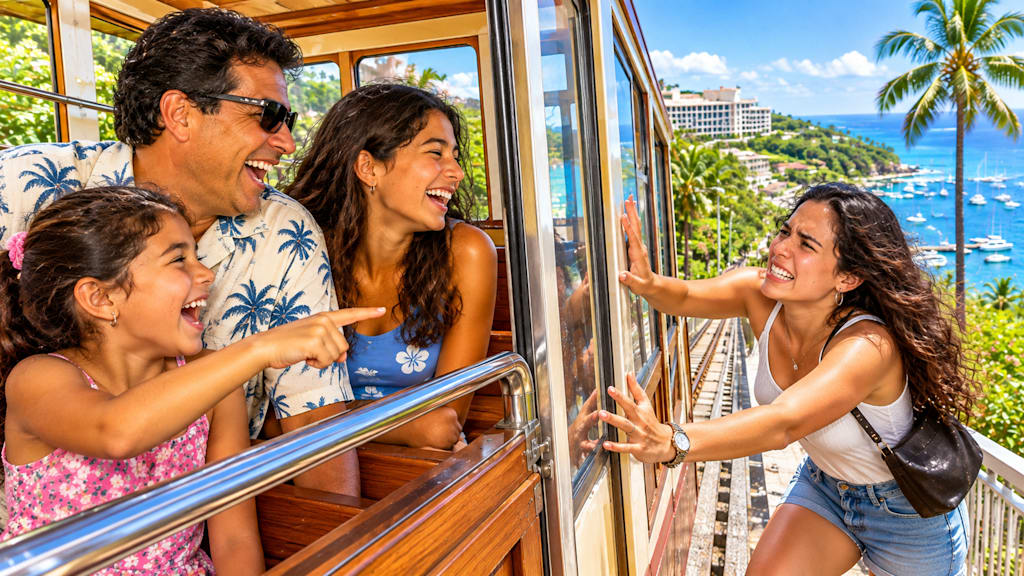
Some family memories become more entertaining with age. Not necessarily because anything exceptional happened, but because the people who were there have somehow managed to remember the same event in three entirely different ways. In our family, one such memory involves a hotel in Puerto Rico, a slow-moving train, three hungry daughters, an increasingly impatient crowd, and one daughter who arrived at the wrong place at precisely the wrong time.
I remember the incident perfectly. My two youngest daughters, Mary and Catherine, remember it almost as well. My oldest daughter, Patty, remembers it too, though I sometimes wonder whether she would prefer the entire event to be erased from our family history.
The year was 2000. I was 43, working as the bank's Chief Global Economist. I had been invited to deliver an Economic and Investment Outlook presentation at the El Conquistador Resort in Fajardo, Puerto Rico. It included a complimentary stay in a hotel room I could share with my family! It couldn’t get any better, or so I thought. The bank had rewarded some of its highest-performing employees, who had achieved record sales of mutual funds and other investments for their clients, with a complimentary trip to this beautiful resort. Apparently, selling investments successfully came with certain privileges, and listening to an economist discuss the global economy was one of them, LOL!
I decided to bring my three daughters along. Patty was 23, Catherine was 13, and Mary was just 8. It was a wonderful opportunity to spend time together in Puerto Rico, where my mother was born and where the sunshine, scenery, and food were far more appealing than anything I could offer them in an economic forecast.
El Conquistador was an extraordinary place. Perched about 300 feet above the Fajardo coastline, about an hour and a half east of San Juan, the resort opened in 1962. It was practically a destination unto itself. But it had one unusual feature that would eventually become the centerpiece of our family story.
Because the main hotel was situated high above the marina, guests needed transportation to get between the two levels. The solution was a funicular, a cable-operated railway with two cars that counterbalanced each other as they traveled up and down a steep incline. The resort's funiculars had originally come from Switzerland. It was a charming, somewhat old-fashioned, and considerably less efficient mode of transport than anyone would have liked, especially when hundreds of hotel guests were always waiting to use it.
Think of a single miniature train with only two carts that runs on its own schedule, shows no concern for your lunch reservations, and can turn an otherwise pleasant afternoon into a test of human patience.
That was our funicular.
On this sunny afternoon, my two youngest daughters and I had been spending time on one side of the resort and wanted to get to the other side for lunch and some additional activities. We made our way to the funicular station and joined the crowd waiting to board.
Patty, meanwhile, was somewhere near the hotel's outskirts. At 23, she was considerably more independent than her younger sisters. She knew we would eventually take the funicular, but she wasn't particularly concerned about joining us. After all, only one train was operating, and she assumed that if she missed it, she could catch the next one.
After what felt like an eternity, the funicular finally arrived. My two youngest daughters and I boarded, delighted that our wait was over. We were hungry and excited, already discussing what we'd eat. The three of us laughed and made enough noise to suggest we were either celebrating a family reunion or had just won the lottery.
Unfortunately, our celebration was premature.
Just as the funicular was preparing to close its doors and depart, another guest appeared and tried to squeeze aboard. The doors reopened. Everyone waited. Then another person arrived and tried the same thing.
This happened again.
And again.
After the fourth interruption, the passengers inside the funicular were beginning to lose their patience. We had already waited a long time for the train to arrive. Now, having finally boarded, we were subjected to what felt like an endless stream of last-minute arrivals who believed the entire transportation system should revolve around their personal schedules.
Every time the doors began to close, someone would appear with a hand, an arm, a leg, or whatever body part was available to be inserted to prevent the departure.
The passengers were getting restless. Some were visibly irritated.
Finally, after about five to seven minutes of interruptions, it seemed we were actually going to leave.
The doors began closing.
The crowd relaxed.
The passengers exhaled.
And then it happened.
From somewhere outside the funicular, everyone heard a voice.
Someone shouted Patty's name. It was my two youngest daughters, screaming her name and laughing at the same time.
Patty suddenly realized that her dad and two sisters were inside the funicular. Until that moment, she had apparently assumed we were still somewhere around the hotel, enjoying ourselves and waiting for the next train. Now she realized this might be her last chance to join us.
She immediately started running toward the train.
I can only imagine what she was thinking. Perhaps she was calculating how long it would take to catch the next funicular. Perhaps she was worried about missing lunch. Or perhaps she wanted to be with her family.
Whatever the reason, she arrived just as the doors were closing.
And she did what any determined 23-year-old daughter might do.
She stuck her hand into the closing doors to force them open.
Now, remember the circumstances. These passengers had already endured multiple interruptions. They had waited patiently, or at least as patiently as hungry people can, while one person after another kept the train from departing.
And now, just when they thought their ordeal was finally over, another person had arrived to interrupt the departure.
The reaction was extraordinary.
A collective gasp swept through the passengers. Several people began waving their hands, essentially pleading with Patty to stop. Others looked as though they were witnessing a natural disaster.
Then came the sound that I will never forget.
One gentleman, apparently speaking for every frustrated passenger on board, let out an enormous, dramatic, almost operatic:
"NOOOOOOOOO!"
It wasn't an ordinary no. It was the kind of no that deserves its own place in the history of public transportation. It was loud and emphatic, carrying the emotional weight of someone who had just learned that his flight had been canceled after waiting at the airport for eight hours.
I honestly don't know whether he was more upset about the delay or the possibility that he might never get out of that funicular.
Meanwhile, my two youngest daughters were laughing uncontrollably!
Mary and Catherine laughed so hard they could barely catch their breath. Their laughter was not directed at Patty. They were reacting to the entire absurdity of the situation: the frustrated passengers, the dramatic protestations, the man screaming NOOOOO, and their oldest sister arriving like a determined emergency rescue team just as the train was about to depart.
Patty, however, was experiencing a very different reality.
She stood outside the train, trying to open the doors, while a collection of increasingly irritated strangers waved her away and begged her to stop.
And now her own sisters, rather than offering encouragement or assistance, were laughing loudly.
Eventually, Patty gave up. She stepped away from the doors, the funicular finally departed, and the passengers were spared another delay.
At least that is how I remember it.
And that is where the story becomes particularly interesting.
You see, Patty remembers this event completely differently.
Her version begins when she arrives at the funicular and sees her father and sisters inside. She remembers trying to board, only to be confronted by a crowd of irritated passengers who seemed to treat her as if she were trying to hijack public transportation.
She remembers the protests. She remembers people waving their arms. Most importantly, she remembers her two younger sisters laughing hysterically as she desperately tries to open the doors.
In Patty's version, the joke was clearly on her.
She had simply been trying to catch up with her family, yet somehow she became the villain in a transportation crisis.
What she doesn't seem to remember, or perhaps never knew, was everything that happened before her arrival.
She wasn't there for the previous four interruptions. She hadn't endured the long wait. She hadn't watched passengers repeatedly settle into their seats only to see someone else appear and prevent the departure. She hadn't witnessed the growing frustration inside that little train.
She arrived at the grand finale without seeing the first four acts.
From her perspective, she was simply a daughter trying to rejoin her family. From the passengers' perspective, she was apparently the fifth and final obstacle standing between them and freedom.
From Mary and Catherine's perspective, the whole thing was comedy gold.
Another interesting difference in our recollections. I remember Patty arriving in a desperate last-minute sprint, while she seems to remember herself as simply trying to board a train that was still boarding. I remember the crowd's reaction as justified frustration after several delays. She remembers being treated as though she had committed an unforgivable offense.
And I remember her sisters laughing because the situation was ridiculous. She remembers them laughing at her.
Those are three very different interpretations of approximately two minutes of family history.
Twenty-six years later, the story has become legendary whenever I get together with Mary and Catherine. All I have to do is mention the El Conquistador funicular, and they burst out laughing. Sometimes, I don't even get to finish my sentence.
Patty, on the other hand, has never seemed particularly enthusiastic about revisiting the incident. Whenever the subject comes up, she usually gives me a look that suggests I should find something more productive to talk about.
She still doesn't fully understand why the event was so funny.
And perhaps that is the funniest part.
I have occasionally considered explaining the entire sequence of events to her, especially the four prior interruptions and the passengers' emotional breakdown. But I suspect that wouldn't change her interpretation much. She would likely still conclude that her father and sisters had abandoned her to the mercy of an angry mob.
My memory may also have become slightly exaggerated over the years. Perhaps the gentleman didn't actually yell NOOOOO as dramatically as I remember. Perhaps the passengers weren't quite as furious. Perhaps Patty wasn't running as fast as I imagine.
But I know what I saw. Mary and Catherine seem to agree with me, though their laughter makes them somewhat unreliable witnesses.
The El Conquistador has had its own memorable journey since our visit. In 2017, Hurricane Maria severely damaged the resort. A Puerto Rico-based group purchased it in 2019, and it reopened in stages beginning in 2021, with all 700 rooms restored by 2022. The old Hilton Waldorf Astoria affiliation ended with the sale. Happily, the funicular still operates, carrying guests between the marina and the main hotel.
I sometimes wonder whether the passengers aboard that funicular in 2000 ever recovered emotionally from their experience. Perhaps that gentleman still tells his grandchildren about the day a young woman nearly kept him from reaching lunch.
And perhaps Patty would like to know that she has become the central character in a story her sisters and father find endlessly entertaining.
But I doubt she will ever agree with our version.
That is the curious thing about family memories. We can stand in the same place, witness the same event, and walk away with entirely different stories. Sometimes one person remembers the circumstances, another remembers the embarrassment, and a third remembers only the laughter.
In our case, three daughters and one father witnessed a transportation mishap involving a slow-moving train and an impatient crowd.
Twenty-six years later, two daughters still laugh, one still grimaces, and their father still thinks it was one of the funniest moments of a family vacation.
I suppose the real lesson is that there are three kinds of passengers in this world: those waiting for the funicular, those trying to board it, and those desperately hoping no one else tries to board it.
And then there is Patty.
She just wanted to have lunch with her family.
Unfortunately, her timing couldn’t have been worse!
About the Creator
Anthony Chan
Chan Economics LLC, Public Speaker
Chief Global Economist & Public Speaker JPM Chase ('94-'19).
Senior Economist Barclays ('91-'94)
Economist, NY Federal Reserve ('89-'91)
Econ. Prof. (Univ. of Dayton, '86-'89)
Ph.D. Economics
Enjoyed the story? Support the Creator.
Subscribe for free to receive all their stories in your feed. You could also become a paid subscriber, letting them know you appreciate their work.
Comments
There are no comments for this story
Be the first to respond and start the conversation.