
The 1:47 A.M. Text I Left Unread
A former coworker sent three words after three years of silence. I didn’t answer, and that was the whole point.
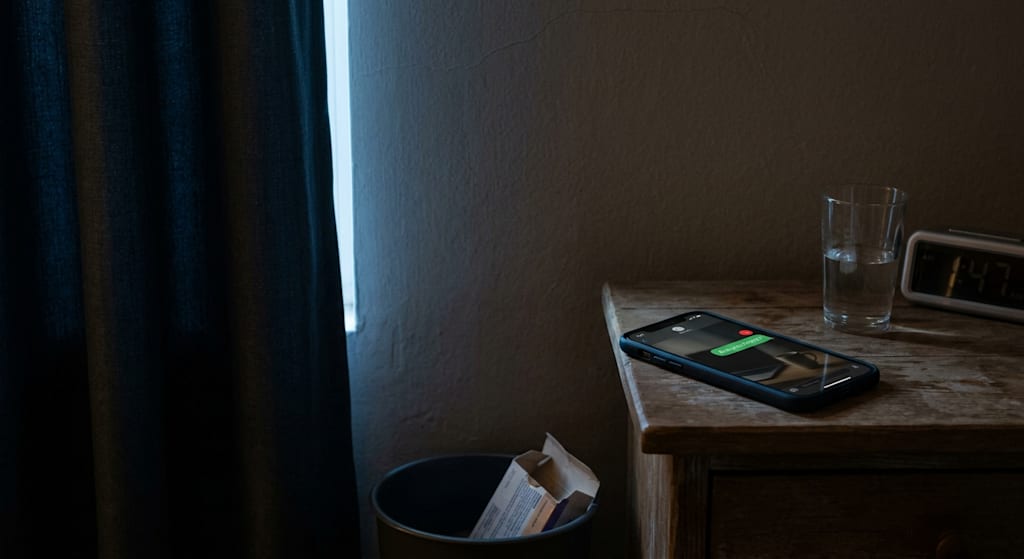
My phone buzzed on the nightstand.
The screen lit up. 1:47 a.m. WeChat. The contact name was “Chen Jianguo, former company, marketing.” The last time I’d spoken to him was three years and two months ago, the day he left the company. He’d sent a farewell message to the group. I replied, “Best of luck.” He replied, “Thanks.” Nothing after that.
The message was three words: Are you there?
I turned the phone face down and stared at the ceiling.
There was a thin crack in the ceiling, running from the light fixture toward the window, about thirty centimeters long. I’d noticed it the first year I moved in. I repainted once a year, and the next year it cracked open again. I hadn’t painted it this year.
The phone buzzed again. I didn’t turn it over. I knew it was him.
I rolled onto my side and folded the pillow in half, pressing it against my ear. It didn’t help. My brain had already started running.
I remembered Chen Jianguo clearly. He sat diagonally across from my desk. He didn’t talk much, but every time the department had dinner, he organized it. He booked the room, split the bill, reminded everyone to get receipts. One year I had gastroenteritis and took sick leave. After work, he went two kilometers out of his way to leave a box of stomach medicine at my door. He didn’t even send a WeChat message. At the time, I thought he was decent.
Decent or not, we hadn’t spoken in three years.
2:03 a.m. I picked up the phone for the third time.
No second message. After “Are you there?” he said nothing. No “I have something to ask you.” No “Is it convenient?” No “It’s urgent.” Three words, a hook with no bait, waiting to see if I’d bite.
Last winter, Zhou Haitao, a primary school classmate I hadn’t contacted in twenty years, added me on WeChat. The verification message said, “Old classmate, remember me?” I accepted. We exchanged four and a half lines of small talk. The fourth and a half was “You’re doing pretty well for yourself now.” The fifth was “Is it convenient right now? I need to tide something over. Two thousand would do.”
Two thousand. Not a lot, not a little. Exactly the amount that makes it hard to say no.
I lent it. He said one or two months. One or two months became half a year. Half a year became “Don’t worry, I’ve got it in mind.” Around Chinese New Year last year, I brought it up. He said, “Definitely after the holiday.” Then nothing.
Two thousand yuan bought a fish that I threw into the water. Not even a splash.
Later I figured it out. The day he added me, he might have sent “Remember me?” to a dozen old classmates. I was one of them. He didn’t remember me. He remembered the possibility that I might loosen up.
I turned the phone over. The screen still showed those three words.
2:21 a.m. I sat up.
There was half a glass of water on the nightstand. I picked it up and took a sip. Cold. Outside, a stray cat was crying, one long meow and one short one, for about ten seconds, then stopped. The convenience store downstairs still had its sign lit. The light squeezed through the gap in the curtains and drew a white line across the ceiling, right over the crack.
I stared at that white line and did the math in my head.
Chen Jianguo. Three years without contact. “Are you there?” at 1:47 a.m.
If he really had an emergency, if it had reached the point where he needed to ask me, that meant he had already gone through everyone he could think of, or none of them were suitable. He came to me because he thought I would lend. He remembered the stomach medicine. He hesitated for three years, worked up the courage in the middle of the night to send three words, and didn’t dare say what it was. He was afraid I’d reject him too quickly. He wanted to put me into a “read” state first, then explain slowly.
Why should I, in the middle of the night, for someone I hadn’t contacted in three years, prepare myself to “have to respond” to something I didn’t even know about?
If I replied “Yes,” his next step would be “There’s something I’d like to trouble you with.” If I replied “What is it,” his next step would be “Is it convenient financially right now?” If I replied “What’s up at this hour,” his next step would be “Sorry to bother you, I’ve really run into some trouble.” And then I’d still have to listen.
If I didn’t reply, tomorrow morning I could say, “I was asleep and didn’t see it.” That was true. At 1:47 a.m., normal people are asleep. He chose the middle of the night. He bears the consequences, including no reply. That’s fair.
I finished the water and put the glass back. The bottom clinked against the tabletop, very softly.
I thought of Lao Zhao. Two years ago, a colleague, half a year after leaving the company, asked me on WeChat, “Are you there?” I replied, “Yes.” His next sentence was “Could you introduce me to a client? I’m still short of my target this month.” I sent him two contacts. He said, “Thanks so much, I’ll treat you to a meal another day.” That meal never happened. I never found out whether the client thing worked out. He didn’t mention it again, and I didn’t ask.
It wasn’t a big deal, but later I realized that every time I saw the words “Are you there?”, my first reaction was no longer “What’s going on?” It was “Here we go again.”
You reply with one word, and you put yourself into a conversation where you have no choice. You don’t know what the other person wants. You don’t know whether you can give it. You don’t know what comes after you give it. You only know that you have to keep going.
I picked up the phone, long-pressed the message, and a few options popped up. I chose “Mark as unread,” then locked the screen and put it back on the nightstand.
The second the screen went dark, I saw the time: 2:38 a.m.
The next morning at seven, the alarm went off.
I turned it off and checked my phone first. Chen Jianguo hadn’t sent a new message. Those three words were still sitting in the chat, the red dot for unread still there.
While I brushed my teeth, I thought it over. If he sent “There’s something I want to ask you” this morning, I might reply, depending on what it was. If he sent “Is it convenient financially right now,” I probably wouldn’t. If he said nothing, I wouldn’t ask.
I kept the judgment in my own hands. Three words would not push me along.
I rinsed my mouth, washed the toothpaste foam away, and tossed the box of stomach medicine on the sink into the trash. That box had expired long ago. I’d kept it there all this time. Every time I saw it, I thought of Chen Jianguo going out of his way to drop it off.
I remember the favor. A favor is not a card that can be cashed at 1:47 a.m.
At the office, I turned on my computer and dealt with email. A little after ten, my phone buzzed. Chen Jianguo’s message: “Never mind, sent it to the wrong person, sorry.”
I looked at it for two seconds and replied with one word: “Okay.”
Then I went back to my email. The colleague at the next desk asked what to have for lunch. I said whatever, nothing too greasy. Outside the window, someone was walking a dog. The leash was blue. I went through all the WeChat contacts with “Former Company” in their notes and turned on “Mute Notifications” for each one. Not deleting, not blocking. Making things quieter.
Next time there’s an “Are you there?” in the middle of the night, at least I’ll sleep until the alarm goes off.
About the Creator
Jin
Writer of reamstories
https://reamstories.com/jin
Enjoyed the story? Support the Creator.
Subscribe for free to receive all their stories in your feed. You could also become a paid subscriber, letting them know you appreciate their work.
Comments
There are no comments for this story
Be the first to respond and start the conversation.