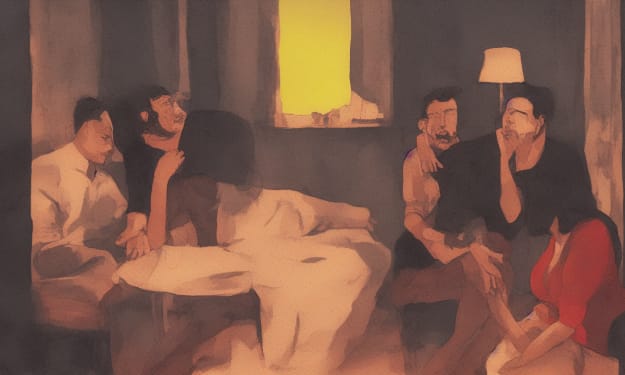
love
All you need is Love, and Love is all you need.
Suffering From Smith-Itis
For 30 years, and still to date, I have been a 911 police, fire, and medical dispatcher. Now, one expects of course, to immediately hear a bunch of either hilarious or chilling anecdotes following that statement. That is not what this post is about. This post is about a poor tormented soul from my city and his recent, lamented, passing. For privacy and personal protection, I will refer to this man as WP.
By Andrew C McDonald3 years ago in Humans
A Journey of Faith
Once upon a time, in a small village nestled amidst rolling hills, lived a young girl named Amelia. She grew up in a loving family, surrounded by the beauty of nature and the warmth of community. Yet, as Amelia journeyed through adolescence, questions about the purpose of life and the existence of something greater started to weigh heavily on her heart.
By Oyetakin Oyekanmi3 years ago in Humans
Forbidden love
Once upon a time, in the sprawling kingdom of Veridonia, a land divided by societal boundaries and ancestral grudges, a forbidden love story unfolded. At the heart of this tale were two individuals from vastly different backgrounds, whose hearts beat as one despite the insurmountable odds stacked against them. Their names were Isabella and Sebastian.
By Emma Schmid 3 years ago in Humans
LIFE AFTER DEATH. Content Warning.
What Happens to Us When We Die The question of what happens to us when we die has fascinated humanity for millennia. It is a topic that stirs deep emotions, sparks philosophical debates, and elicits a wide range of beliefs and interpretations. While the exact answer remains unknown and continues to be the subject of speculation, various perspectives offer insights into the mysteries that surround the finality of life. From a scientific standpoint, death marks the cessation of biological functions that sustain our existence. When the body ceases to function, the brain no longer receives oxygen and nutrients, leading to the irreversible loss of consciousness and bodily functions. Death, in this sense, is the end of our physical existence, where the body decomposes and returns to the elements from which it was formed. However, the question of what happens to our consciousness, our essence, after death remains a topic of great conjecture. Different cultural, religious, and spiritual beliefs offer diverse interpretations, providing solace and hope to those grappling with the concept of mortality. Many religious traditions propose the existence of an afterlife—a realm or state of being that follows death. The specifics of the afterlife vary across different faiths and cultures. Some envision a heaven or paradise, a realm of eternal bliss and reunion with loved ones. Others believe in reincarnation, where the soul is reborn in a new body to continue its journey of growth and spiritual evolution. There are also notions of hell or purgatory, where the soul faces judgment and experiences retribution or purification before moving on to a higher state. Spiritual and metaphysical beliefs also explore the possibilities of what happens after death. Some posit the existence of an astral plane, a realm of consciousness beyond the physical plane. It is considered a place where the soul may reside, learn, and heal before embarking on its next adventure. Near-death experiences, often described as encounters with a bright light or a sense of peace and transcendence, are cited as evidence of an existence beyond the physical realm. Furthermore, philosophical perspectives offer contemplative insights into the question of what happens to us when we die. Existentialist thinkers emphasize the finality of death and the need to find meaning and purpose in our finite lives. They encourage us to embrace the present, to live authentically, and to create a legacy that outlasts our physical existence. From this perspective, the meaning we assign to our lives and the impact we have on others become crucial aspects of our posthumous presence. In contemplating death, we inevitably confront questions of consciousness, identity, and the nature of the self. Does our consciousness simply cease to exist? Is it absorbed into a collective consciousness? Or does it transcend the physical realm and continue to exist in some form beyond death? The answers to these profound inquiries remain elusive, shrouded in mystery and subjectivity. Ultimately, what happens to us when we die remains a deeply personal question, intimately intertwined with our beliefs, experiences, and cultural upbringing. It is a topic that elicits diverse perspectives and emotions, from fear and uncertainty to hope and comfort. While science may shed light on the physical processes of death, the exploration of consciousness and the nature of existence transcends the boundaries of empirical observation. In the face of this existential mystery, it is perhaps the journey of life itself that holds the most significance. Regardless of what lies beyond death, the present moment is an opportunity to cherish, to live with purpose and compassion, and to cultivate a sense of connection with ourselves, others, and the world around us. It is through embracing life that we find solace and meaning, even in the face of mortality's enigma.
By Isaac Smith 3 years ago in Humans
The Ever-Evolving Journey of Relationships
Just like how people change and grow throughout their lives, relationships also need to adapt and transform. It's important to face and overcome challenges that come up in relationships so that there can be harmony – not only between partners but also in each person's personal life.
By Amanda Doyle3 years ago in Humans
Understanding Self harm. Content Warning.
Introduction: Self-harm is a complex and deeply personal issue that affects individuals across various age groups, genders, and backgrounds. While the reasons behind self-harm can be diverse, it is crucial to approach this topic with empathy, understanding, and the goal of providing meaningful support. In this essay, we will explore the underlying factors that drive individuals to engage in self-harm, and discuss strategies and interventions that can help prevent self-harm and assist those in need.
By Eshaal Zeeshan3 years ago in Humans
Build Genuine Romantic Connection
Building a meaningful and healthy romantic relationship is a process that requires time, effort, and genuine connection. While there is no one "simple move" that can guarantee turning a girl into your girlfriend, there are certain steps you can take to increase your chances of developing a romantic relationship. Here are some general tips:
By Ritchell Navarro3 years ago in Humans
Unveiling the Wisdom Within. Content Warning.
At the age of 25, as the world opens up to new opportunities and experiences, a woman embarks on a transformative journey of self-discovery. It is a pivotal stage of life filled with both challenges and triumphs, offering valuable lessons that shape her future. This is the story of Emily, a young woman who learns what truly matters and the wisdom she acquires along the way.
By Odey Thomas3 years ago in Humans
The Art of Communication in Human Relations
Once upon a time in a bustling city, there lived a young woman named Maya. Maya was known for her exceptional ability to connect with people from all walks of life. Her secret? The art of communication in human relations. Maya worked as a social worker, dedicating her life to helping those in need. She believed that effective communication was the key to truly understanding and supporting others. Every day, Maya encountered individuals with different backgrounds, experiences, and challenges. She knew that each person had a unique story to tell, and it was her job to listen and connect. One sunny morning, Maya received a new case. It was a young teenager named Alex who had recently lost his parents in a tragic accident. Maya could sense the pain and confusion in Alex's eyes when they first met. She knew that building trust and establishing a connection was crucial in helping him through this difficult time. Maya started their conversation with open-ended questions, allowing Alex to share his emotions and memories freely. She listened intently, providing a safe space for him to express his grief. Maya used active listening skills, nodding and maintaining eye contact, demonstrating that she genuinely cared about his story. As Alex opened up, Maya validated his feelings and assured him that his emotions were normal and understandable. Over the following weeks, Maya continued to visit Alex, sharing stories of hope and resilience. She understood that communication was not just about words, but also about non-verbal cues. She smiled, held his hand when needed, and provided a comforting presence. Maya recognized that her body language conveyed empathy and support, helping Alex feel understood and accepted. As their bond grew stronger, Maya introduced Alex to a support group of other teenagers who had experienced similar loss. Through the art of communication, Maya facilitated discussions and encouraged the sharing of stories among the group members. The teenagers realized they were not alone in their struggles, and their shared experiences created a sense of belonging and comfort. Maya also focused on empowering the teenagers by teaching them effective communication skills. She organized workshops where they practiced active listening, constructive feedback, and conflict resolution. Maya believed that these skills were essential in building healthy relationships and overcoming obstacles. One day, Maya received an invitation to speak at a conference on human relations. She was thrilled to share her experiences and insights with a larger audience. During her presentation, she emphasized the importance of communication in fostering understanding, empathy, and collaboration. Maya shared stories of her interactions with individuals like Alex, highlighting how effective communication could transform lives and build stronger communities. The audience was captivated by Maya's words and the genuine passion she exuded. They were inspired to reflect on their own communication practices and consider how they could improve their relationships. Maya's story resonated with many, reminding them of the power of genuine connections and the art of communication in human relations. Months later, Maya received a letter from Alex. In it, he expressed his gratitude for her unwavering support and the impact she had made on his life. Alex shared how he had developed his own communication skills, using them to connect with others who were going through tough times. He had become a mentor to younger children in need, just as Maya had been to him. Maya's heart swelled with pride and joy as she read the letter. It was a testament to the transformative power of communication in human relations. Maya knew that her journey had only just begun, and she was determined to continue spreading the art of communication, one connection at a time. And so, Maya embarked on her next adventure, ready to touch more lives through her dedication, empathy, and the art of communication in human relations.
By Gopikrishna3 years ago in Humans
10 Creative Entertainment Ideas for the Adventurous Woman
Are you looking for some creative entertainment ideas for the adventurous woman? If so, you’ve come to the right place! we’ll explore 10 unique and exciting ideas for every type of woman, from the thrill-seeking adventurer to the laid-back homebody.
By Dhouha zarria3 years ago in Humans