love
All you need is Love, and Love is all you need.
Tate McRae: Songs, Age, Height, Net Worth, Albums, Relationships & More. AI-Generated.
Tate McRae is a Canadian singer, songwriter, dancer, and performer who rose to international fame through viral music releases, social media success, and her standout appearance on So You Think You Can Dance: The Next Generation.
By Enoch Sagini5 months ago in Humans
She Was Waiting… But I Kept Saying ‘Later
She was not the type of girl who asked for much. She didn’t demand attention. She didn’t complain. She didn’t even fight. She just waited. And I… I always thought she would keep waiting. That was my biggest mistake. It started like every normal story. Late-night talks. Random messages during the day. Small jokes. And a connection that felt… safe. She used to text me things like: “Are you free?” “Did you eat?” “Can we talk for a bit?” And I always replied the same way: “Later.” “Busy right now.” “Talk after some time.” I never realized how heavy the word “later” can become. At first, she understood. She never showed anger. She just said, “Okay.” And waited. Days turned into weeks. Weeks turned into months. And I kept repeating the same pattern. Busy… tired… not now… later. Life was not really that busy. I was just distracted. Distracted by everything except the one person who actually cared. Sometimes I would see her messages sitting there for hours. Unread. Unreplied. But I convinced myself: “She will understand.” She always did… until she didn’t. One day, something felt different. Her messages stopped. No “good morning.” No “are you free?” No “did you eat?” At first, I felt nothing. I thought maybe she is busy. Maybe she is tired. Maybe she will text later. Yes… I still believed in “later.” But days passed. Then a week. Then more. Silence started becoming strange. Not loud silence… but heavy silence. The kind that sits on your chest without saying anything. One night, I opened our chat again. I don’t know why. Maybe boredom. Maybe curiosity. Maybe guilt. And I saw it. The last message she ever sent: “I waited for you more than I should have.” I stared at it for a long time. It didn’t feel like a normal message. It felt like a goodbye that I didn’t notice at the time. My fingers started shaking slightly. I called her. No answer. I texted again. “Where are you?” “Are you okay?” “Please reply.” Delivered. Not seen. That’s when panic slowly started building inside me. I checked her social media. Nothing unusual. But something was missing. Her presence. Her replies. Her “waiting.” I waited that night. Just like she used to wait for me. But no message came. The next day, I asked a mutual friend. That’s when I learned something I was not ready for. She had stopped waiting. Not because she stopped caring… But because she got tired. Tired of hoping for someone who always said “later.” And somewhere along the way… Someone else said “now.” That hit me differently. Not like sadness. More like realization. A quiet, painful understanding. I remembered every “later” I said. Every ignored message. Every moment I chose something else over her. And suddenly, I understood something very simple: People don’t stop caring suddenly. They stop slowly. One ignored message at a time. One delayed reply at a time. One broken expectation at a time. I tried calling her again. Still nothing. I wanted to explain everything. But deep down, I knew something had already changed. Not in her. In the timing. I had all the time in the world to reply… But I chose not to. And now she had all the reasons in the world not to come back. Weeks passed. Life continued. But something inside me stayed stuck. Not her memory… But my guilt. I realized love is not just about feelings. It’s about attention. Presence. Timing. And respect for someone’s waiting. Now when I look back, I don’t blame her. I don’t hate anyone. I only understand one thing clearly: She was never asking for too much. She was just asking at the wrong time… from the wrong version of me. And I kept thinking she would always wait. But nobody waits forever. Not even the ones who love you the most.
By Muhammad Yousaf 5 months ago in Humans
Seven Levels of Self-Love
Why are you unhappy? Why do you lack security? Why does it feel like no one understands or loves you? Why are you lonely and empty? Why do you project strength on the outside while remaining guarded within? Why is your life filled with blame and conflict?
By Emily Chan - Life and love sharing5 months ago in Humans
Scorpio Woman and Scorpio Man Compatibility Score. AI-Generated.
When two Scorpios come together in a relationship, the connection is rarely ordinary. A Scorpio woman and a Scorpio man are both passionate, emotional, mysterious, and intensely loyal once committed. This pairing can feel like meeting someone who truly understands the deepest parts of your personality. However, because both partners share the same strong traits, the relationship can either become incredibly powerful or emotionally exhausting.
By Inspire and Fun5 months ago in Humans
Signs. Content Warning.
They were there, and I’m curious by nature and like reading them and following them, so I did. The first one stands out in my memory. We were on the phone, and I was walking down the hall on campus to my car. I told him that my dentist had referred me to a periodontist, and he asked if I was sure it wasn’t pronounced perodontist, that he knew how I am about words and precision.
By Harper Lewis 5 months ago in Humans
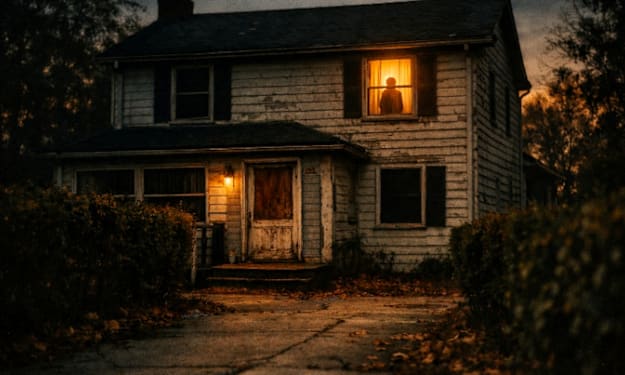
"I Returned to My Childhood Home After 20 Years. The Bedroom Door Was Closed — and Someone Was Breathing Behind It.". AI-Generated.
I almost didn't go. Twenty years is enough time to convince yourself that a place has stopped mattering. That the memories have softened enough, faded enough, that walking back into them won't cost you anything. I had a good life in Portland — steady work, an apartment with big windows, a routine that felt solid on most days. I had moved on. I was sure of it. Then my uncle called and told me the house in Dayton was going on the market. My father had passed in 2019. My mother followed fourteen months later, quietly, the way she did most things — without making a fuss, without giving any of us enough time to prepare. The house had been sitting empty since then, the estate tangled in paperwork, my uncle managing everything from a distance. He asked if I wanted to do a final walk-through before the realtor came. Take what I wanted. Say whatever I needed to say. I booked a flight that same night. The lawn stopped me before I even got to the front door. I turned onto Calloway Drive and pulled up slowly, and the first thing I noticed — before the sagging gutters, before the peeling shutters, before the maple tree my father had planted the year I was born that had grown so large it now shaded half the roof — was that the grass had been freshly cut. Clean lines. Neat edges along the driveway. Someone had been out here recently and done a careful job of it. My uncle hadn't mentioned hiring anyone. I hadn't asked him to. I sat in the rental car for a moment, just looking at it. Told myself it was probably a neighbor. Someone who couldn't stand watching an empty house go to ruin. That happened sometimes. There was a perfectly reasonable explanation and I was going to find it and it was going to be nothing. I got out of the car. The smell of the house hit me before I was fully through the door. Wood and dust and something faintly floral — my mother used to keep dried lavender in a ceramic bowl by the staircase, and somehow, two years later, the ghost of it was still there. My body recognized it before my brain did. I stood in the entryway with my hand on the doorframe and just breathed for a moment. The living room was empty. Bare floors, bare walls, afternoon light coming through curtains no one had bothered to take down. My parents' furniture had been donated years ago — a practical decision that I had agreed to over the phone and was now, standing here, deeply unprepared for. I moved through the house slowly. The kitchen where my mother stood every morning with her back to me, making oatmeal I always complained about. The narrow bathroom with the small hexagonal tiles. The hallway that felt half the size I remembered, the way childhood spaces always do when you return to them as an adult and realize the whole world you grew up in was actually quite small. I was holding it together. I was doing fine. Then I started up the stairs. My old bedroom was the second door on the right. It was the only door on the floor that was closed. I noticed it halfway up. Every other door was open — the master bedroom, the upstairs bathroom, the small room my parents had used as a study. All open. Just mine was shut. I stopped on the stairs and stood there. Old houses settle. Doors swing closed on their own. There was no reason for the feeling moving through my chest right now. There was a completely logical explanation and I was going to feel foolish in about thirty seconds. Then I heard it. Soft. Steady. Unmistakable. Someone on the other side of that door was breathing. I stood in that hallway for a long time. Then I walked forward and knocked. Silence. A long pause. Then a voice — thin, careful, elderly: "Michael? Is that you, sweetheart?" Her name was Carol. She was 77 years old, and she had been living in my childhood bedroom for seven months. We sat on the floor together — the pale blue carpet was still there, still the same shade, worn thin in the spot near the window where I used to sit and read — and she told me everything slowly, like someone who had been carrying a confession for a long time and wasn't sure how it would be received. She had known my mother. Not recently — years ago, before we moved to this house, when my mother was in her early thirties and going through something she had apparently never talked about with anyone in the family. Carol had been her neighbor during that time. They had been close in the particular way people become close when one of them is struggling and the other one shows up anyway. Then life moved them apart, the way it does, and they lost touch. When Carol's apartment building was sold last year and the rent on her new lease came in at nearly double what she'd been paying, she was stuck. Fixed income. No family nearby. Every affordable housing waitlist in the county was backed up by months. She had remembered my mother mentioning, once, that she kept a spare key under the ceramic frog by the back door. She had come to stay for one night. She had been mowing the lawn because she said she felt she owed the house something for letting her stay. I didn't call the police. That thought entered my mind and left it within seconds. We talked until the room went dark and I had to turn on the small lamp she'd set up on the floor beside her folding chair. She told me about my mother as a young woman — before marriage, before kids, before she became the fixed, certain person I had known my whole life as Mom. She told me about a version of my mother who had doubted herself, who had been lost for a while, who had leaned on a neighbor's kindness during a chapter she'd chosen to keep private forever. It was like being handed a photograph of someone you love from before you existed. Like discovering a whole room in a house you thought you knew completely. I cried. Carol handed me a tissue from her cardigan pocket without making it into a moment. Before I left, I called my cousin in Columbus. He has a spare room and he's a good person. He said yes without hesitation. I drove Carol there the following morning. She brought one suitcase and a small plant she'd been keeping on the windowsill of my old bedroom. She had kept it alive for seven months. The realtor got a clean, empty house. I got something I hadn't known I was looking for — a fuller, more honest picture of my mother. A woman who had an entire life before I arrived and complicated everything with my needs and my noise and my love for her. A woman who had struggled privately and never once let it show. I used to think I knew her completely. I was standing in her house, in the room where I grew up, being introduced to her by a 77-year-old woman with a suitcase and a small plant and nowhere else to go. I don't think that's a sad ending. I think that's just what it looks like when you finally stop seeing your parents as parents — and start seeing them as people.
By Baseer Shaheen 5 months ago in Humans