friendship
C.S Lewis got it right: friendship is born when one person says to another: "What! You too? I thought I was the only one!"
Fathers Day 2026 Will Mean More Than Gifts for Many Families
For many people, Father’s Day carries emotions that are difficult to explain fully. Some celebrate loving fathers who shaped their childhood with patience and sacrifice. Others quietly miss fathers who are no longer alive. Some people remember painful relationships, while others think about becoming fathers themselves for the first time. Behind the cards, meals, and family photos, the day often holds deep emotional meaning.
By Muqadas khan3 months ago in Humans
Scorpio Woman and Capricorn Man Compatibility Score. AI-Generated.
A relationship between a Scorpio woman and a Capricorn man is often considered one of the strongest matches in astrology. Both signs are highly determined, loyal, and serious about their goals. While they may appear very different on the surface, they share many core values that can help them build a lasting and meaningful relationship.
By Inspire and Fun3 months ago in Humans
11 SIGNS YOUR CHILDHOOD TRAUMA IS RUINING YOUR RELATIONSHIPS
Some relationship problems are not created in relationships. They were planted years earlier… in childhood homes, emotionally confusing environments, inconsistent love, silence, criticism, abandonment, or survival habits you never realized followed you into adulthood.
By The Curious Writer3 months ago in Humans
The Haus of Roots and Secrets
The salon was alive with sounds of clients talking over driers, electric razors humming, and Millennial jams grinding in the background. Had it not been a weekday, I wouldn't have been able to recognize the song so quickly. Deee-Lite's Groove is in the Heart. Classic.
By Laura Roodenburg3 months ago in Humans
TAINTED LOVE THORN
CREATED, WRITTEN, EDITED BY TRUSSELLI ART ALL PHOTOS ARE MINE FROM MY CANON REBEL AND CELL PHONES. I USED AI FOR ANIMATION. IF YOU DO NOT READ OR LIKE MY ART OR MY PHOTOGRAPHY THAT WAS WRITTEN FROM MY HEART AND SOUL BECAUSE I USED AI FOR ANIMATIONS, THEN THAT IS YOUR ISSUE NOT MINE. IT IS MY WRITING, MY ART, MINE, & copyright 2026 and before that too. I worked on this song and editing 10 hours. No magic buttons found.
By Vicki Lawana Trusselli 3 months ago in Humans
Channeled Message #2: "Makeup Your Mind"
Lately, I've been intensely wrestling with standards of beauty - for the soul and the physical. This message from Spirit is...tender. I see a woman, her hair pulled back, bending down to help a child with their work. I see investment. Love. Collaboration. Energies exchanging data, this could be texting, or listening hearing something that stays with you. I see someone recording content, or getting things together behind the scenes, preparing to execute on a new love or passion.
By A.I. Reads3 months ago in Humans
Say It Again
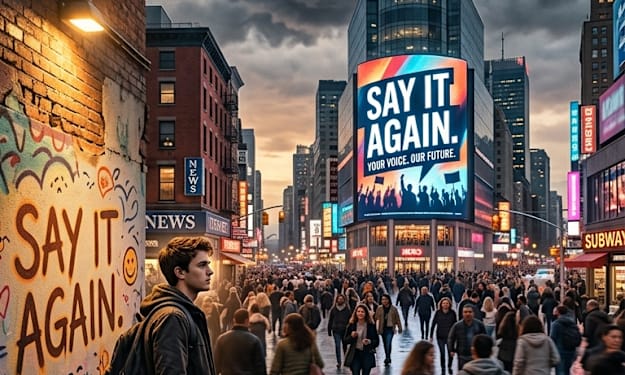
The first time anyone heard the phrase, people laughed. It was during the annual Spring Festival in the city of Bellweather, a place famous for its cheerful citizens and strange traditions. Every year, the town square filled with musicians, food vendors, and performers eager to entertain the crowds. Among them was a street comedian named Leo Finch. Leo was known for his quick wit and his ability to turn ordinary observations into jokes. That afternoon, he stood atop a wooden crate and pointed toward the massive clock tower that overlooked the square. "The city council says they're fixing the clock next week," he announced dramatically. The crowd groaned. The clock had been broken for nearly five years. Leo shook his head and smiled. "Sure they are," he said. "And I'm the king of Bellweather." Laughter erupted. Then he raised a finger and delivered the line that would follow the city for years. "Say it again." The crowd repeated it playfully. "Say it again!" More laughter. Whenever someone made an unbelievable claim, people began repeating the phrase. The baker promised his bread recipe would remain secret forever. "Say it again." A student claimed he had studied all night. "Say it again." A politician promised lower taxes. "Say it again." The words became a joke shared by everyone. They were harmless. At least, they seemed harmless. Three years later, Bellweather was no longer the same city. A severe economic downturn had struck the region. Businesses closed. Families struggled. The cheerful atmosphere that once defined the town began to fade. People wanted leadership. More importantly, they wanted hope. That was when Mayor Eleanor Graves emerged. She was charismatic, intelligent, and confident. Unlike previous officials, she spoke with certainty. When she announced ambitious plans to revive the city's economy, many citizens were skeptical. But Eleanor understood something important. People trusted confidence. During her first major speech, she addressed thousands gathered in the square. "We will rebuild every abandoned district." Applause. "We will create opportunities for every family." More applause. "We will restore Bellweather's greatness." Thunderous applause. Then she smiled. "I know some of you doubt me." The crowd grew quiet. "I know what people usually say." A few people chuckled. Eleanor raised her voice. "So I'll say it again." The crowd froze. The phrase sounded different coming from her. Stronger. More deliberate. "I said we will rebuild this city." Cheers erupted. "So I'll say it again." The cheers grew louder. "We will rebuild this city." The phrase that had once been a joke suddenly became something else. A promise. Campaign posters appeared throughout Bellweather. SAY IT AGAIN. Citizens wore shirts displaying the slogan. Students painted murals. Business owners hung banners. The words became a symbol of persistence. If a goal seemed impossible, people simply repeated it. If success seemed distant, they said it again. And again. And again. For a while, it worked. The economy improved. New businesses opened. Construction projects transformed neglected neighborhoods. Mayor Graves became a hero. People credited her determination. Many believed the slogan itself possessed a strange kind of power. If you repeated something often enough, perhaps it could become reality. Years passed. Bellweather prospered. The phrase remained everywhere. Children learned it in school. Companies included it in advertisements. Politicians quoted it during debates. No one questioned it anymore. That was precisely the problem. Because repetition has a peculiar effect on people. The more often they hear something, the more familiar it becomes. And the more familiar it becomes, the more likely they are to accept it. Even when they shouldn't. The change happened slowly. So slowly that almost nobody noticed. A local journalist named Ava Mercer did. Ava worked for Bellweather's oldest newspaper. She spent her days investigating city projects and reviewing government reports. One evening, she noticed inconsistencies in several public contracts. Large sums of money had disappeared. Important records were missing. The numbers didn't add up. When she brought her concerns to officials, they dismissed her. "The reports are accurate." Ava frowned. "But these figures contradict each other." The official smiled politely. "They don't." "They do." "They don't." A pause. Then the official leaned back. "As we've already explained, the reports are accurate." Ava stared at him. The statement was obviously false. Yet he repeated it calmly. Confidently. Again and again. Weeks later, multiple officials were repeating the same claim. "The reports are accurate." Journalists challenged them. Experts questioned them. Evidence contradicted them. Still they repeated it. "The reports are accurate." "The reports are accurate." "The reports are accurate." Suddenly Ava understood. The city had spent years celebrating repetition. People had learned that confidence mattered more than evidence. That persistence mattered more than truth. That saying something repeatedly could make others believe it. The slogan had evolved. Once a joke. Then a promise. Now something far more dangerous. Ava published her findings. The article spread quickly. Some citizens supported her. Others attacked her. They accused her of undermining the city. Of spreading negativity. Of refusing to believe in Bellweather's success. At a public meeting, Ava addressed hundreds of residents. She presented documents. Financial records. Witness statements. Hard evidence. When she finished, the room fell silent. Then a man stood. He wore a shirt displaying the city's famous slogan. "We've heard these accusations before," he said. Several people nodded. "The officials already explained everything." More nods. Ava felt a chill. The man smiled. Then he spoke the phrase. "Say it again." The crowd repeated it. "Say it again." Louder this time. "Say it again." Ava looked around the room. For the first time, she felt afraid. Years earlier, those words would have triggered laughter. Later, they inspired hope. Now they demanded obedience. They no longer encouraged people to think. They encouraged people to stop thinking. That was the moment Bellweather changed forever. Months later, a formal
By Khalil Ullah3 months ago in Humans
The Outrage Economy
It is ironic how similar the structures are on both sides. ActBlue and WinRed may serve opposite political teams, but they operate within the same kind of incentive system: turn moral outrage into money, lists, mobilization, and political power.
By Peter Thwing - Host of the FST Podcast3 months ago in Humans