book reviews
Reviews of books by relationship gurus, dating experts, and cautionary tale-tellers.
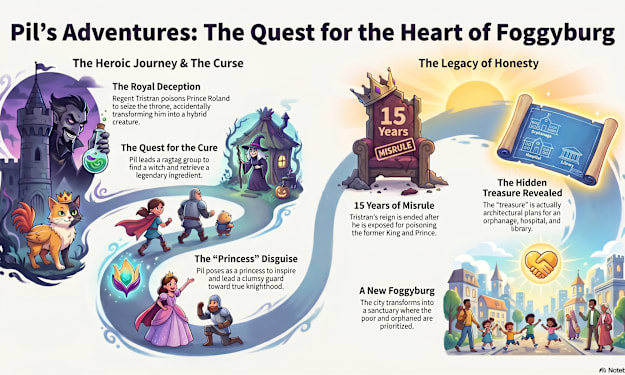
Foggyburgh: When Outcasts Redefine Leadership
The Setup: When Outcasts Become Heroes Imagine a kingdom ruled by fear, where a tyrant monetizes violence and a street orphan named Pil becomes the unlikely savior. When the rightful prince is poisoned and transformed into a "Chickat" (chicken-cat hybrid), the kingdom's fate rests not with the powerful, but with those society deemed worthless. This is Foggyburgh—a story that deconstructs traditional power structures and reveals what real leadership looks like.
By Anees Kaleem4 months ago in Humans
Ellafino. Top Story - May 2026.
"I'm stuck." "What has you stuck?" "Ellafino." "Heh, heh. Yeah, right. What's going on?" "I'm...frozen. My mind freezes between words. I just sit here...almost as if I were paralyzed. Stuck. ... Zoning out. Tunnel vision sets in. I see only the computer screen, and the rest of the room blurs as if I'm not wearing my glasses. It takes effort to move my fingers to type. I...just want to sit here, mindlessly watching nothing happen, irritated that the grammar check puts a blue line under the word 'just.'"
By Mack D. Ames4 months ago in Humans
How to Avoid Procrastination (Laziness)
How to Avoid Procrastination (Laziness) Procrastination, often called laziness, is one of the biggest obstacles to success. Almost everyone delays important work at some point in life. Students postpone studying, workers delay projects, and many people avoid tasks that seem difficult or stressful. However, procrastination is not simply about being lazy. Scientists explain that procrastination is closely connected to emotions, habits, stress, fear of failure, and lack of motivation. The good news is that research has shown several effective methods to overcome procrastination and become more productive.
By Wings of Time 4 months ago in Humans
Immunity and Practical Unaccountability
In theory, no one is above the law. This phrase is repeated often enough that it functions as a civic mantra, a reassurance that power is ultimately constrained and that authority remains accountable to the same moral and legal standards imposed on everyone else. On paper, police officers, prosecutors, and government agents are subject to the law just like any citizen. They can be investigated, disciplined, sued, or prosecuted when misconduct occurs.
By Peter Thwing - Host of the FST Podcast4 months ago in Humans
Bad Faith Does Not Deserve Comfort
There is a deeply ingrained belief in modern discourse that civility is always morally required, regardless of context. No matter how dishonest a question is, how manipulative the framing, or how distorted the premise, the expectation is that the response must remain gentle, patient, affirming, and emotionally managed. This belief is often treated as self-evident, as though politeness itself were synonymous with virtue.
By Peter Thwing - Host of the FST Podcast4 months ago in Humans
Why Comfort Fails and Discipline Endures
Modern culture increasingly treats comfort as a moral guide. Ease is framed as wisdom. Emotional smoothness is treated as maturity. Difficulty is often interpreted as a sign that something is wrong, unfair, or unnecessary. When a task feels heavy, when a conversation feels uncomfortable, or when effort feels draining, the instinct is often to stop and reconsider rather than persist.
By Peter Thwing - Host of the FST Podcast4 months ago in Humans
Expression vs Distortion
One of the most persistent frustrations in communication is the gap between what a person intends to say and what others actually receive. This gap exists regardless of intelligence, sincerity, conviction, or depth of understanding. Someone can hold an idea with clarity internally, yet watch it arrive distorted, flattened, reduced, or misinterpreted once it is expressed. The failure is often blamed on the idea itself, when the deeper issue is frequently translation.
By Peter Thwing - Host of the FST Podcast4 months ago in Humans
Truth Is Not Obligated to Conform to Your Comfort
Truth does not exist to regulate emotions. It does not exist to protect identity. It does not exist to maintain a person’s sense of safety. Truth describes reality as it is, whether that reality is welcomed, hated, resisted, misunderstood, or completely unprepared for. That is not cruelty. That is simply the nature of truth.
By Peter Thwing - Host of the FST Podcast4 months ago in Humans
Midnight on the Rooftop: A Love That Refused to Die
Midnight on the Rooftop: A Love That Refused to Die The night Cairo forgot how to breathe began with a scream. Not the kind that comes from fear—no. This scream was sharp, furious, and alive, slicing through the rooftop air like a blade. “Are you completely insane?!” a woman shouted, her voice echoing against the ancient buildings. A man laughed—actually laughed—like the city itself was a joke and the stars were his audience. “Relax,” he said, stepping closer to the edge of the rooftop. “If I fall, I’ll fall dramatically. At least give me credit for style.” “You’re standing on the edge of a building twelve floors high!” she snapped. “And you’re standing here with me,” he replied, his voice suddenly quieter. “So maybe you’re the insane one.” The woman froze. The wind whipped her hair across her face, and the moonlight revealed her eyes—wild, furious, but hiding something else beneath the anger. Something softer. Something wounded. The man tilted his head, as if he could hear her heartbeat. “You came,” he said simply. She swallowed hard. “I didn’t come for you.” He smiled. “That’s a lie.” She took a step forward, her boots scraping against the rooftop floor. “I came because you sent me that message. The one that sounded like a goodbye.” He shrugged like it didn’t matter. Like he didn’t matter. Like nothing mattered. “Maybe it was,” he said. Her chest tightened. “Don’t do that.” “Do what?” “Talk like you’re leaving,” she whispered, her voice breaking despite her effort to sound strong. “Talk like you don’t care if you disappear.” His eyes softened for a second, and the playful arrogance slipped. The air between them changed. The city noise below faded into something distant and irrelevant. Then he turned his gaze away. “You always cared too much, Leila,” he murmured. Her name sounded dangerous on his tongue. Like a match near gasoline. She clenched her fists. “And you never cared enough, Adam.” That name—Adam—hung between them like a curse and a prayer. A memory flickered behind her eyes: the first time she saw him, the way he smiled like he knew secrets the world didn’t deserve. The way he made her feel like the universe had suddenly chosen her as its favorite story. She hated that memory. Because it was beautiful. And because it hurt. Adam stepped down from the edge and walked toward her slowly, his hands in his pockets like he had all the time in the world. But his eyes… his eyes didn’t look calm. They looked like a storm trying to pretend it was the ocean. “You shouldn’t have come,” he said. Leila laughed bitterly. “You literally told me to come.” He stopped just a few feet away. “Because I needed to see you,” he admitted. “One last time.” Her heart slammed against her ribs. “Don’t say that,” she warned. He leaned closer, his voice low enough to be stolen by the wind. “What if I mean it?” Leila’s breath caught. The rooftop lights flickered. Somewhere far away, a siren screamed through the streets. Cairo pulsed below them, alive and chaotic, but on that rooftop, the world narrowed into only two people and a thousand unspoken words. Leila stared at him as if she could force the truth out of his face. “You promised,” she said quietly. Adam’s jaw tightened. “I promised a lot of things.” “And you broke all of them,” she replied. That was the moment his smile died completely. He reached into his jacket and pulled out a small envelope—crumpled, worn at the edges, like it had been carried around for too long. “I kept this,” he said. Leila’s eyes narrowed. “What is that?” He held it out. Her fingers trembled as she took it. She opened it slowly, and the paper inside slid out like a secret. It was her handwriting. A letter she had written two years ago and never meant to send. Her lips parted. “How did you…?” Adam’s eyes didn’t leave her face. “You left it in my car,” he said. “The night you told me you hated me.” Leila’s throat tightened painfully. She remembered that night. She remembered rain and rage and heartbreak so heavy it felt like drowning. She looked down at the letter, and her own words stared back at her like ghosts. Adam, If you ever read this, it means I failed. It means I couldn’t keep pretending I don’t love you. And if I love you, then I’m in danger. Because loving you is like holding fire in my hands and praying it won’t burn me alive. Her eyes blurred. Adam watched her, his voice rough. “I read it a hundred times.” Leila’s hands shook as she lowered the letter. “You had no right,” she whispered. “I know,” he said. “But I needed to know if I was crazy. If what I felt was real.” Her chest ached. Leila had spent two years building walls around her heart, brick by brick, telling herself she was stronger without him. And now he stood in front of her, tearing those walls down with nothing but a letter and a look. “You’re still the same,” she said, trying to regain control. “Still selfish.” Adam smiled faintly. “And you’re still stubborn.” Leila glared at him, but her eyes were wet. “Why did you call me here?” she demanded. “Why now?” Adam looked away toward the city lights. His face hardened as if he was preparing to say something that would ruin them. “I’m leaving,” he said. Leila froze. The words didn’t make sense. Not at first. Then they sank into her chest like a knife. “Leaving where?” she asked. Adam exhaled. “London.” Her lips trembled. “For how long?” He hesitated. Leila stepped closer, her voice rising. “For how long, Adam?” His silence answered her. Her stomach dropped. “No,” she whispered. “No, you can’t just—after everything—you can’t just leave again.” “I have to,” he said. Leila’s laugh was sharp and broken. “You always have to.” Adam turned back to her, and for the first time that night, his eyes looked desperate. “You don’t understand,” he said. “If I stay, I’ll destroy everything.” Leila’s voice softened, despite herself. “What are you talking about?” Adam took a step closer. “You remember why we ended?” he asked. Leila swallowed. How could she forget? Two years ago, she found out he wasn’t who he claimed to be. Adam wasn’t just a charming man with a dangerous smile. He had secrets, connections, enemies. He lived in shadows she wasn’t prepared for. And she had paid the price. A car following her. Strange calls at night. A warning note slipped under her door. Leave him, or you will lose more than your heart. She remembered the fear. The panic. The way her father begged her to end it. And she remembered Adam’s face when she told him she couldn’t do it anymore. He didn’t fight her. He just looked like someone had ripped his soul apart and left him standing. “I remember,” she said. Adam nodded slowly. “I’m leaving because the people who wanted to hurt me… they’re back. And if they see you near me, they’ll use you.” Leila’s heart pounded. “You’re lying,” she whispered. Adam’s expression didn’t change. Leila stepped closer, almost touching him now. “You called me here,” she said. “You dragged me into this again. So don’t pretend you’re protecting me.” His jaw tightened. “I couldn’t leave without seeing you,” he admitted. “I tried. I swear I tried. But every time I thought about leaving, all I could see was your face.” Leila’s eyes burned with tears she refused to let fall. “You ruined me,” she whispered. Adam’s voice cracked. “I know.” Leila clenched her fists against her sides, trying to keep her voice steady. “You ruined me,” she repeated, “and the worst part is… I still miss you.” The confession fell into the air like a shattered glass. Adam’s breath stopped. For a moment, he looked like a man who had been starving and finally saw food. Then he stepped forward so fast it startled her. Leila gasped as his hands gently held her arms, not forceful, but like he was afraid she might vanish. “Say it again,” he whispered. Leila’s heart hammered. “I hate you,” she said instead. Adam smiled, and his smile was heartbreak. “You’ve always lied beautifully,” he murmured. Leila tried to pull away, but he didn’t let go. “Adam—” His fingers slid up her arms to her shoulders, his touch warm even in the cold night. “I’m sorry,” he whispered. “I’m sorry I loved you like a storm.” Leila’s eyes widened. “You loved me?” she asked, as if she didn’t believe the words. Adam stared at her like she was the only truth left in his world. “I loved you,” he said. “I love you. I think I’ll love you even when I’m dead.” Leila’s breath trembled. That was the problem. Adam didn’t love like normal people. He loved like a tragedy. Leila’s voice broke. “Then why did you leave me?” Adam closed his eyes, his forehead almost touching hers. “Because staying would have killed you,” he whispered. Leila’s tears finally spilled. She hated herself for crying. She hated that he still had this power over her. But she hated even more that she still wanted him. Her hands rose slowly, and she pressed them against his chest. His heart was beating fast, like it was trying to escape. “I waited,” she whispered. Adam opened his eyes. “I waited for you,” she confessed. “For months. I told myself you’d come back. That you’d knock on my door and tell me it was safe. That you chose me.” Adam’s throat moved as he swallowed. “I wanted to,” he said. “God, Leila, I wanted to. But I couldn’t drag you into my life. You deserve peace.” Leila laughed through tears. “Peace?” She looked at him with anger and love tangled together. “You think I have peace without you?” she asked. “You think my life is calm after you set my soul on fire?” Adam’s hands tightened slightly on her shoulders. “Don’t,” he warned, voice low. Leila stepped closer until there was no space between them. “Don’t what?” she whispered. “Don’t make me stay,” he said. Leila’s heart clenched. “Why?” she asked. “Because you’re afraid?” Adam’s eyes darkened. “Because if you ask me to stay, I will. And I will ruin you.” Leila’s voice was barely a breath. “Maybe I want to be ruined.” Adam stared at her like she had just handed him the world and dared him to break it. The wind roared around them, but all Leila could hear was her own heartbeat and the sound of Adam breathing. Then he let go of her shoulders slowly, as if he was trying to regain control. He stepped back. Leila’s chest rose and fell quickly. She watched him like he was a man walking toward the edge of a cliff. “I loved you,” he said again, quieter now. “I loved you in a way that scared me. You were the only thing that ever made me want to stop running.” Leila wiped her tears angrily. “Then stop running.” Adam laughed bitterly. “You don’t understand what you’re asking.” Leila’s voice became fierce. “I’m asking you to choose me,” she said. “Just once. Choose me instead of your fear. Instead of your darkness. Instead of your past.” Adam’s eyes flashed with pain. “You think I haven’t tried?” he snapped. “You think I didn’t fight myself every day to stay away from you? I did it because I wanted you alive.” Leila’s breath shook. “I don’t care,” she whispered. Adam froze. Leila stepped forward again. “I don’t care if it’s dangerous,” she said. “I don’t care if people are watching. I don’t care if the world burns.” Her voice cracked. “I care that you’re leaving me again.” Adam looked like he was losing the war inside him. He stared at her for a long moment, and the silence felt like thunder. Then, slowly, he reached into his pocket and pulled out something else. A small velvet box. Leila’s eyes widened. Adam opened it. Inside was a ring—simple, silver, and elegant, with a tiny diamond that caught the moonlight like a captured star. Leila’s hand flew to her mouth. “What…?” she whispered. Adam’s voice trembled. “I bought it the day I met you,” he said. Leila’s knees almost gave out. “You’re lying,” she said. Adam shook his head. “I knew,” he whispered. “The moment I saw you, I knew. I told myself it was impossible. I told myself you were too good, too bright. But I bought it anyway.” Leila’s tears fell freely now. “Why didn’t you give it to me?” she asked. Adam’s eyes burned. “Because I didn’t want to trap you in my world,” he said. “Because I wanted you to have a chance at happiness… even if it wasn’t with me.” Leila’s voice was broken. “And what if my happiness was always you?” Adam’s hands shook as he held the box out to her. “Then I’m sorry,” he whispered. “Because if you take this ring… there’s no going back.” Leila stared at it like it was a door to a life she was terrified to enter. Then she looked up at him. At the man who had destroyed her peace but given her a love that made everything else feel empty. She stepped forward and took the ring from the box. Adam’s breath hitched. Leila slipped it onto her finger herself. And suddenly, Adam looked like he had been shot. His eyes widened. His lips parted. His hands rose, trembling, as if he wasn’t sure if he was allowed to touch her. Leila lifted her hand, showing him the ring. “I’m not afraid,” she whispered. Adam’s voice broke. “Leila…” She stepped closer, her forehead almost touching his. “I choose you,” she said. “Even if the world hates it.” Adam stared at her like he was trying to memorize her soul. Then, finally, his hands cupped her face gently, like she was something sacred. And when he kissed her… It wasn’t soft. It wasn’t polite. It was desperate and burning and real, like two people who had been dying without each other and finally found air. Leila’s fingers gripped his jacket. She tasted tears and midnight and everything she had ever wanted. Adam kissed her like he was making a promise with his mouth. When he pulled away, their foreheads stayed pressed together. “You don’t know what you’ve done,” he whispered. Leila smiled through tears. “Yes,” she said. “I do.” Adam exhaled shakily. “Then I swear,” he said, voice trembling with fierce devotion, “I will spend the rest of my life protecting you. Even from myself.” Leila’s voice was quiet. “Good,” she whispered. “Because I’m not letting you leave.” Below them, Cairo kept moving, unaware that on one rooftop, a love story had just restarted like a wildfire. Adam looked into her eyes and smiled—this time not with arrogance, but with surrender. “Then,” he whispered, “let’s make the world regret trying to keep us apart.” Leila tightened her arms around him, and for the first time in two years, she didn’t feel like she was drowning. She felt like she was flying. And the night Cairo forgot how to breathe… was the night their love finally decided to live.
By Ahmed aldeabella4 months ago in Humans
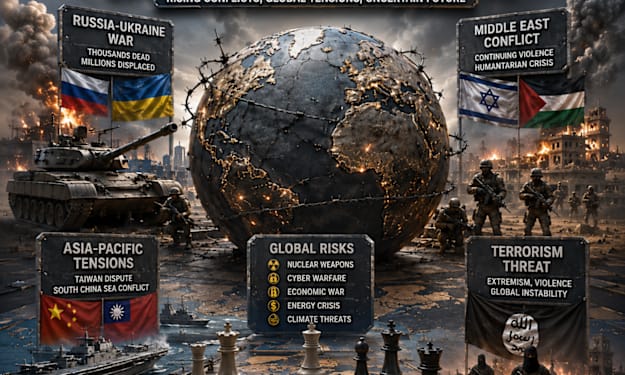
Today’s World War Affairs
Today’s World War Affairs The modern world is facing increasing political tension, military conflicts, and international disputes. Many people fear that today’s growing conflicts could eventually lead to another world war. Countries are competing for power, resources, technology, and influence, while wars and regional tensions continue to spread in different parts of the world. Although the world has experienced two devastating world wars in the past, humanity still struggles to maintain lasting peace.
By Wings of Time 4 months ago in Humans
Why Misinterpretation Feels Like a Personal Attack
When Disagreement Is Not the Real Injury Misinterpretation often hurts more than direct disagreement because it strikes at something deeper than the idea being debated. When someone disagrees honestly, they are at least engaging with what was actually said. The position has been seen clearly enough to be challenged. That kind of disagreement can still be frustrating, but it leaves the basic structure of communication intact. The original meaning remains present in the exchange.
By Peter Thwing - Host of the FST Podcast4 months ago in Humans
Poverty Is Expensive Because Stability Is Missing
Poverty Is Not Only the Absence of Money Poverty is often described as a shortage of income, but that description is too small. Low income matters, obviously. A family cannot pay bills with explanations. But poverty is not only the absence of money. It is also the absence of the conditions that allow money to stretch. Stable housing, storage space, reliable transportation, clean water, working appliances, sleep, time, tools, privacy, credit, and emergency margin all affect what a dollar can actually do. Without those things, the same dollar buys less, solves less, and disappears faster.
By Peter Thwing - Host of the FST Podcast4 months ago in Humans