
The Last Gasp of Magic: Why Jurassic Park Still Haunts Us
It wasn’t just about dinosaurs. It was about the moment cinema held its breath before diving into the digital abyss.

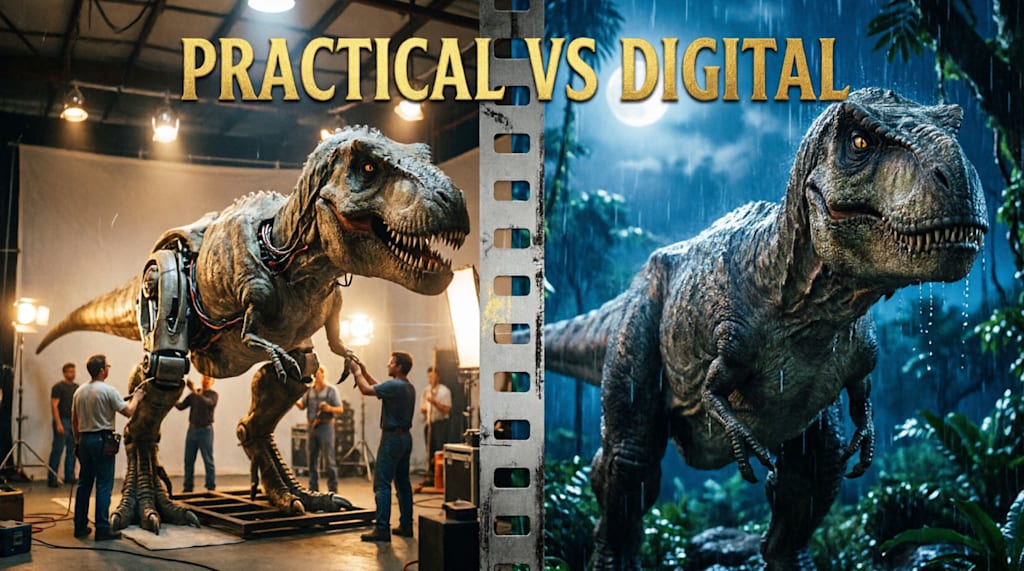
I remember the first time I saw a T. rex on screen.
Not in real life, obviously-that’s not happening anytime soon unless someone’s been holding out on us-but in that darkened theater in ’93, when the water started trembling in that plastic cup and my entire childhood simultaneously expanded and imploded. I was nine. Maybe ten. Old enough to know dinosaurs were extinct, young enough to believe they might not be.
And honestly? That feeling never really left.
Here’s the thing about Jurassic Park that most people miss: it’s not really about dinosaurs. Not exactly. Sure, the CGI was revolutionary, the practical effects were jaw-dropping (pun intended), and John Williams’ score still gives me chills every single time. But strip all that away-the spectacle, the technology, the box office records-and you’re left with something far more interesting.
You’re left with obsession.
I mean, think about it. There are people-real, functioning adults-who spend their nights frame-by-framing Spielberg’s masterpiece, hunting for Easter eggs like digital archaeologists. Terry Davis Jr., for instance. By day, he’s a cable company technician. By night? He’s what he calls a “digital paleontologist,” dissecting every pixel of Jurassic Park lore until he finds connections nobody else even knew existed. Like the fact that if you pause at exactly 37 minutes and eight seconds into the film, you can see “Jurassic Park Europe” projected on a wall-a detail so obscure it makes your head spin.
That’s devotion. That’s love bordering on madness. And I get it. Completely.
Michael Crichton didn’t just write a novel; he engineered a psychological trap. He took cutting-edge science-DNA from amber-encased insects, warm-blooded dinosaurs, velociraptors with bird-like intelligence-and wrapped it in a thriller so tight, so convincing, that you forgot you were reading fiction. It read like a New Yorker profile crossed with a roller coaster. Cold, detached, yet weirdly believable.
But here’s where it gets fascinating: Crichton fudged almost everything.
The velociraptors? They weren’t six-foot-tall killing machines with cheetah speed and Einstein-level IQs. The actual Velociraptor mongoliensis was barely half that size, more turkey than terror. Crichton borrowed from Gregory Paul’s work, swapped in a larger dinosaur (Deinonychus), and called it a day. He waged what he himself described as a “tremendous psychological campaign” against readers, burying them under so many little facts that we stopped questioning the big ones.
And it worked. God, did it work. A year after the movie dropped, an NBA team named themselves after a dinosaur that barely existed in the form we’d come to know. That’s cultural osmosis at its finest-or its most deceptive, depending on how you feel about historical accuracy.
But let’s talk about what actually matters: the T. rex scene.
Eight minutes and four seconds. That’s how long the tyrannosaur attack lasts. No music. Just footsteps, rain, the vibration of water in a cup, and then pure, unadulterated terror. Spielberg was 46 when he made this film-not the young firebrand who gave us Jaws, but something closer to your disco-dancing uncle who’d somehow retained his edge. And in those eight minutes, he nearly matched Jaws beat for beat.
He shot almost the entire sequence from inside the cars. Why? Because scale matters. If you show the whole dinosaur, it becomes Godzilla. If you stay small, trapped, human-sized-it becomes real. Visceral. The T. rex isn’t just a monster; she’s a character. Watch her pupil constrict. Notice her breath fogging up the windows. She’s acting. And she’s doing it better than most of the humans on screen.
Stan Winston’s 13,000-pound model dragged onto Stage 16 wasn’t just a prop. It was a performance. Dennis Muren’s CGI tagged in when needed, but Winston’s team often insisted on manual control because computers couldn’t capture nuance. “It acted its ass off,” Winston said later. And you can tell. Every gesture, every tilt of that massive head, feels intentional. Alive.
Now, here’s where things get weirdly academic.
There’s an entire school of thought-yes, really-that reads Jurassic Park as a feminist text. Critics Laura Briggs and Jodi Kelber-Kaye published a paper arguing that the film’s real theme isn’t man versus dinosaur, but man versus woman. The dinosaurs are female. They’ve reproduced without men (“life finds a way,” remember?). They’re threatening the nuclear family structure embodied by Alan Grant, Tim, and Lex. Some even argue the Costa Rican setting adds a layer of colonial anxiety, with the dinosaurs representing “Third World women” running amok.
Look, I’m not saying this is wrong. Film theory is supposed to make you uncomfortable, supposed to force you to see things differently. And sure, there are moments that support this reading-like when Grant ties together two female seatbelt parts early in the film, or when the final shot shows him snuggling with the kids, essentially agreeing to start his own white, nuclear family.
But is that really what we’re watching when we revisit Jurassic Park for the hundredth time? Or are we just chasing that feeling we had at nine years old, when the world felt bigger and more dangerous and infinitely more magical?
Because that’s the secret, isn’t it? Fanboy-dom-for lack of a better term-isn’t about the object of obsession. It’s about what that object represents. A lost world. A childhood that can’t be reclaimed. Jurassic Park arrived during this strange, beautiful in-between moment in cinema history, sandwiched between the Analog Era and the Computer Era. It had 55 CGI shots. The Phantom Menace, six years later, had around 2,000.
George Lucas reportedly cried when he saw the first Jurassic CGI tests. Not because it was good-though it was-but because he knew what came next. The future was charging toward us, and it was going to bury everything we loved. Practical effects. Tangible sets. Actors interacting with 13,000-pound mechanical dinosaurs instead of green screens.
We were standing on the precipice, staring into the abyss of fully digital filmmaking, and Jurassic Park was the last gasp of something palpable. Real. You could touch it.
Ariana Richards, who played Lex, still gets recognized for that role. She’ll be out somewhere, living her life, and some guy will stare at her the same way Sam Neill stared at that Brachiosaurus-with wonder, with nostalgia, with a hint of disbelief. She was twelve when they filmed it. Twelve! And now, decades later, she’s still part of this collective memory we all share.
That’s the power of Jurassic Park. It’s not just a movie. It’s a touchstone. A shared experience that transcends generations. My parents saw it in theaters. I saw it on VHS, rewinding the T. rex scene until the tape wore out. My niece streamed it last summer and asked me why everyone was making such a big deal about “old CGI.”
And I wanted to explain. I wanted to tell her about the magic of that in-between era, about Stan Winston’s models and Dennis Muren’s breakthroughs and Spielberg’s decision to shoot from inside the car because scale matters. But how do you explain nostalgia to someone who wasn’t there? How do you describe the feeling of watching something that changed everything, knowing that nothing would ever be quite the same again?
You don’t. You just keep watching. Keep analyzing. Keep finding new details at 37 minutes and eight seconds.
Because the dinosaurs might be extinct, but the obsession? That’s very much alive.
And honestly? I wouldn’t have it any other way.
About the Creator
KWAO LEARNER WINFRED
History is my passion. Ever since I was a child, I've been fascinated by the stories of the past. I eagerly soaked up tales of ancient civilizations, heroic adventures.
https://waynefredlearner47.wixsite.com/my-site-3
Enjoyed the story? Support the Creator.
Subscribe for free to receive all their stories in your feed.
Comments
There are no comments for this story
Be the first to respond and start the conversation.