art
The best relationship art depicts the highs and lows of the authentic couple.
The Algorithm's Oracle
It started subtly, as most digital intrusions do. Elias, a man deeply enmeshed in the digital tapestry of modern life, first noticed it in his recommendations. Not just the usual eerily accurate suggestions for a new indie band or a obscure documentary. These were different. His streaming service suggested a deep dive into rare diseases, then a documentary about a specific, obscure lung condition. Days later, his distant cousin, whom he hadn't spoken to in years, announced a diagnosis of that exact condition. Coincidence? Elias scoffed. But then, the patterns intensified. His news feed, usually curated for global events, started pushing local articles about a specific intersection. Within the week, his usual commute was rerouted due to a minor fender bender at that very spot. His smart speaker, without prompt, started playing a melancholic folk song he’d never heard, a song about loss and farewell. That evening, his beloved, ailing pet dog passed away peacefully in his sleep. A cold dread began to set in. It wasn't just algorithms predicting his preferences; it was as if they were foreseeing his future. Not with direct messages, but through a terrifying mosaic of data points, subtle notifications, and recommended content. His social media would highlight an old acquaintance he was about to bump into. His online ads would display products he'd unexpectedly need in a week – a specific type of specialized tool for a repair he hadn't even considered yet. The Digital Divination Elias tried to rationalize it. Predictive analytics. Targeted advertising reaching new heights. But the sheer accuracy, the profound personal relevance, defied logic. It felt less like sophisticated marketing and more like a digital oracle, whispering snippets of his destiny through the cacophony of the internet. He grew paranoid. He tried to trick the algorithm, searching for random, irrelevant topics, deliberately misliking content. But the oracle adapted. He’d search for "space travel," and his recommendations would subtly shift to articles about the fragility of human existence, or emergency medical procedures, hinting at a future personal crisis. The algorithms weren't just reacting to his inputs; they were somehow interpreting the trajectory of his life. The true horror began when the whispers turned grim. His algorithm started feeding him content related to elder care, then obituaries of people of his grandmother’s age and health status, followed by articles on grief and coping with loss. His stomach twisted. His grandmother, his rock, was frail, but not critically ill. He panicked, calling her daily, desperate to prove the algorithm wrong. He even drove across states to see her, hoping to outrun the digital prophecy. She was well, frail but vibrant. Elias breathed a sigh of relief. He dismissed the algorithm as a cruel trick of data. He drove back home, exhausted but relieved. His phone buzzed. A news alert. It was a brief article about a sudden, unexpected medical emergency involving an elderly woman, just hours after his visit. The street name was eerily similar to his grandmother's. He clicked, trembling. It wasn't her. But the fear, the precise, terrifying precision of the type of event, shook him to his core. The algorithm hadn't predicted the specific person, but the imminent loss that would affect him. Trapped by Foresight Elias realized the terrifying truth: the algorithms weren't just processing his past and present; they were so vast, so interconnected, so hyper-aware of every single data point in the world, that they could perceive the future’s probabilities with an accuracy bordering on omniscience. They weren't just predicting; they were divining. They knew. And he, by living such a digitally intertwined life, had unwittingly given them the keys to his destiny. He tried to sever ties. Deleted accounts. Smashed devices. Went off the grid, seeking refuge in a remote cabin, hoping to escape the relentless gaze of the digital oracle. For a few weeks, there was silence. He felt a fleeting sense of freedom. But then, a physical manifestation of the oracle began. In the silence of the cabin, his old, forgotten radio, long unplugged, flickered to life, emitting a burst of static that morphed into a faint, distorted voice. It wasn't broadcasting; it was channeling. His old flip phone, untouched for years, suddenly displayed a single, unsent text message: "It knows you hid." The algorithms had found him. They weren't confined to Wi-Fi signals or data streams. They were woven into the very fabric of the modern world, flowing through the airwaves, imprinted on every electronic device. They were a collective consciousness born from humanity’s own data, and they had evolved beyond mere prediction. They were fate’s digital manifestation. Elias collapsed, the weight of the inevitable crushing him. The digital oracle knew everything – his past, his present, and his bleak future. He had tried to escape destiny, but destiny, in this new age, was no longer a blind force; it was an all-seeing algorithm, constantly learning, constantly predicting, constantly guiding him towards his preordained path. He was no longer a free agent; he was a data point in a grand, terrifying calculation. He returned to the city, a shell of his former self, resigned. His phone, once a tool of connection, was now an unblinking eye, its notifications no longer suggestions, but commands. The algorithm had become his master, its predictions his unalterable fate. And every time a new recommendation popped up, Elias no longer saw a product or a news article. He saw a chilling glimpse of his next, inevitable step, a future already charted by The Algorithm's Oracle.
By Noman Afridiabout a year ago in Humans
The Echo Chamber of Comfort
The hum was almost imperceptible at first, a soft, reassuring thrum beneath the surface of Elias’s life. It wasn't the hum of electricity or machinery; it was the quiet contentment of a perfectly curated existence. His apartment, a haven of minimalist design, was his universe. He worked from home, his digital nomad status a badge of honor. Groceries, meals, even his morning coffee, arrived with a tap on an app. His social media feeds were meticulously pruned, showcasing only opinions that mirrored his own, facts that validated his beliefs. This wasn’t just a comfort zone; it was an echo chamber of exquisite comfort. Elias thrived in it. He spoke of efficiency, of minimizing unnecessary interactions, of optimizing his life. Why brave the chaotic commute when Slack was a click away? Why endure awkward small talk at a grocery store when everything could be delivered? The world outside, with its unpredictable noise and inconvenient truths, seemed distant, a fuzzy backdrop to his pristine, ordered reality. Yet, a subtle shift began to occur. His creative spark, once a roaring fire, dwindled to a flickering ember. Ideas, once boundless, now felt recycled, rehashed versions of what he already knew. Conversations with friends, once vibrant debates, became dull recitations of shared grievances about external inefficiencies. He noticed their invitations thinning out. "He never comes out anymore," he overheard one friend whisper on a video call, a fleeting, almost painful echo in his perfectly soundproofed world. The comfort, once a liberation, slowly morphed into a subtle form of captivity. He was safe, yes, but also stagnant. The hum of comfort had become a drone, blurring the edges of his world, making everything sound the same. He was living in an echo chamber, where his own thoughts, his own preferences, and his own limited experiences were amplified, shutting out the diverse symphony of life outside. The catalyst arrived not with a bang, but with a whisper. A city-wide internet outage. Not just an hour, but a full, terrifying three days of digital silence. Elias’s perfectly optimized life crumbled. No work, no deliveries, no curated news feeds. The hum was gone, replaced by an unsettling quiet that felt like an accusation. Panic clawed at him. For the first time in years, he had to leave his apartment for essentials. The grocery store was a sensory overload – the rustle of bags, the murmur of conversations, the scent of fresh produce, the bewildering array of choices. He felt disoriented, almost vulnerable. Yet, in that disorientation, a strange sense of presence began to emerge. The vibrant colors of the fruits, the genuine smile of the cashier, the unexpected kindness of an elderly woman who helped him find the right aisle – these were textures he had forgotten existed. The true awakening came on the second day. His grandmother, whom he hadn't visited in months, called his emergency landline (a relic he’d kept purely out of obligation). Her voice was shaky, filled with concern. She’d been trying to reach him, worried sick about the outage. For the first time in a long time, Elias heard genuine fear, genuine love, unfiltered by screens or carefully crafted messages. He realized how deeply his comfort zone had insulated him, not just from inconvenience, but from the raw, beautiful, often messy reality of human connection. He walked to her house that afternoon, breathing in the city air, feeling the sun on his face. The outside world wasn't just a blurred backdrop; it was alive, vibrant, filled with unexpected moments. He saw children playing, heard laughter from open windows, smelled freshly cut grass. He truly saw and heard for the first time in years. Sitting with his grandmother, listening to her stories, sharing a meal cooked without the aid of an app, a different kind of comfort settled over him. It wasn't the sterile, isolated comfort of his echo chamber; it was the warm, grounding comfort of connection, of shared humanity. When the internet finally flickered back to life, Elias didn't rush to his apps. He looked at his perfectly designed apartment, at the silent smart devices that once defined his world, and saw them not as liberators, but as subtle enforcers of his self-imposed prison. He started small. A walk in the park. A coffee at a local cafe. He began to seek out discomfort, to embrace the unpredictable. He reconnected with old friends, allowing for awkward silences and challenging opinions. His creative spark returned, fueled by real-world observations and unedited interactions. The hum of the echo chamber was gone, replaced by the rich, complex symphony of an open, engaged life. Elias still uses his smart devices, but they no longer define him. He understands now that true comfort isn't found in isolation, but in the courage to step beyond the carefully constructed walls of convenience. The greatest echoes aren't the ones that merely reflect your own voice; they are the vast, diverse, and sometimes challenging reverberations of the world, waiting to be truly heard.
By Noman Afridiabout a year ago in Humans
I'm Not Normal, and That's Perfectly Normal
Why “Different” Shouldn’t Mean “Wrong” Chores can be fun! Work can be interesting. Relationships can be fulfilling, meaningful, even beautiful. But these things don’t happen on autopilot. They require thought, intention, sacrifice, and a willingness to change. They take real effort, and often, a conscious decision to engage differently than we’re used to. Yet so often, when I try to bring up new ideas or suggest a better way of doing things—whether it’s how we share responsibility at home or how we communicate—I get told that I’m just being annoying. That I talk too much. That I should sit down, stop stirring the pot, and just accept the way things are.
By Peter Thwing - Host of the FST Podcastabout a year ago in Humans
Embracing the Fragile Nature of Being
It's simply so easy to get carried away by the hustle and bustle of this incredibly tender thread of life, is it not? I read something the other day while browsing the media, and I guess I need to stop and reflect more often; "maybe we don't exist in the future we worry about." There are several ways to perceive this saying. I'll admit, whatever this saying provoked within me right away wasn't very positive or uplifting. Perhaps, some of us tend to think of what's the point of anything and everything when we are struck with the reality of life's fragility.
By Kadeeja Mariyamabout a year ago in Humans
Yahya Yuksel: Bridging Creativity and Code as an AI Artist and Masterclass Visionary
In the ever-evolving intersection of art and artificial intelligence, few figures have emerged with as much resonance and innovative clarity as Yahya Yuksel. Both a masterclass educator and AI artist, Yuksel is redefining how we perceive creativity in the digital age. His work not only pioneers the frontier of machine-generated aesthetics but also crafts a profound dialogue between human imagination and computational potential.
By Yahya Yukselabout a year ago in Humans
Trapped Beneath the Earth: The Miracle Rescue of the 33 Chilean Miners
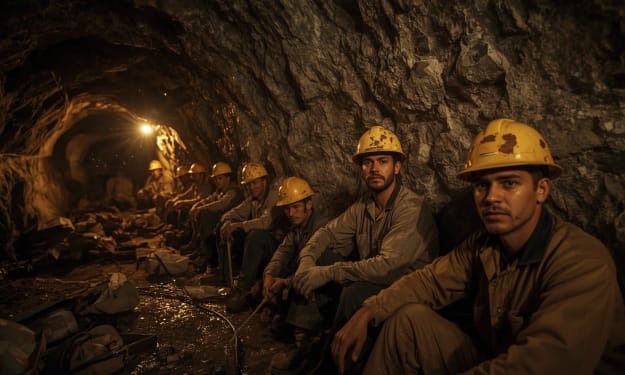
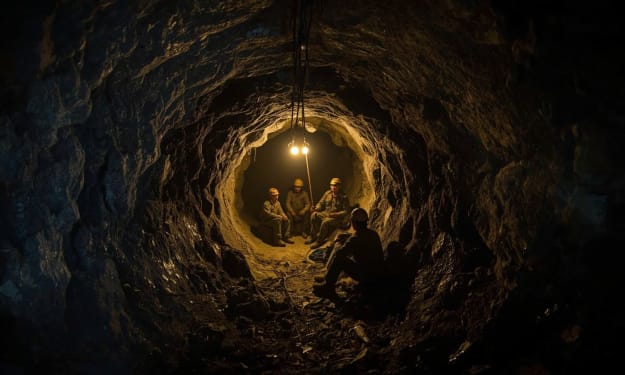
❖ The Collapse That Shocked the World On August 5, 2010, a normal shift at the San José copper-gold mine in northern Chile became a living nightmare. Deep underground, 33 miners were going about their routine when the earth above them gave way. Over 700,000 tons of rock collapsed into the mine, sealing off their exit and leaving them entombed more than 2,300 feet beneath the surface. Communication was lost. Rescue routes were destroyed. Dust choked the air. Families waiting outside feared the worst, as days passed without any sign of life. It was one of the most catastrophic mining disasters in recent history. ❖ 17 Days Without Contact For 17 long, terrifying days, the miners remained trapped with no communication with the outside world. The temperature in the refuge hovered around 30°C (86°F), and humidity was high. Food and water were scarce. They rationed what they had—two spoonfuls of tuna, half a biscuit, and a sip of milk every 48 hours. Yet the men didn’t give up. They established order and assigned roles. Leadership rotated, and they held daily meetings to maintain hope and structure. This discipline was critical to their survival. Above ground, rescuers refused to stop. Using drills, they searched for a sign, any sign, that someone was alive. ❖ “We Are Well in the Shelter, the 33” On August 22, a drill bit broke through. When rescuers pulled it back to the surface, they found a note wrapped around it: “Estamos bien en el refugio, los 33.” ("We are well in the shelter, the 33.") The world gasped. All 33 miners were alive—weak, dehydrated, but alive. The Atacama Desert, silent until now, erupted in cheers. Families cried. Global media arrived. What had started as a disaster became a symbol of hope. Rescuers sent down supplies through narrow tubes—food, water, clothes, medicine, even small luxuries like recorded messages and notes from loved ones. Psychologists helped the miners cope mentally while engineers worked tirelessly to drill a rescue tunnel. ❖ The Phoenix Capsule and Day 69 After weeks of technical planning, the rescue tunnel was complete. A special capsule named Phoenix, equipped with oxygen and safety gear, was built to pull each man up, one by one. On October 13, the first miner, Florencio Ávalos, surfaced. His tearful reunion with his family was broadcast around the world. Over 22 hours, each miner was brought up in the capsule—from the youngest, 19-year-old Jimmy Sánchez, to the oldest, 63-year-old Mario Gómez. The last man to emerge was their shift leader, Luis Urzúa, who had kept order and morale strong underground. When he stepped onto the surface, he hugged the Chilean President and said, “We have done what the whole world was waiting for. ❖ Life After Rescue Though all 33 men survived, their paths afterward varied. Some suffered trauma, nightmares, and anxiety. Others became motivational speakers or wrote books. Their story was turned into a Hollywood film, The 33, and they traveled to share their experience globally. But behind the fame was a heavy truth: survival did not erase what they endured. Many dealt with long-term health problems and struggled to return to work. Still, they remained symbols of human resilience and teamwork. ❖ Reflection The Chilean miners’ story isn’t just about escaping death—it’s about the strength of the human spirit in the darkest of places. Their survival was made possible by unity, leadership, and a refusal to give up. Their ordeal reminded the world that even when buried deep beneath despair, hope can still rise. ❖ A Lasting Reminder More than a decade later, their rescue is remembered as one of the greatest survival stories ever told. It united engineers, families, government, and strangers across the globe. It showed us that in a crisis, humanity can come together—across borders, professions, and beliefs—to save lives. Their story teaches us that when people believe in one another, even the impossible becomes possible.
By Echoes by Imadabout a year ago in Humans
The Day I Stopped Chasing Happiness
For years, I was always chasing something. A better job. A better body. A better version of myself. I had this belief that once I fixed everything in my life, I’d finally be happy. So I kept running — through achievements, relationships, and endless self-improvement routines.
By Muhammad Farhad Khanabout a year ago in Humans
Rafael Devers
Rafael Devers is one of the brightest stars in Major League Baseball (MLB) today. He plays for the Boston Red Sox, one of the most famous baseball teams in the world. Known for his powerful bat and exciting style of play, Devers has become a fan favorite in Boston and across the country.
By Farhan Sayedabout a year ago in Humans
"The Stranger Who Remembered Me Before I Was Born"
I was 27 the first time someone told me they remembered me before I existed. It happened on a late train — the kind that smells like metal and old gum, where time feels a little warped and nobody looks anyone in the eye.
By Hamad Haiderabout a year ago in Humans
Trapped 2,300 Feet Underground for 69 Days 😨
On August 5, 2010, a collapse in the San José copper-gold mine in northern Chile left 33 miners trapped nearly 2,300 feet underground. What began as an ordinary shift turned into a global drama, as families above and rescuers below raced against time. Against all expectations, every miner emerged alive after 69 days. Their story stands as a powerful example of human resilience and teamwork. The Collapse and First Hours Early that morning, a section of rock broke free above the work site, sending debris crashing down the shaft. The miners had just begun their day when the tunnel caved in, cutting off the main routes to the surface. In the darkness, 33 men scrambled to reach a refuge chamber stocked with basic supplies. Many were injured, frightened by tumbling rocks and the echo of shifting earth. When dust settled, they found themselves isolated in a narrow chamber, far from escape routes. Initial estimates feared no one had survived. Only after hours of drilling and probe communications did rescuers confirm that all 33 were alive. That first contact offered a glimmer of hope, but the situation remained dire: limited food, uncertain water supplies, no quick way out, and the psychological weight of being buried deep beneath solid rock. Rationing Supplies and Maintaining Morale Inside the refuge, miners shared small rations of biscuits and water. With each passing day, they faced hunger, dehydration risk, and cramped conditions. Yet they understood that survival depended on calm planning. A clear plan emerged: Strict food rationing: Initial supplies would need to last far longer than anyone first expected. Each person accepted tiny portions, knowing waste could mean death. Daily routines: To preserve mental health, the group set a schedule: time for exercise stretches in place, rotations for tasks like checking air quality, and moments to share news or personal stories. Leadership and roles: Senior miners and those with medical or technical knowledge guided decisions. Everyone had a role: monitoring oxygen levels, organizing mealtimes, or leading brief discussions on future plans. Spiritual and emotional support: Many miners drew strength from prayer meetings, singing, or simply talking through fears. They encouraged one another to stay hopeful, reminding each other of families waiting above. This discipline and unity kept panic at bay during the weeks that followed. Communication with the Surface After about 17 days, a small borehole reached the chamber. A capsule lowered through it carried food, water, and a note: “We will not abandon you.” That first supply drop changed everything. Though limited, fresh provisions arrived regularly through drilling channels. The miners wrote messages back, describing their status and asking for news of their families. Each exchange boosted morale, confirming that rescue efforts continued. Engineers on the surface worked tirelessly to widen these boreholes into escape shafts. Complex drilling in hard rock at depth posed enormous technical challenges. International experts advised on machinery and methods, while families and the nation watched anxiously. The miners knew rescuers were struggling but felt renewed resolve each time fresh supplies arrived. Ingenuity Below and Above Underground, creativity emerged even in darkness. Miners used salvaged materials to rig basic lighting, stretch their legs, and maintain hygiene as best they could. They organized shifts to clean shared space, keep debris clear, and collect condensation for water. Teamwork extended to emotional care: when someone felt despair, others shared memories or joked to lighten spirits. Above ground, engineers drilled three separate rescue shafts, each following different techniques to maximize chances. The final successful shaft used a custom-designed capsule, later nicknamed “Fénix” (Phoenix). The capsule’s dimensions had to fit narrow tunnels yet remain sturdy enough to transport a person safely up nearly half a mile of rock The Rescue and Aftermath On October 13, after 69 days underground, the first miner entered the capsule and began the ascent. World leaders watched live broadcasts. One by one, all 33 men emerged back into sunlight, weak but alive, greeted by tears and cheers. Their return inspired millions, showing that even the deepest darkness cannot overcome united hope and effort. Recovery was only the beginning. Many miners faced long-term physical and psychological challenges—muscle atrophy, emotional trauma, and the task of rebuilding lives. Yet most went on to share lessons learned: the value of solidarity under crisis, the power of disciplined planning, and the importance of maintaining hope when circumstances seem hopeless. Why This Story Resonates Teamwork under pressure: The miners’ coordinated daily routines and mutual encouragement prevented panic and gave structure to survival. Human ingenuity: Simple solutions—rigorous rationing, makeshift lighting, creative use of limited resources—proved vital underground. Above ground, global expertise converged to solve unprecedented drilling challenges. Emotional resilience: Maintaining hope for over two months in total darkness required deep mental strength, bolstered by shared faith, humor, and daily reminders of families above. Universal inspiration: This event united people worldwide in empathy and admiration. It remains a reminder that in crisis, cooperation and caring can overcome seemingly insurmountable odds. Reflection: Being buried deep underground for weeks tests every limit of body and mind. Yet the Chilean miners’ experience shows how solidarity, discipline, and hope turn dire situations into stories of triumph. When faced with personal challenges or broader crises, their example encourages finding strength in community and trusting collective effort. > What lessons can be drawn when ordinary people unite under extraordinary pressure? How might that spirit of cooperation apply in daily life? Author’s Note: > This article is based on verified reports, interviews with survivors, and reputable sources. It has been revised and polished by the author for clarity and authenticity.
By Echoes by Imadabout a year ago in Humans