
King Charles Hosts an Extraordinary Gathering at Buckingham Palace: The Remarkable Minds Behind Britain's Order of Merit
From the inventor of the World Wide Web to world-renowned scientists, artists, and medical pioneers, the King's latest gathering celebrated people whose achievements have helped shape the modern world.

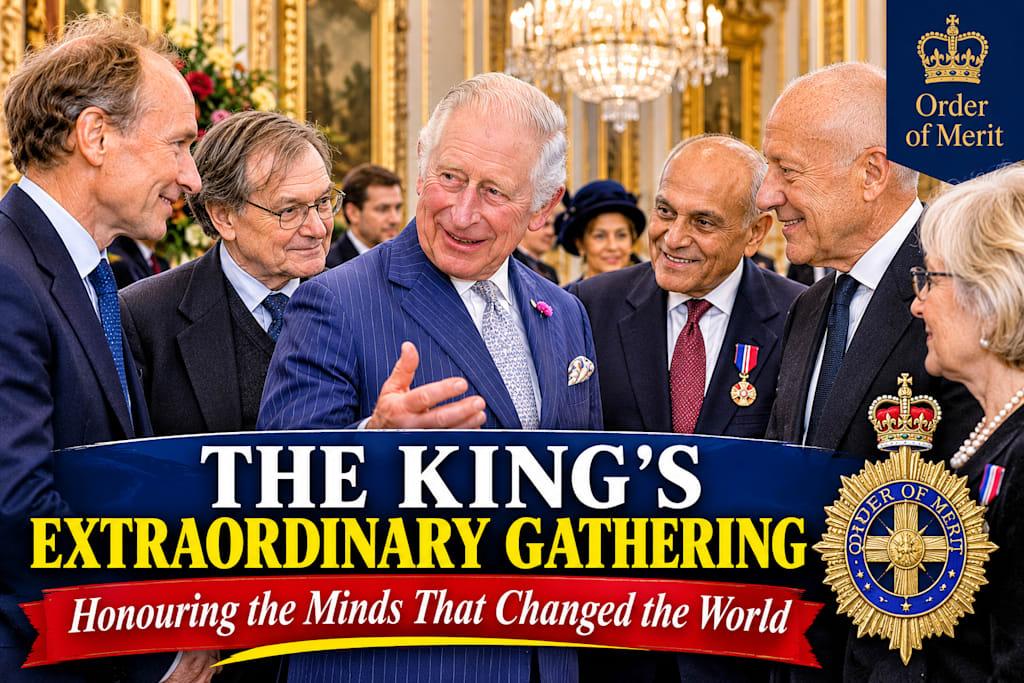
Inside Buckingham Palace, some gatherings are remembered not for their size or spectacle, but for the extraordinary people sitting around the same table.
On November 12, 2026, King Charles III hosted a luncheon for members of the Order of Merit, bringing together individuals whose achievements have made lasting contributions to science, medicine, literature, architecture, public service, and the arts.
Among those invited were Sir Timothy Berners-Lee, widely recognised for inventing the World Wide Web; Professor Sir Roger Penrose, the celebrated mathematical physicist; Professor Sir Magdi Yacoub, one of the world's best-known heart surgeons; and architect Lord Norman Foster.
It was an impressive collection of talent, experience, and achievement.
Yet the significance of the occasion went beyond a royal luncheon. It offered a reminder that a country's greatest achievements are often built by people whose influence reaches far beyond their own professions.
An Honour Unlike Most Others
The Order of Merit is among the most distinctive honours in the British honours system.
Founded by King Edward VII in 1902, it recognises exceptional contributions to the arts, learning, literature, science, and other areas of public life.
Unlike many honours, membership is awarded personally by the Sovereign. The Order is restricted to 24 ordinary members at any one time, making it an exceptionally exclusive distinction.
It does not automatically give recipients a new title or rank. Instead, members may use the letters OM after their names.
Its history includes some extraordinary figures, among them Florence Nightingale, Winston Churchill, Bertrand Russell, and Dorothy Hodgkin.
The honour reflects a particular idea of achievement: recognition not simply for holding an important position, but for making a contribution that changes how people understand, experience, or improve the world.
The Man Behind the World Wide Web
One of the most recognisable names at the luncheon was Sir Timothy Berners-Lee.
His invention of the World Wide Web transformed communication, education, business, and everyday life.
Today, billions of people use websites to learn, work, exchange information, and connect with others. What began as a system for sharing information has become one of the most influential developments in modern history.
Yet the technology itself is only part of the story.
Berners-Lee has also spoken about the importance of keeping the web open, accessible, and useful for humanity.
His presence at Buckingham Palace represented the extraordinary influence that one person's ideas can have across generations.
A technology developed decades ago continues to shape the lives of people who were not even born when it first appeared.
Science That Changed Our Understanding of the Universe
Professor Sir Roger Penrose was another distinguished guest.
Known for his contributions to mathematical physics and the study of black holes, Penrose has helped transform scientific understanding of some of the universe's most complicated questions.
His work demonstrates the importance of curiosity and the willingness to challenge established ideas.
Scientific progress rarely happens overnight. It often requires years of research, difficult questions, repeated experiments, and the courage to explore possibilities that others may not immediately understand.
Penrose's achievements illustrate how theoretical ideas can influence the way future generations approach science.
The King's gathering therefore brought attention not only to scientific success, but also to the patience and intellectual commitment behind it.
A Life Dedicated to Saving Hearts
Professor Sir Magdi Yacoub represented another extraordinary field: medicine.
A pioneering cardiothoracic surgeon, Yacoub is internationally respected for his contributions to heart surgery and medical research.
His career has been associated with efforts to improve treatment for people suffering from serious heart conditions.
His work also demonstrates that medical achievement is not measured only through discoveries or professional recognition. Its real importance can be seen in the lives of patients and families who benefit from better treatment.
For many people, the work of a surgeon or medical researcher may remain invisible. They may never meet the individual responsible for an important development, but they experience its impact through improved healthcare and the possibility of a longer life.
That human dimension gives medical achievement a special place in any celebration of public contribution.
Architecture, Art, and Ideas
The gathering also included Lord Norman Foster, whose architectural work has influenced skylines and public spaces around the world.
Architecture is more than the construction of impressive buildings. It affects how people move through cities, interact with their surroundings, and experience public spaces.
The Order of Merit also recognises achievements in the arts and learning, demonstrating that progress is not limited to laboratories or hospitals.
Artists, writers, architects, and historians help societies preserve their memories, question their assumptions, and imagine new possibilities.
The presence of people from such different backgrounds made the luncheon particularly meaningful.
It was a meeting of individuals whose professions may seem very different, yet whose work shares one important quality: a lasting contribution beyond personal success.
A Royal Tradition With a Modern Meaning
King Charles's luncheon continued a tradition associated with the Order of Merit and the Sovereign's personal role in recognising exceptional achievement.
According to the official Court Circular, the King attended a service in the Chapel Royal at St James's Palace for members of the Order before hosting the Buckingham Palace luncheon.
The event brought together figures whose work has influenced millions of lives, often without those people knowing the names behind the achievements.
In an age when public attention frequently moves from one headline to another, the occasion offered a different perspective on success.
It reminded observers that lasting influence is not always loud, fashionable, or immediately visible.
Sometimes it comes from a scientist spending decades investigating a difficult problem, a doctor dedicating a lifetime to saving patients, an architect reimagining cities, or an inventor creating something that changes how the world communicates.
King Charles's gathering was therefore more than a formal royal engagement. It was a celebration of human imagination, dedication, and service.
And perhaps that is the most important lesson behind the Order of Merit: true distinction is not simply about being recognised. It is about leaving something valuable behind for others.
Which achievement do you believe has had the greatest impact on modern society: the World Wide Web, medical breakthroughs, scientific discoveries, or architecture and the arts?
About the Creator
Behind the Curtain
"Exploring the untold stories and hidden truths. From royal rumors to cultural deep dives, Behind the Curtain brings you bold, insightful narratives that spark curiosity and conversation."
Enjoyed the story? Support the Creator.
Subscribe for free to receive all their stories in your feed.
Comments
There are no comments for this story
Be the first to respond and start the conversation.