
Humanity Just Crossed a Line: There Are Now More Elderly People Than Children
The global milestone is real. The crisis isn’t. Every country is aging on a different clock, and some aren’t aging fast enough to notice yet.
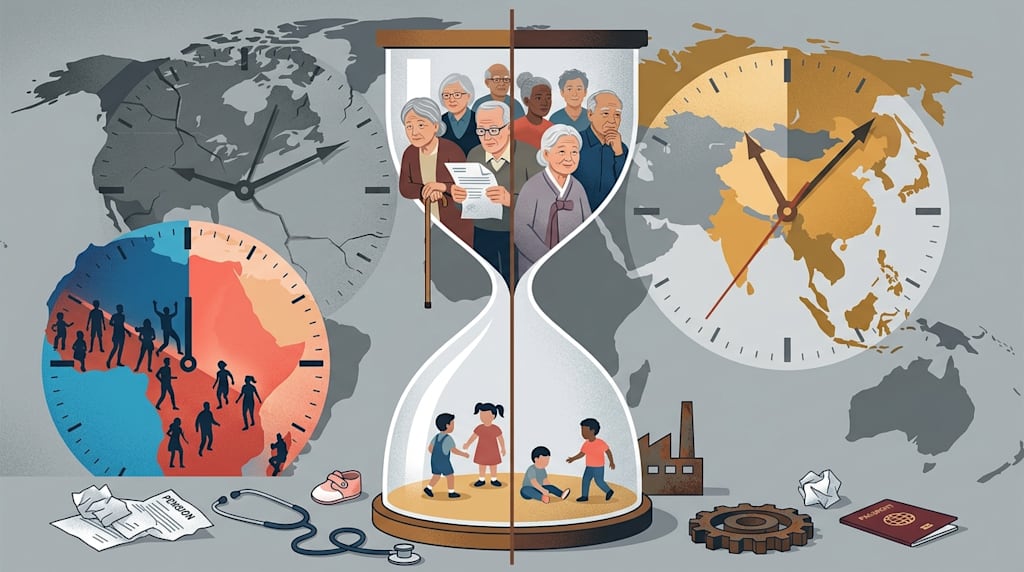
The divergence of demographic clocks
In 2025, the global population aged 65 and over was about 852 million, or 10.5% of the total. Children under 5 accounted for less than 10%. This is the first time on record that the former has outnumbered the latter.
Two numbers drive this change. The global total fertility rate fell from 3.74 in 1980 to 2.25 in 2023, and more than 71% of the world's population lives in countries with fertility rates at or below replacement level. A decade ago, that share was 45%. Over the same period, global average life expectancy rose from 60.5 to 73.2 years. Fewer births, longer lives: the base of the population pyramid is narrowing, while the top is expanding.
But this "global first" matters more as a statistic than as an economic event. Different economies' demographic clocks run at completely different speeds.
Asia is expected to see the largest increase in the population aged 65 and over, rising from 487 million in 2025 to 1.24 billion in 2060, accounting for two-thirds of the global increase. Europe is currently the most aged region, with the share of those 65 and over rising from 21% to 30.8%. But Africa's older population will also grow from 60 million to 249 million, surpassing Europe's 214 million by then. Aging is not at all the core issue for African countries today. Sub-Saharan Africa remains in a high-fertility stage, with informal employment accounting for 80% of the labor force, and pension coverage and fiscal sustainability not yet established. These countries need to cope with population expansion and turn a huge population into an effective labor force.
India is in a different position. In 2025, India has the world's largest young population, with about 138 million people aged 60 and over. By 2050, one in five Indians will be over 60. India needs to build pension, medical, and care systems for a rapidly growing older population before completing its infrastructure. Many older people face disability, unpaid care, declining labor force participation, and rising out-of-pocket medical expenses. This is what "aging before growing rich" means in concrete terms.
Developed countries that are already deeply aged face a different problem. Japan has the world's highest share of people aged 65 and over at 29.7%; South Korea is expected to overtake Japan with 41% by 2060. These countries face pressure on pension payments, structural labor shortages, and long-term care needs. They are already responding by bringing in foreign workers, extending working lives, and reforming pension systems.
Germany's approach is to establish a multi-level coordinated governance structure at the federal, state, and local levels, and it pioneered a universal long-term care insurance system. In 2025, the German cabinet approved an "active pension" plan, under which employees who continue working beyond the standard retirement age can earn up to 2,000 euros a month tax-free. Japan has built a system of "legal guarantees plus diverse measures." The Basic Act on Measures for an Aging Society and other laws lay the institutional foundation. Long-term care insurance covers all people aged 65 and over, and foreign care workers are being recruited: plans call for raising the cap on foreign workers from 350,000 to 800,000 over the five years starting in 2024. South Korea implemented pension reform in April 2025, raising the mandatory pension contribution rate from 9% to 13%.
China's path balances institution-building and human resource development. According to the 2025 work plan on aging, China will take 15 years to advance a gradual delay of retirement, raising the statutory retirement age for male employees from 60 to 63, and for female employees from 50 and 55 to 55 and 58, respectively. At the same time, it explicitly proposes "promoting productive aging," optimizing age-limit policies in employment and social security, and developing the silver economy. Fudan University's Institute on Aging predicts that by 2035 China's silver economy will reach about 30 trillion yuan, accounting for 9.6% of GDP.
The IMF's 2025 World Economic Outlook predicts that global output growth will be about 1.1 percentage points lower by 2050 than the 2016–2018 level. In the emerging Europe region covered by the European Bank for Reconstruction and Development, the decline in the working-age population share is expected to reduce per capita GDP growth by about 0.4 percentage points per year on average from 2024 to 2050. Allianz's 2025 Global Pension Report estimates a global pension savings gap of about $51 trillion, requiring an additional $1 trillion in retirement savings each year for the next 40 years.
But the IMF also notes that today's 70-year-olds have the cognitive acuity of 53-year-olds in 2000, and better health has raised the probability of older people participating in the labor market by 20 percentage points. If countries promote preventive medicine, delay retirement, and narrow gender gaps, annual growth could increase by as much as 0.6 percentage points, offsetting about 75% of the demographic drag during this period.
These numbers show that population issues are not the same everywhere. Japan is anxious about how to provide care for nearly 30% of its population who are elderly; India is exploring how to build a safety net for a population that is aging rapidly before it becomes wealthy; and more African countries must first answer how to provide education and jobs for a huge young population. Labor and talent can flow globally, which to some extent alleviates labor shortages in aging economies, but it also makes it harder for later-developing countries to smoothly enter their demographic dividend period.
The number "older people outnumber children" is not a reason to "worry before the rest of the world worries." Each economy needs to recognize its own demographic stage and choose policies to match. The global totals matter less.
About the Creator
Jin
Writer of reamstories
https://reamstories.com/jin
Enjoyed the story? Support the Creator.
Subscribe for free to receive all their stories in your feed. You could also become a paid subscriber, letting them know you appreciate their work.
Comments
There are no comments for this story
Be the first to respond and start the conversation.