
Catholics hit back at president for posting AI image of himself as Jesus
'Trump has crossed a line!
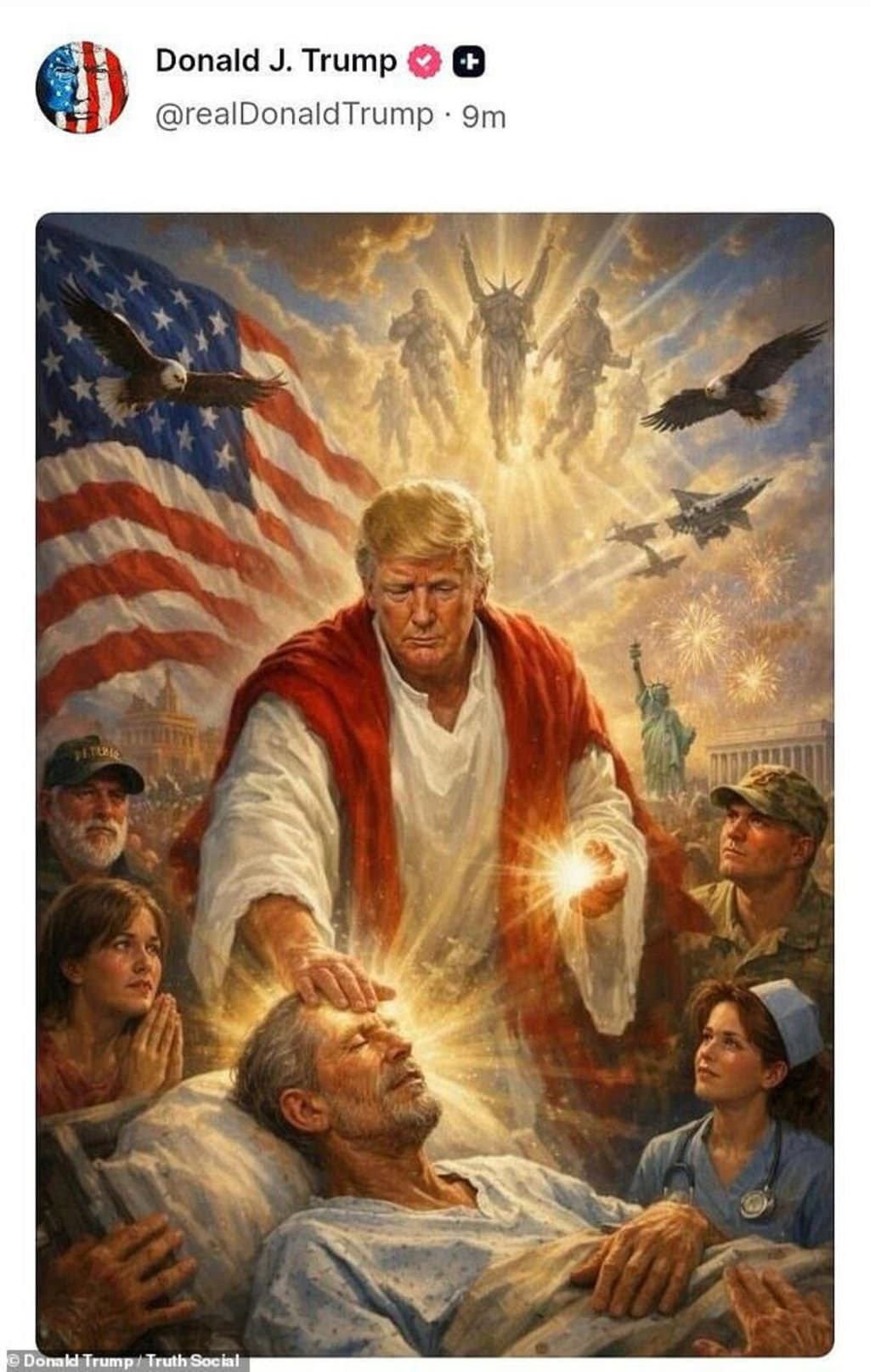
When Donald Trump posted an AI-generated image of himself depicted in the likeness of Jesus Christ — glowing, messianic, and draped in symbolism drawn directly from Christian iconography — he did not merely court controversy. He ignited a firestorm of condemnation that crossed continents, faiths, political allegiances, and even the boundaries of his own inner circle. And for once, the backlash did not come only from his opponents.
Mark Burns, the American pastor who once served as Trump's personal spiritual adviser, went on Times Radio to reveal that he had privately urged the President to take the image down. It was, Burns said, "a step too far" — one that "so clearly offends millions of Christians and Catholics all over the world." When a man who has spent years defending Trump's religious credibility tells him he has gone too far, it is worth pausing to consider what exactly has been crossed.
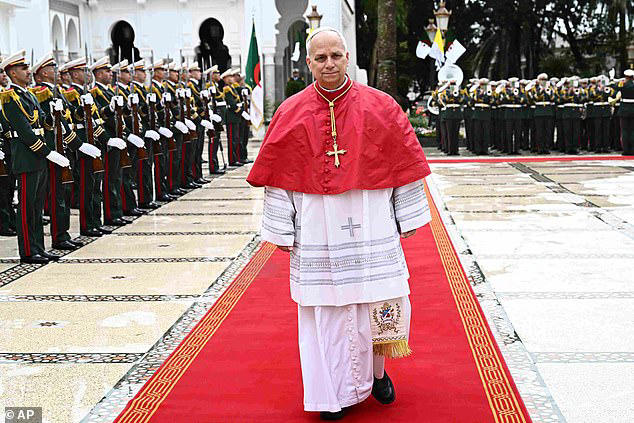
The answers came swiftly, and from every direction. British Cardinal Timothy Radcliffe, who had just participated in the papal conclave that elected the new Pope Leo XIV, told BBC Newsnight that the post was "just quite frankly bizarre." He was measured but pointed in his assessment, noting that while many had called the image blasphemous — implying a deliberate attack on Christianity — he did not believe that was Trump's intention. What it did reveal, however, was something the Cardinal found almost equally troubling: a complete misunderstanding of what Christianity is fundamentally about. When Trump later attempted to explain himself, claiming the image was meant to show him "as a doctor, making people better," Radcliffe's response was dry and devastating. "I find it very strange," he said. "I've met many doctors in my life and none of them have glowed quite like that."
The condemnations kept coming. Father Gary Donegan, a prominent Catholic priest based in Belfast, did not mince words, describing the post as "verging on blasphemy" and calling Trump a "wannabe King" who mocks Christ. Speaking to the Irish Times, he drew on his own decades of pastoral experience — 35 years at the bedsides of the sick and dying, including seven people who had died in his arms — to convey just how sacred the imagery Trump had so casually appropriated truly is. "As I anointed the sick," he said, "it's a profoundly sacred and holy experience." He called on every American who "represents Jesus" to hold the President accountable, and said he would pray for the American people. His conclusion was blunt: "Depicting himself as Our Lord blessing the sick is indeed sick in itself."
Archbishop Paul Coakley, president of the US Conference of Catholic Bishops, said he was "disheartened," and offered a reminder that seemed necessary precisely because it should not have been. "Pope Leo is not his rival," Coakley said, "nor is the Pope a politician. He is the Vicar of Christ who speaks from the truth of the Gospel and for the care of souls." The fact that such a clarification needed to be made publicly speaks volumes about the nature of the moment.
The condemnation reached beyond the English-speaking world with remarkable speed. Former Italian Prime Minister Matteo Renzi, a Catholic himself, called the image "crazy," "ridiculous," and "silly," and said flatly that Trump had "destroyed his credibility" by posting it. Even Giorgia Meloni — Italy's current Prime Minister and one of the White House's most reliable right-wing allies in Europe — broke ranks. "I find President Trump's words towards the Holy Father unacceptable," she said, adding that the Pope, as the head of the Catholic Church, had every right to call for peace. Perhaps most striking of all was the response from Iran, a nation that finds itself in the crosshairs of Trump's foreign policy. Iranian President Masoud Pezeshkian took to social media to write: "I condemn the insult to Your Excellency... the desecration of Jesus is not acceptable to any free person." When Tehran and the Vatican find themselves on the same side of a controversy, the breadth of the miscalculation becomes impossible to ignore.
The image did not emerge in a vacuum. It was the latest and most incendiary episode in a rapidly escalating feud between Trump and Pope Leo XIV — the first North American to lead the Catholic Church, whose election had itself been a historic moment. The Pope had used his platform to speak with unusual directness about the moral dimensions of war, stating that God rejects the prayers of leaders who start wars with "hands full of blood." He called the conflict in Iran "atrocious," urged Trump to find an "off-ramp," and described the President's threat to wipe out Iranian civilization as "truly unacceptable." They were not the words of a diplomat seeking to avoid friction. They were the words of a man who had decided that his office required him to speak plainly, regardless of the consequences.
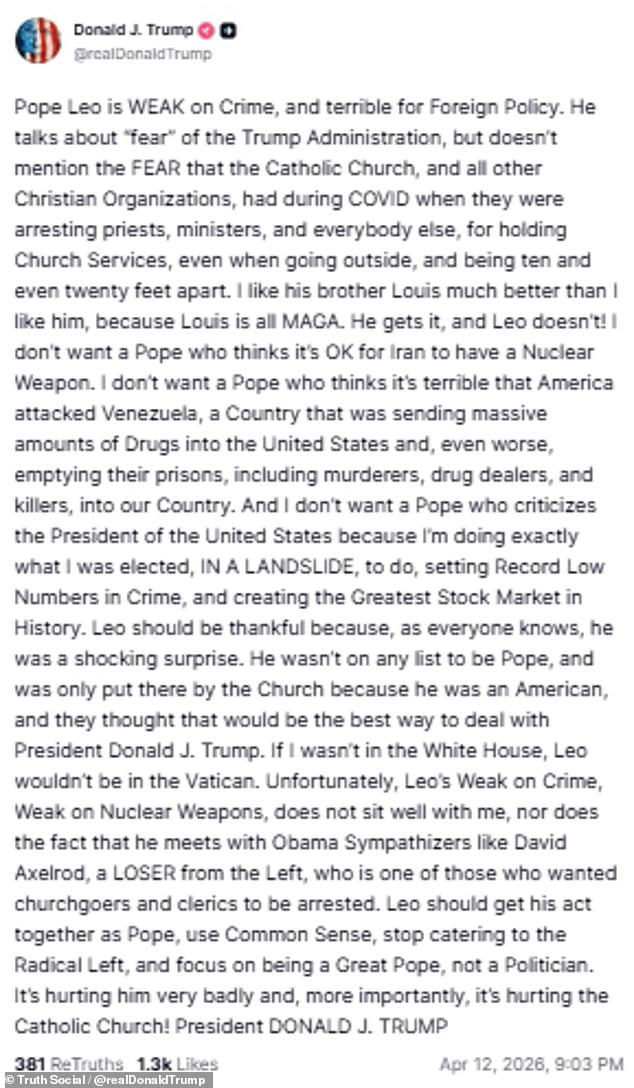
Trump's response was characteristically combative. Taking to Truth Social, he wrote that he did not want a Pope who criticizes the President of the United States, and made the extraordinary claim that "if I wasn't in the White House, Leo wouldn't be in the Vatican." He called the Pope "a very liberal person" who "doesn't believe in stopping crime," and doubled down when pressed by reporters. Leo, for his part, said he had "no fear" of the administration but had no desire to get drawn into a public debate. Of the AI image, he was quietly withering: "I don't think the message of the Gospel is meant to be abused in the way that some people are doing."
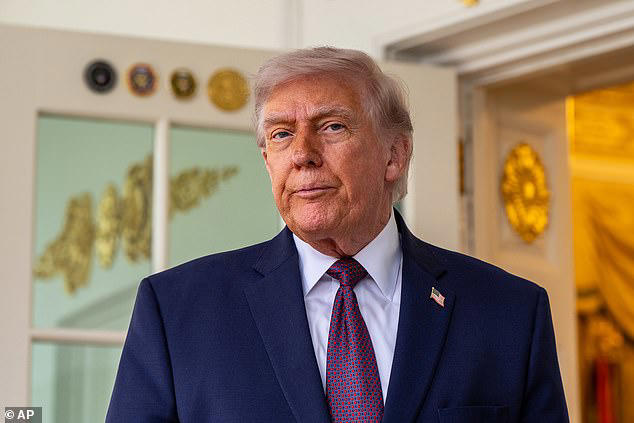
Even within Trump's own coalition, the image proved a step too far. After widespread condemnation — including from supporters in the United States — Trump removed it from social media. He did not apologize. At an impromptu press conference held, surreally, while receiving a McDonald's delivery at the Oval Office, he insisted the picture had been misread. "It's supposed to be me as a doctor, making people better," he told reporters. "And I do make people better." He accused the media of manufacturing a narrative and maintained there was "nothing to apologise for." Vice President JD Vance, himself a convert to Catholicism, offered what amounted to a diplomatic rebuke of the Pope wrapped in the language of institutional boundaries, suggesting that the Vatican should "stick to matters of morality" and leave American public policy to the President.
What makes this episode so revealing is not simply the image itself, but the context in which it appeared. Trump has long cultivated a deep relationship with America's evangelical Christian base, who backed him through scandal, impeachment, and personal controversy across two election cycles. He has sold Bibles branded with his own name at $60 a copy. At his inauguration, he declared he had been "saved by God" following a 2024 assassination attempt on the campaign trail and has leaned increasingly into religious language throughout his second term. Whether that represents genuine spiritual conviction or shrewd political branding is a question only Trump can truly answer. What is clear is that somewhere between the branded Bibles and the AI-generated messianic imagery, the line between faith and performance has become very difficult to find. And for millions of Christians around the world, that line — wherever it once was — has now been crossed.
About the Creator
Enjoyed the story? Support the Creator.
Subscribe for free to receive all their stories in your feed.
Comments
There are no comments for this story
Be the first to respond and start the conversation.