
Why Does Every Town in America Have a Lover’s Leap?
Iron Lighthouse Exclusive

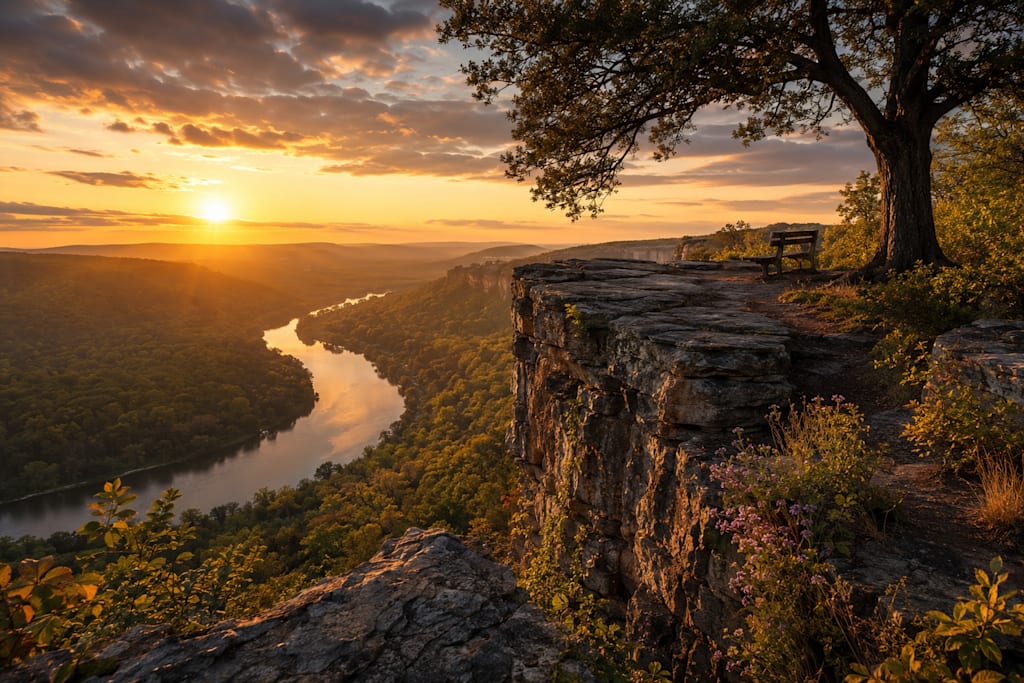
Drive long enough through the mountains, forests, and back roads of America and eventually you may encounter a peculiar sign... LOVER’S LEAP.
Perhaps it points toward a scenic overlook, a towering cliff above a river, or simply an impressive outcropping of rock overlooking a valley. Whatever the landscape, the name immediately demands an explanation: Who were the lovers? Why did they leap? And, perhaps most curiously, why does practically every other state seem to have one too?
Welcome to one of the strangest recurring legends in American folklore. There isn’t just one Lover’s Leap; there are dozens! They appear in Texas, Virginia, Missouri, Vermont, Georgia, California, West Virginia, Connecticut, and beyond. Some overlook rivers, others rise above forests or mountain valleys, and many have become beloved local landmarks. Yet, an astonishing number come equipped with roughly the same story: two young people fall desperately in love, their families, tribes, or communities forbid the relationship, and the lovers realize they can never be together. There is usually an angry father somewhere in the proceedings, and eventually, someone ends up at the top of a cliff. Things deteriorate rapidly from there. The names change, the geography changes, the historical period changes, but the legend remains remarkably consistent.
But somehow, America has spent centuries repeatedly producing the same tragic romance beside convenient geological formations. Once you notice the pattern, it’s impossible not to wonder what’s happening. The answer takes us deep into the strange intersection of American folklore, nineteenth-century romanticism, and the birth of domestic tourism. The phrase “Lover’s Leap” is older than the United States itself; versions of the term appeared in English long before Americans began attaching it to scenic overlooks. The basic concept… A dramatic precipice connected to doomed romance fit perfectly into European traditions of tragic storytelling. During the nineteenth century, America provided fertile ground for the legend to multiply, as the young nation was discovering its scenery. Railroads pushed into previously difficult-to-reach regions, resorts appeared near springs, waterfalls, caves, and mountains, guidebooks encouraged Americans to explore their own country, and towns competed for visitors. Suddenly, having a beautiful view was good business. There was only one problem: everybody had beautiful views. A cliff was impressive, but a cliff with a tragic love story attached to it? Now you had something.
Visitors didn’t merely stand at the overlook; they asked what happened there. Someone told them the legend, and they repeated it when they returned home. Postcards appeared, travel writers mentioned it, and local newspapers retold the story. Before long, an ordinary geological formation had acquired something far more valuable than another hundred feet of elevation: it had a mythology.
By the early twentieth century, the Lover’s Leap phenomenon had become common enough to inspire jokes. Humorist Ellis Parker Butler, who had experience producing promotional books for American communities, wrote about the formula used to advertise towns; such publications naturally included photographs of Main Street, the local school, government buildings, prosperous homes, and scenic attractions. And, according to Butler, remarkably often there was a Lover’s Leap. Even people living at the time had apparently noticed America’s suspicious surplus of romantically fatal cliffs.
The stories attached to those locations varied tremendously in detail while remaining remarkably similar in structure. One of the best-known examples is at Cameron Park in Waco, Texas, where a cliff overlooking the Brazos and Bosque river country became associated with a tale of two Native American lovers whose relationship was supposedly forbidden. Like many Lover’s Leap legends, the story evolved through retelling and publication until the romantic tragedy became inseparable from the landscape itself.
The problem is that documentation supporting many such stories is often remarkably thin, which leads us to one of the more complicated aspects of the Lover’s Leap phenomenon: many American versions involve Native American characters. To nineteenth-century audiences, Indigenous legends provided exactly the kind of ancient, tragic atmosphere that tourism promoters and writers wanted. Native characters frequently appeared in poems, novels, paintings, advertisements, and local legends as symbols of a supposedly disappearing romantic past. Unfortunately, storytellers often cared more about creating compelling narratives than accurately representing Indigenous cultures; names were invented, tribal customs were simplified or fabricated, communities that historically had little connection were transformed into mortal enemies, and complicated societies became scenery for romantic tragedy.
As a result, many Lover’s Leap legends tell us considerably more about the Americans who repeated them than about the Indigenous people supposedly depicted in them. In some cases, historians examining the legends have found that the alleged customs at the center of the story don't align particularly well with what is known about the cultures involved, but that rarely stopped a good story. Once a legend became attached to a place, it developed remarkable staying power.
Consider what happens when someone visits an overlook in 1885: a local resident tells them that two lovers jumped from the cliff generations earlier. The visitor has no practical way to verify it; there’s no internet, local archives may be nonexistent, and the supposed event may have occurred decades or even centuries before. So, the visitor accepts the story. Perhaps they write it in a letter, perhaps a newspaper prints it, or someone publishes it in a travel guide. Twenty years later, another writer encounters the printed version and assumes the earlier author had reliable information. The story gets printed again, and eventually, nobody remembers where it started. Folklore quietly puts on a necktie and introduces itself as history.
Occasionally, the transformation becomes almost comical. An old Vermont account describes a place known as Lover’s Leap, even though the local incident involved two men quarrying stone; one fell. No forbidden romance, no feuding families, no desperate lovers embracing beneath the moonlight, just an unfortunate quarrying accident. Yet, somehow, the landscape still ended up with the far more marketable name: Lover’s Leap. Apparently, “Unfortunate Quarry Worker’s Plunge” lacked the necessary tourism appeal.
The story illustrates something important about place names: people don’t simply describe landscapes; we narrate them. A mountain becomes more memorable when someone tells us a story about it. A cave becomes mysterious when legends surround it. A battlefield becomes sacred when we know what happened there. And a cliff becomes irresistible when someone whispers that two people once loved each other enough to choose the precipice rather than separation. Whether the story is true almost becomes secondary. The legend changes how people experience the place.
That may explain why Lover’s Leap landmarks spread so successfully across America. They emerged during an era when communities were learning how to market themselves to travelers: railroads needed destinations, resorts needed attractions, and towns needed reasons for outsiders to stop rather than continue down the line. Nature provided the scenery; folklore provided the advertising copy.
None of this necessarily means that some Lover’s Leap locations don’t preserve memories of genuine tragedies; people have fallen from cliffs throughout history, and local stories sometimes begin with actual events. But the sheer repetition of the same romantic formula should make us cautious whenever legend presents itself as documented history. And perhaps that uncertainty is precisely what makes these places so fascinating.
Today, many Lover’s Leap landmarks remain popular scenic destinations. The old postcards have faded, railroad tourism has changed, and Victorian travel writers are long gone, yet the names remain attached to maps, parks, overlooks, and roadside signs. Modern visitors still stand at the edge, still admire the view, and inevitably someone still asks: “Why do they call it Lover’s Leap?” Then the story begins again.
Maybe two lovers really stood there generations ago. Maybe a genuine tragedy slowly became romanticized. Maybe a nineteenth-century writer borrowed a familiar legend and attached it to a convenient cliff. Or maybe some enterprising town promoter simply looked at an impressive overlook and realized that every respectable tourist destination apparently needed doomed lovers. After enough generations, separating those possibilities becomes almost impossible. But perhaps that is the real story of Lover’s Leap.
America is covered with landscapes whose histories exist somewhere between fact and folklore. We inherit the names, we inherit the stories, we repeat them, and eventually the distinction between what happened and what people have always said happened begins to disappear. So the next time you’re traveling down some forgotten highway and see an old sign pointing toward LOVER’S LEAP, pull over. Take the walk, stand at the overlook, admire the view, and when someone tells you the heartbreaking story of two doomed lovers who supposedly stood on that very spot long ago, listen closely. They may be telling you a piece of history. They may be telling you a piece of folklore. Or they may be repeating one of the most successful tourism stories America ever told itself. Either way, more than a century later, it still worked. You stopped...
About the Creator
The Iron Lighthouse
Where folklore meets freeway. A guide to the strange heart of the American backroads...
Enjoyed the story? Support the Creator.
Subscribe for free to receive all their stories in your feed.
Comments
There are no comments for this story
Be the first to respond and start the conversation.