
When America Built Buildings That Looked Like Lunch
Munchy Monday Edition
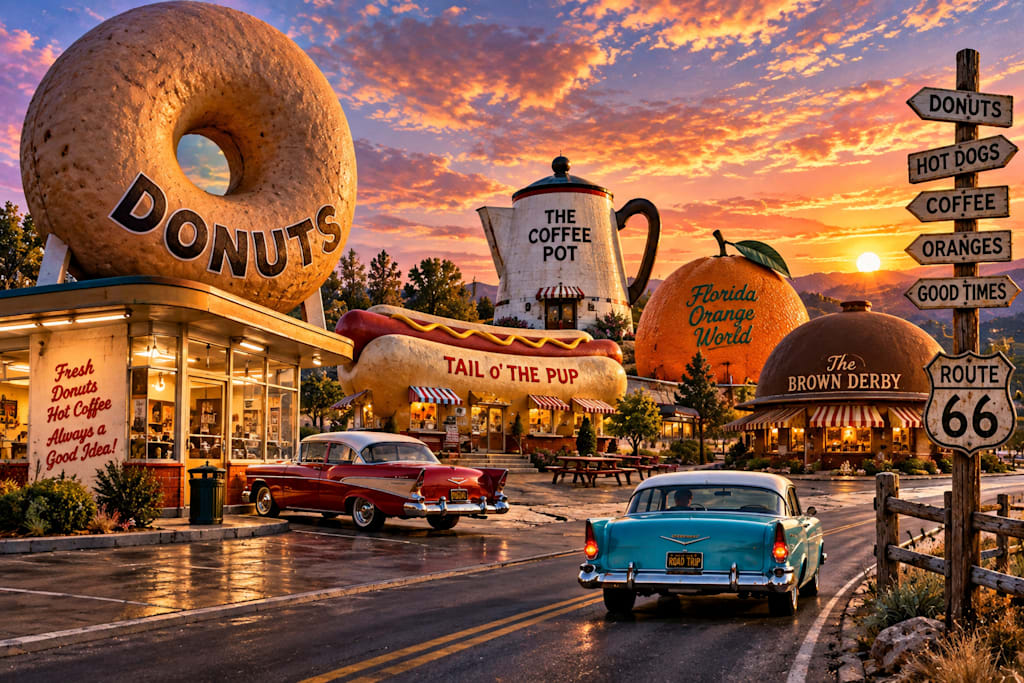
Should the building look like the food? For a surprising number of business owners, the answer was yes. Absolutely... Make it enormous!
During the great flowering of American roadside culture in the twentieth century, motorists encountered restaurants shaped like hot dogs, cafés resembling gigantic coffee pots, enormous oranges dispensing juice, colossal milk bottles, buildings topped by donuts large enough to feed a small town, and establishments that looked as though someone had dropped the contents of a kitchen onto the side of the highway.
Today we might call it kitsch. Architectural historians have more dignified terminology: mimetic architecture, programmatic architecture, novelty architecture. But the basic idea was wonderfully simple... if you're selling something, build a building that looks like it.
The phenomenon wasn't merely a bizarre American fascination with constructing habitable food. It developed alongside one of the greatest transformations in American life: the automobile.
As cars became increasingly common during the early twentieth century, the relationship between businesses and customers changed. A traditional shop on a city street had pedestrians. People walked past slowly. They could examine windows. They could read signs. They might stop and browse.
The roadside business had a different problem: its potential customer was approaching at thirty or forty miles per hour. The driver might have only seconds to notice the establishment, understand what it sold, and decide whether to stop. A small sign wasn't always going to accomplish that. A gigantic coffee pot? Now we're talking.
Southern California became particularly enthusiastic about this new architectural language during the 1920s and 1930s. The region was expanding rapidly, automobile ownership was booming, and commercial strips increasingly catered to motorists. Suddenly buildings weren't merely buildings; they were advertisements. Instead of putting a billboard beside your restaurant, you could make the restaurant itself the billboard.
Want to sell oranges? Build an orange. Want to sell tamales? Make the stand look like a tamale. Want to sell coffee? Apparently there was only one responsible course of action: construct the largest coffee pot local zoning officials would tolerate.
One of the great surviving examples stands far from California in Bedford, Pennsylvania. Built in 1927, The Coffee Pot looks exactly like its name suggests: a gigantic metal coffee pot large enough for people to enter. It originally served motorists as a lunch stand along the Lincoln Highway. And really, what additional advertising did it need?
Imagine driving through Pennsylvania in 1927.
"Honey, I'd like some coffee."
"We should look for a café."
"Never mind. I SEE THE COFFEE!"
The Coffee Pot eventually outlived its original purpose, deteriorated, and faced an uncertain future. But instead of allowing this wonderfully peculiar piece of roadside history to disappear, preservationists saved and relocated it. Because somewhere along the way, a giant coffee pot stopped being merely an advertisement. It became Americana.
California, meanwhile, continued operating on the principle that architecture could always use more lunch. One of its most beloved survivors is Tail o' the Pup, the famous Los Angeles hot-dog stand. The structure, which dates to 1946, is essentially a giant hot dog nestled inside a bun. Sometimes architectural analysis is unnecessary. It is a building. It is a hot dog. It sells hot dogs. The system works.
Tail o' the Pup became a Los Angeles landmark, appearing in photographs and popular culture and attracting generations of customers. Eventually, development threatened its original location. Ordinary commercial buildings disappear under circumstances like that every day. Tail o' the Pup was not ordinary. The hot dog was moved. Later it closed. The structure went into storage. Years passed. Then it was restored and reopened in 2022.
Los Angeles had effectively announced: Fine. Redevelop whatever you want. But the hot dog comes with us.
The city has another monument to America's determination to make food visible from orbit: Randy's Donuts in Inglewood. The building itself isn't technically shaped like a donut. Instead, an absolutely enormous donut sits on the roof. This distinction matters primarily to architectural historians and absolutely nobody driving underneath it. The famous drive-in dates to the early 1950s and became one of Southern California's most recognizable landmarks.
You do not need a sign explaining what happens there. Nobody has ever driven past Randy's giant rooftop donut and wondered whether the establishment specializes in transmission repair. But perhaps the greatest expression of the entire philosophy was one of Hollywood's legendary restaurants.
The Brown Derby...
The original Brown Derby restaurant on Wilshire Boulevard opened in the 1920s inside a building shaped like a gigantic brown derby hat. Why? Because apparently someone looked at conventional restaurant architecture and decided: Needs more hat.
The Brown Derby became inseparable from old Hollywood culture, frequented by celebrities and endlessly photographed. Its shape was so recognizable that the building itself became part of the entertainment. A restaurant had become a visual joke, an advertisement, and a landmark all at once.
But the strangest legacy of this architectural movement may belong to a giant bird on Long Island. In 1931, duck farmer Martin Maurer constructed a building in Flanders, New York, shaped like an enormous white duck. Appropriately, he used it to sell ducks and duck eggs. The Big Duck isn’t food-shaped in quite the same way as a donut or hot dog, but architecturally it belongs to the same glorious family. The building tells you what the business is before you ever enter.
The Big Duck eventually became so famous that architectural writers Robert Venturi, Denise Scott Brown, and Steven Izenour helped popularize the term “duck” for architecture in which the building itself communicates its function or identity. That means legitimate architectural theory descends, in part, from somebody who built a giant duck beside the road. America is magnificent.
And the Big Duck wasn’t alone. Across the country, roadside entrepreneurs experimented with buildings shaped like milk bottles, oranges, teapots, shoes, animals, food containers, and other enormous objects. Some were sophisticated. Others looked as though a contractor had been handed a napkin sketch and told: “Just make the orange bigger.”
But they all understood something fundamental about the emerging automobile age: attention mattered. Before search engines, online reviews, social media, targeted advertising, and navigation apps, a roadside proprietor had to capture the imagination of someone passing by. That created an entirely different commercial landscape.
Road trips became treasure hunts. Children watched through car windows for strange landmarks. Families remembered where they stopped. Directions could include phrases like: “Turn left after the giant donut.” A ridiculous building became geography.
And that may be the most charming part of the story. These businesses didn’t merely sell things. They gave roads personalities. Before interstate exits became increasingly standardized collections of familiar gas stations, hotel chains, and restaurants, American motorists could encounter places that existed nowhere else. A giant orange here. A coffee pot there. A hot dog down the road. A building shaped like something that had absolutely no business containing plumbing. You might stop simply because you had to see what was inside. That was the genius. The ridiculousness was the advertisement.
Unfortunately, ridiculous architecture occupies real estate. As American cities expanded, property values increased, and highways changed, many novelty buildings became vulnerable. Businesses closed. Roads bypassed them. Independent establishments lost customers to chains. Developers looked at old roadside structures and saw valuable land occupied by something shaped like breakfast. Many disappeared. Once they were gone, Americans began to realize they'd lost something beyond architectural silliness.
These buildings were artifacts of a particular moment in American history. They represented the optimism and entrepreneurial chaos of the automobile age. They came from a period when a small-business owner could compete for attention not with an advertising algorithm but with imagination, plywood, concrete, steel, and an alarming willingness to construct a gigantic piece of food.
That is why surviving examples are now restored, relocated, photographed, and protected. The Coffee Pot isn’t merely a coffee pot anymore. Tail o’ the Pup isn’t merely a hot-dog stand. The Big Duck isn’t merely an oversized waterfowl with a door in it. They preserve the landscape that existed before so much of roadside America became predictable. There is something wonderfully human about them. They are excessive. Unnecessary. Occasionally ridiculous. And completely unforgettable.
No committee studying nationwide brand consistency would likely recommend constructing every new restaurant in the shape of its primary menu item. Perhaps that’s precisely why these places remain so beloved. Most were never intended to become monuments. They were advertisements. Somebody needed motorists to stop for coffee, donuts, hot dogs, oranges, or lunch. So they built something impossible to ignore.
Drivers noticed. Children pointed. Families stopped. Photographs were taken. Stories were told. And decades later, long after many of the original businesses disappeared, Americans began fighting to preserve the strange buildings they left behind.
Their creators had only wanted passing motorists to remember them long enough to pull over. They succeeded beyond anything they could have imagined. Because in the golden age of the American roadside, sometimes the best way to sell somebody lunch... was to build the building out of the menu!
About the Creator
The Iron Lighthouse
Where folklore meets freeway. A guide to the strange heart of the American backroads...
Enjoyed the story? Support the Creator.
Subscribe for free to receive all their stories in your feed.
Comments
There are no comments for this story
Be the first to respond and start the conversation.