
What Really Happened to the Library of Alexandria: The Answer Nobody Wants
The Library of Alexandria did not burn down in a single fire. The true story of how the ancient world lost its greatest collection of knowledge is far more disturbing—and far more familiar.

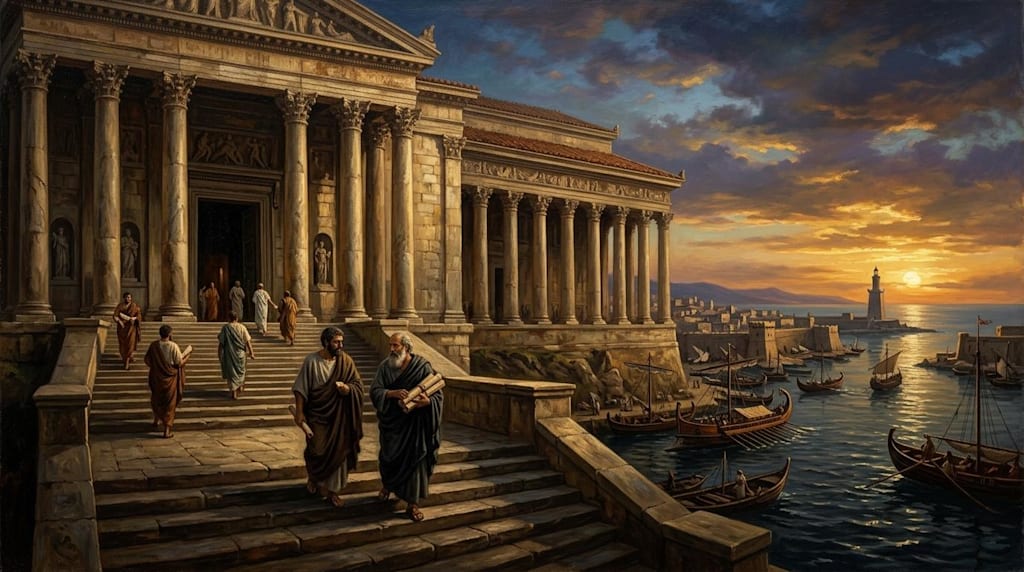
There was no fire.
Not one, anyway. There was no single night, no single villain, and no single catastrophic moment that erased everything. The story you know — Julius Caesar, the flames, the irreplaceable scrolls turning to ash — is real. It just isn't the whole story.
The whole story is worse.
Everyone Burned It. That's the Problem.
The Library of Alexandria was destroyed more than once. Rather, it was destroyed slowly and repeatedly by almost everyone who came into contact with it, and each time, the reasons were entirely logical to those doing the destroying.
The destruction of the library remains one of the most misunderstood events in ancient history. Caesar's fire in 48 BCE was real. However, historians now believe that the fire burned a warehouse near the harbor containing scrolls awaiting export, not the library itself. The library continued for centuries after Caesar.
The Roman emperor Aurelian damaged it in 270 CE during his campaign to retake Alexandria from the Palmyrene Empire, which had broken away. The library survived, albeit diminished.
In 391 AD, Pope Theophilus ordered the destruction of the Serapeum, a daughter library that housed thousands of texts. Christian mobs carried out the order. The library survived, further diminished.
The most famous story comes from the Arab conquest of Alexandria in 642 AD: Caliph Omar allegedly ordered the scrolls burned because they either agreed with the Quran and were therefore redundant or disagreed with it and were therefore heretical. However, most historians now consider this story to be a later fabrication. But by 642 CE, it may not have mattered. There may not have been much left to burn.
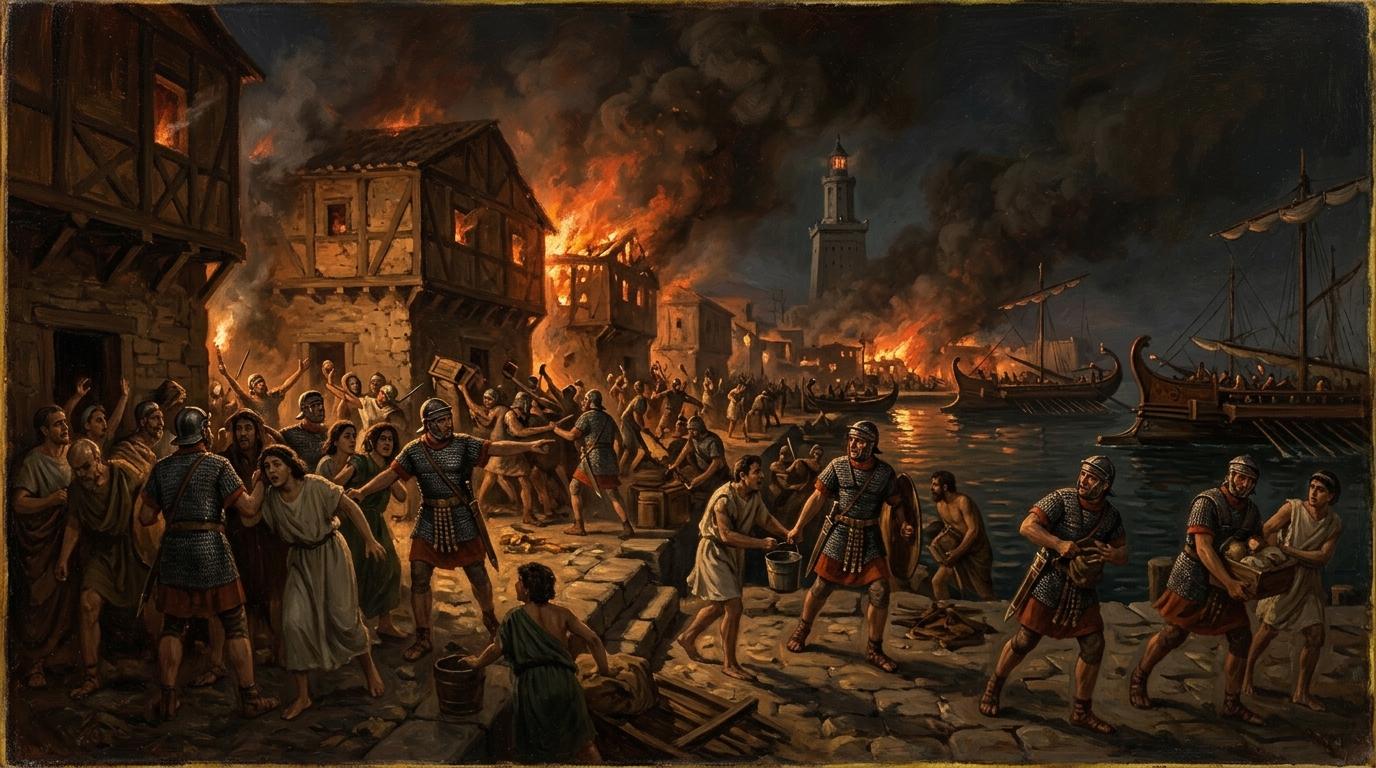
The Official Version Has a Convenient Villain
According to the official version, a great library existed, and then someone destroyed it, causing humanity to lose centuries of knowledge overnight.
Here is what the official version cannot explain:
If the library was destroyed in a single catastrophic event, why do ancient sources disagree so much about when, how, and by whom it was destroyed? First, Caesar is blamed. Then Aurelian. Then Theophilus. Then Omar. There were four different destroyers across seven centuries. Each story is recounted with equal confidence. Each story is backed by real historical evidence.
Historians are not confused.
The answer is that they are all right.
It Died the Way Everything Dies
The Library did not burn. It starved.
At its peak, the institution employed hundreds of scholars. Ships carrying books from across the Mediterranean docked there. Ptolemaic kings ordered that any scroll found on a ship docking in Alexandria be confiscated and copied; the copy would be returned to the owner, while the original would be kept for the library. At its height, it is estimated that the library held between 400,000 and 700,000 scrolls.
Then the money stopped.
The Ptolemaic dynasty weakened. Roman rule brought different priorities. Imperial funding dried up. Scholars stopped coming. Copying ceased. The collection stopped growing and began to shrink due to neglect, occasional violence, and the slow decay of papyrus in a humid climate.
By the time of the Arab conquest, the great Library of Alexandria had likely been reduced to smaller collections scattered throughout the city. It was not destroyed overnight. It was abandoned over centuries.
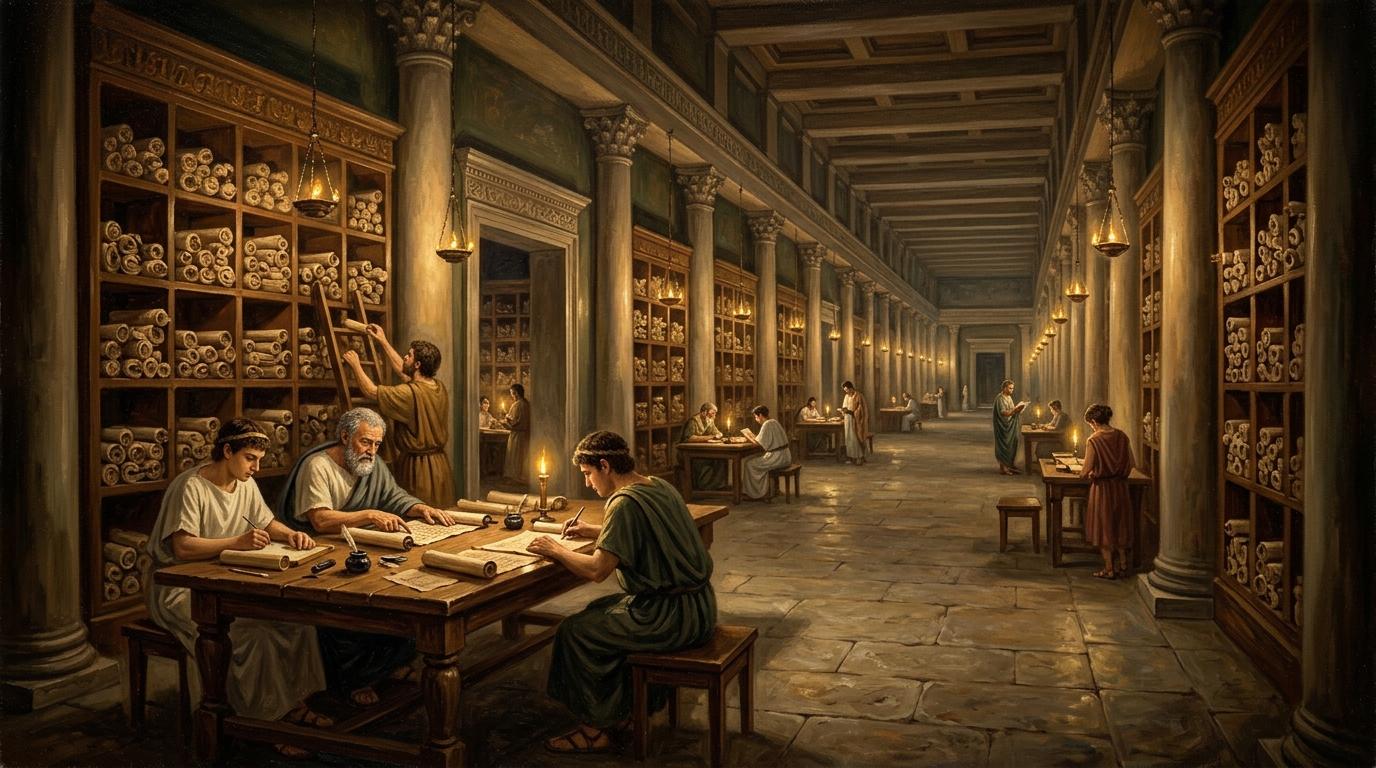
What Was Actually Lost
This is the part that should genuinely disturb you.
What the Library of Alexandria contained — and what was lost forever — can only be reconstructed from fragments. We know what was in the library not from the library itself — nothing survives — but from references in surviving texts. Ancient authors quote works that no longer exist. They cite studies, measurements, calculations, and arguments from scrolls that were never copied before they decayed.
In the third century BC, Eratosthenes calculated the circumference of the Earth to within 1% accuracy. His method survives. His complete works do not.
Around 270 BC, Aristarchus of Samos proposed a heliocentric model of the solar system, suggesting that the Earth orbits the Sun. This was seventeen centuries before Copernicus. We know this because other writers mentioned it. His original texts are gone.
Hero of Alexandria designed a steam-powered device in the first century CE. It was a working prototype of the Industrial Revolution that was built and then forgotten.
These were not lost in a fire. They were lost gradually, through indifference and the assumption that someone else was keeping a copy. They were lost through the quiet administrative failures of institutions that forgot their purpose.
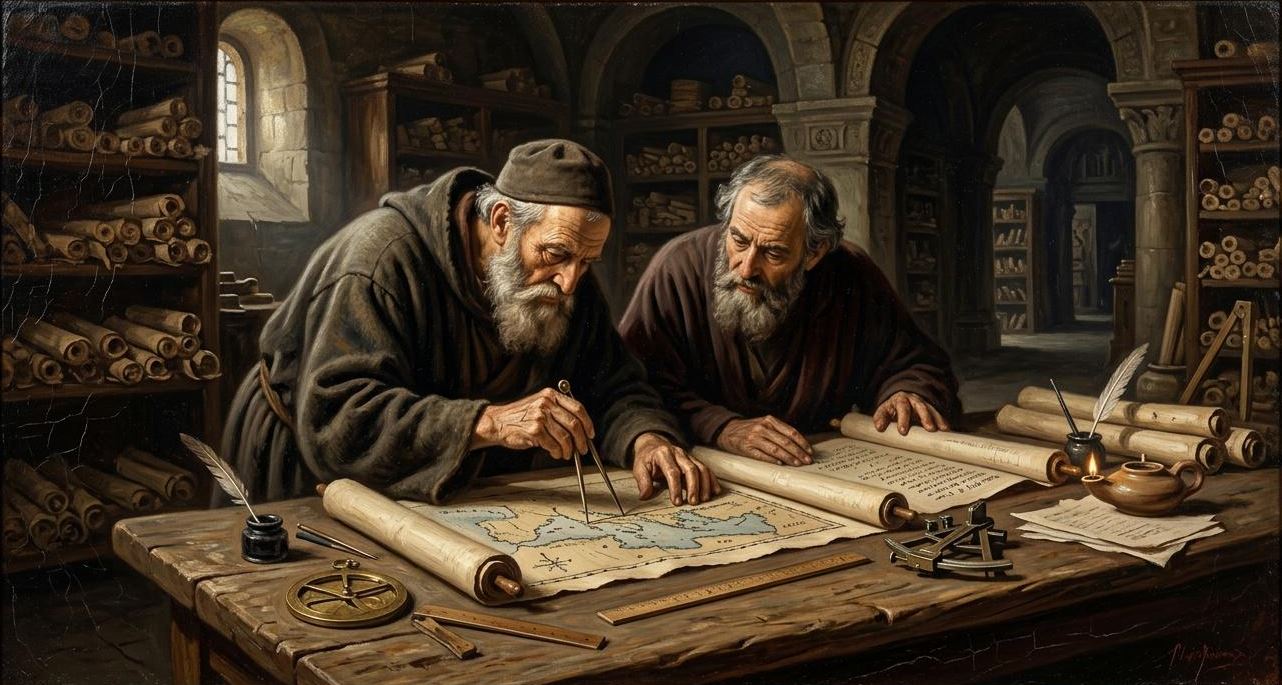
The Pattern Nobody Wants to See
The Library of Alexandria is not a story of destruction. Rather, it is a story about what happens when knowledge is no longer protected — a pattern that has repeated itself across every civilization that has ever existed.
Every civilization that decided the preservation of knowledge was less important than its political or religious priorities has eventually looked back and tried to count what it lost.
We tell the story of the burning because burning has a villain. Neglect does not.
The Library of Alexandria contained between 400,000 and 700,000 scrolls. We have recovered only a few hundred texts from that time period. The rest is silence.
Which concerns you more: the fire or the centuries of indifference before and after it?
If this investigation interested you, you might also explore:
— Rome Had Markets, Banks, and Trade Routes — and Still Never Built Capitalism
— The Revolution That Devoured Its Own: How the French Terror Became a Virtue
About the Creator
Chronicle and Void
Every collapse has a cover story. Every war has a cause that didn't make it into the history books. History is not an accurate record of what happened. It's a record of what they allowed to survive.
Enjoyed the story? Support the Creator.
Subscribe for free to receive all their stories in your feed.
Comments
There are no comments for this story
Be the first to respond and start the conversation.