
The World's Smallest Park (And Its Very Serious Leprechaun Problem)
Silly Saturday Edition

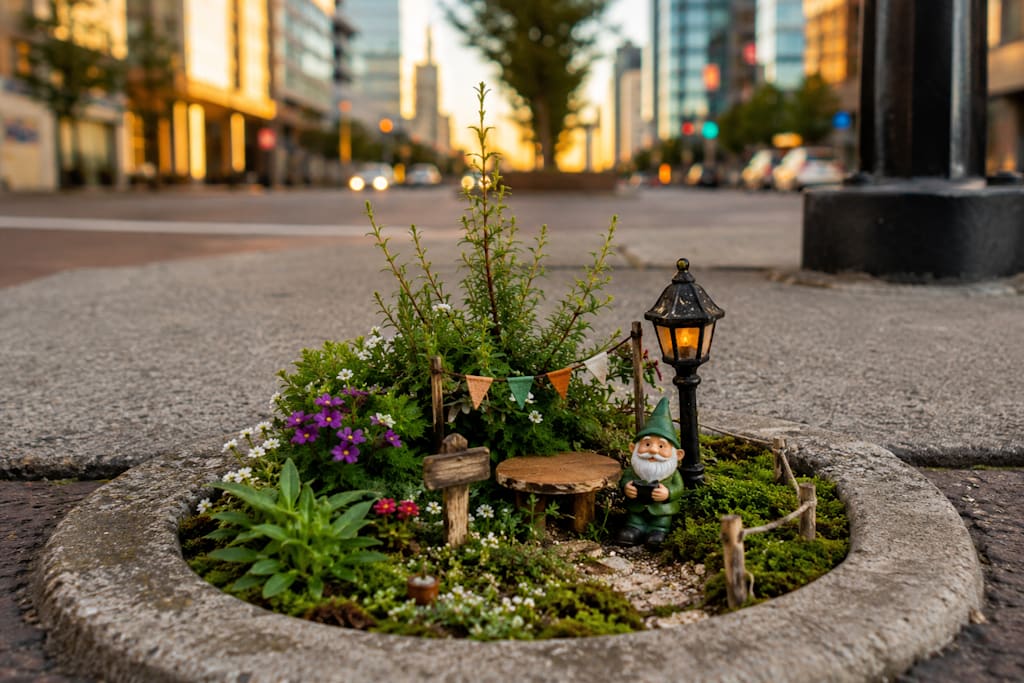
America has no shortage of famous parks. There is Yellowstone, where geysers erupt from the earth with explosive force; there is Yosemite, where granite cliffs tower thousands of feet into the sky; and there is the Grand Canyon, a geological masterpiece visible from space. Then, in sharp contrast, there is a tiny circle of dirt in Portland, Oregon, roughly the size of a pizza. Welcome to Mill Ends Park.
For decades, this microscopic patch of greenery held the title of World's Smallest Park, a distinction officially recognized by Guinness World Records. Measuring only about two feet across, the entire park occupies less space than many coffee tables. Yet somehow, this miniature landmark developed a history richer than some national monuments. Like many great American stories, it began with a newspaper columnist who had too much imagination and just enough free time.
In the 1940s, a traffic median in downtown Portland contained an empty hole intended for a light pole. The pole never arrived, and weeds began growing inside the abandoned space. Most people would have ignored it, but Dick Fagan, a columnist for the Oregon Journal, was not most people. Rather than complain about the neglected hole, he planted flowers in it and declared it a park, naming it Mill Ends Park after his newspaper column, "Mill Ends." What began as a joke slowly evolved into something far more unusual.
Soon, Fagan wasn't merely writing about the park; he was writing about its residents, specifically its leprechauns. According to Fagan, Mill Ends Park was home to the only leprechaun colony west of Ireland. Their leader was a fellow named Patrick O'Toole, whom Fagan claimed only he could see. The columnist spun elaborate tales of the tiny community, chronicling their adventures as if they were legitimate citizens of Portland. Readers eagerly followed along, and what started as a whimsical newspaper gag became local folklore. Portland, being Portland, embraced the absurdity completely.
The city eventually leaned into the mythology rather than dismissing it. St. Patrick's Day celebrations became associated with the park, tiny decorations appeared, and miniature attractions occasionally materialized. Over the years, the little circle hosted everything from tiny swimming pools for butterflies to miniature Ferris wheels. The park's size actually became part of its charm.
Maintaining Mill Ends Park requires an entirely different perspective than maintaining a traditional city park. A gardener can practically service the entire property while standing in one spot; landscaping decisions that would affect acres elsewhere affect mere inches here. Every flower, every decoration, every seasonal display must fit inside a space barely larger than a dinner plate. And yet, Portland treats it with remarkable seriousness.
The city officially recognized Mill Ends Park as a municipal park on St. Patrick's Day in 1976. From that moment on, the tiny patch of greenery became a legitimate member of Portland's park system, receiving official care and maintenance despite being smaller than many potholes. Perhaps that is what makes the story so uniquely American.
The United States has always had a fascination with "the world's biggest": the world's tallest building, the world's largest ball of twine, the world's biggest frying pan. Mill Ends Park went in precisely the opposite direction. Instead of building something enormous, Portland celebrated something absurdly tiny. It was a reminder that significance is not always measured in acreage. For decades, Guinness World Records agreed. Mill Ends Park officially held the title of World's Smallest Park beginning in 1971, bringing international attention to a space so small many tourists accidentally walked past it without noticing. Visitors from around the globe traveled to Portland just to photograph a landmark that could comfortably fit inside a living room.
But even legends face challengers. In 2025, a tiny park in Japan claimed the Guinness record, narrowly surpassing Mill Ends Park in the battle for microscopic supremacy. After more than half a century at the top, Portland's beloved landmark lost its official title. Most cities might have viewed that as a defeat, not Portland. Portlanders responded much as one might expect from a city famous for keeping a straight face while discussing leprechaun colonies; the reaction was largely amusement mixed with civic pride. After all, records come and go. Stories endure. And Mill Ends Park has one of the best stories around.
Think about it: a forgotten hole becomes a garden, a garden becomes a joke, a joke becomes folklore, folklore becomes a city landmark, and a city landmark becomes a world record holder. All because one newspaper columnist decided that an empty patch of dirt deserved a little imagination.
Today, visitors can still find Mill Ends Park nestled in downtown Portland, quietly occupying its tiny corner of the world. It remains decorated for the season, lovingly maintained, and is one of the most delightfully unnecessary landmarks in America.
Whether or not Patrick O'Toole and his leprechaun companions still reside there is, of course, impossible to verify. Then again, perhaps that's the point. Mill Ends Park exists because someone looked at an ordinary thing and chose to see something extraordinary. The park may no longer be the world's smallest, but it may still be the world's biggest reminder that wonder doesn't require much space. Sometimes all it takes is two feet of dirt, a handful of flowers, and a city willing to believe in leprechauns.
About the Creator
The Iron Lighthouse
Where folklore meets freeway. A guide to the strange heart of the American backroads...
Enjoyed the story? Support the Creator.
Subscribe for free to receive all their stories in your feed.
Comments
There are no comments for this story
Be the first to respond and start the conversation.