
The White Hurricane of 1913: The Day the Great Lakes Swallowed a Fleet
The Iron Lighthouse | Forgotten American History

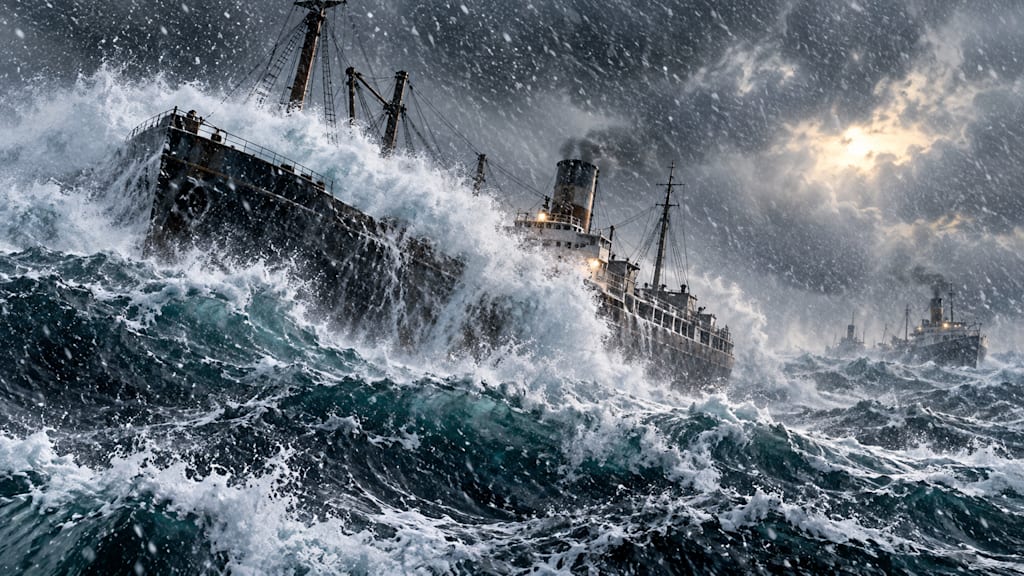
November 9, 1913. Lake Huron.
Somewhere beneath the black water, steel ships were disappearing. Above them, winds approaching ninety miles per hour drove snow and freezing spray across a lake that had become almost unrecognizable. Waves rose to heights associated with violent ocean storms, crashing across the decks of freighters built to haul thousands of tons of cargo. Visibility deteriorated to nothing… Water froze against exposed surfaces. Navigation became increasingly difficult. The wind shifted, and the waves grew larger. In the space of a few terrible hours, eight major freighters would be lost on Lake Huron alone.
No distress calls survive to explain the final moments of those ships. No eyewitness could describe precisely what happened aboard each vessel. The crews vanished with them. By the time the storm had exhausted itself, roughly 250 sailors had died across the Great Lakes, twelve major vessels had sunk, and dozens more had been damaged or driven ashore. It remains one of the deadliest maritime weather disasters in North American history. And perhaps the most astonishing detail of all? It happened on freshwater lakes, hundreds of miles from the nearest ocean.
The Inland Seas
To understand the catastrophe, one must first understand the Great Lakes themselves. Viewed on a map, they might appear to be unusually large bodies of freshwater. Viewed from the deck of a freighter, they can look like oceans. Lake Superior stretches approximately 350 miles from east to west. Lake Huron covers more than 23,000 square miles. Lake Michigan reaches deep into the American Midwest. These are not placid ponds with picturesque shorelines. They are enormous inland seas, capable of generating waves powerful enough to damage harbors, overturn vessels, and send experienced sailors searching desperately for shelter.
By 1913, the Great Lakes were among North America’s most important industrial transportation corridors. Steel freighters carried iron ore, coal, grain, and other raw materials between growing industrial cities. Factories depended upon their cargoes. Railroads and steel mills relied on the supplies moving through the lakes. Shipping companies pushed to complete as many voyages as possible before winter closed the navigation season.
November was especially dangerous. Cold Arctic air could sweep southward and collide with warmer, moisture-laden air, producing powerful low-pressure systems. The enormous stretches of open water gave the wind room to build destructive waves. Veteran sailors knew the risks. They had weathered autumn gales before. But in November 1913, the atmosphere was assembling something far beyond an ordinary storm.
Two Storms Become One
The catastrophe began developing around November 7. One low-pressure system moved across the upper Great Lakes. Another developed farther south. As the systems interacted and intensified, the weather deteriorated dramatically. Wind directions changed. Temperatures plunged. Rain became snow, and snow became a blinding wall of white.
By November 9, the storm had reached extraordinary strength. The conditions earned it several names, including the Big Blow, the Freshwater Fury, and the one that would become most famous: The White Hurricane. Despite that name, this was not a tropical hurricane. It was an exceptionally powerful extratropical storm, fueled by the interaction of contrasting air masses and atmospheric pressure systems. But to the mariners caught inside it, the distinction offered little comfort.
Historical accounts describe wind gusts approaching ninety miles per hour. Waves reportedly reached thirty-five feet. And these weren’t merely exaggerated stories told by frightened sailors. A century later, National Weather Service meteorologists reconstructed the storm using historical observations and modern computer modeling. Their simulations indicated wind gusts exceeding eighty miles per hour and waves reaching approximately thirty-six feet on Lake Huron. The numbers were astonishing. And the location of those towering waves corresponded closely with the region where so many ships disappeared.
The Weather Warning That Couldn’t Keep Up
Today, meteorologists can watch storms develop through satellites, radar, computer models, and networks of constantly updated observations. In 1913, none of those modern systems existed. The United States Weather Bureau issued warnings using information from scattered observing stations. Reports traveled by telegraph, and designated shoreline locations displayed warning flags or lanterns. The system was not entirely blind. Storm warnings existed, and captains sometimes received notice of dangerous weather approaching. But forecasting the precise development of a rapidly intensifying storm was another matter. Once ships moved away from shore, obtaining reliable updates could be difficult or impossible.
A captain might begin a voyage expecting rough November weather, only to discover that the situation had changed far more dramatically than anyone anticipated. And on November 9, the weather changed with terrifying speed. Modern reconstructions suggest that wave heights on southern Lake Huron nearly doubled during a critical period that evening. Imagine being aboard a massive freighter when the waves around you suddenly grow from dangerous to overwhelming. Now add snow so thick that familiar landmarks disappear. Add freezing spray that coats exposed equipment in ice. Add shifting winds that make the seas increasingly confused. Then remember that the nearest safe harbor may be many miles away. For some ships, there would be no escape.
Eight Ships. One Lake. One Night.
Lake Huron suffered the worst losses. Eight major freighters sank during the storm: Argus. Hydrus. John A. McGean. James Carruthers. Regina. Wexford. Charles S. Price. Isaac M. Scott. Their names would become part of Great Lakes maritime history. Together, their losses accounted for approximately 187 lives. Some of these vessels were enormous by the standards of the day. They were not fragile wooden boats. They were steel cargo ships built for commercial service, operated by professional crews accustomed to difficult conditions. Yet the storm overwhelmed them.
The Isaac M. Scott, built in 1909, was carrying coal when it was lost. Twenty-eight people died aboard her. The ship’s wreck now rests approximately 175 feet beneath Lake Huron. The Charles S. Price, another large steel freighter, also went down with twenty-eight people aboard. After the storm, rescuers found an overturned vessel floating in Lake Huron. For a time, its identity remained uncertain. They eventually confirmed it as the Charles S. Price. Consider the terrible image. A great steel freighter, overturned and drifting on the surface, its crew gone. The storm had left behind not merely scattered wreckage, but the unmistakable evidence that even the largest vessels could be defeated. And elsewhere on the lakes, the destruction continued.
A Disaster Beyond Lake Huron
Although Lake Huron became the center of the catastrophe, the storm struck across the Great Lakes region. Ships were wrecked or stranded on other lakes. Harbors sustained damage. Communication lines failed. Snow and ice disrupted communities ashore. In Cleveland, severe winter weather brought transportation to a standstill. Along exposed shorelines, immense waves battered structures that had withstood years of ordinary storms.
On Lake Erie, the disaster claimed another victim whose story was particularly poignant. Light Vessel No. 82, a floating navigational aid stationed near Point Abino, was lost with its crew. It was meant to help other mariners avoid dangerous waters. Yet the vessel itself could not survive the storm. The people charged with warning ships of danger had become victims of the very conditions they helped others navigate. There was little distinction between the danger faced by commercial sailors and those serving aboard navigational vessels. The White Hurricane threatened anyone caught in its path.
The Men Who Came Home
Not every vessel disappeared. Some crews survived extraordinary ordeals. The freighter L.C. Waldo was driven onto rocks near Manitou Island in Lake Superior. Its crew endured the aftermath of the grounding before rescuers could reach them. Lifesavers from the Eagle Harbor station participated in the effort to bring the stranded mariners to safety. Their survival stands in sharp contrast to the fate of so many vessels on Lake Huron. It also reminds us that the storm was not simply a story about wind speeds and wave heights. It was a story about human beings. About sailors struggling to preserve their ships. About rescue crews willing to venture into dangerous conditions. About families waiting for news that sometimes never came. And about communities along the lakes that would soon confront the full scale of the losses.
The Shoreline Gives Up Its Dead
As the weather finally improved, evidence of the catastrophe began to emerge. Wreckage washed ashore. Bodies were recovered along the eastern shores of Lake Huron. Communities in Ontario, including Goderich and surrounding areas, helped manage the heartbreaking task of identifying victims and assisting families. Temporary morgues were established. Newspapers carried the names of missing vessels and crews. For relatives waiting at home, the absence of news could be agonizing.
The disaster’s final death toll remains somewhat uncertain. Historical sources differ, with estimates ranging from approximately 235 to more than 250 lives lost. Records of crews and vessels were not always complete. But no one seriously disputes the catastrophe's magnitude. Roughly a dozen major ships sank. Dozens of others were stranded, crippled, or damaged. The Great Lakes shipping industry had suffered a devastating blow. Many of the people who died were simply doing the work that kept America’s industrial economy moving.
What the Storm Changed
The White Hurricane exposed serious vulnerabilities in Great Lakes navigation. The disaster intensified criticism of weather forecasting and the speed at which storm warnings reached mariners. It also prompted a closer look at vessel construction, stability, and large freighters' ability to withstand severe lake conditions. Discussions among shipbuilders, insurers, and maritime interests encouraged improvements in vessel design and safety practices. The catastrophe did not instantly produce the sophisticated forecasting systems available today. Scientists and engineers developed those systems over decades of scientific and technological progress. But the events of November 1913 became a powerful reminder of what could happen when extreme weather overtook ships operating with limited information. The lakes had always been dangerous. The White Hurricane showed just how dangerous they could be.
The Storm History Nearly Forgot
In November 1975, another Great Lakes freighter disappeared during a violent autumn storm. The Edmund Fitzgerald sank on Lake Superior, taking all twenty-nine members of her crew. That tragedy would become one of the most famous shipwrecks in American history, immortalized in song and remembered by generations of listeners. But sixty-two years earlier, the White Hurricane had claimed far more lives and destroyed an entire group of major vessels. The comparison is not meant to diminish either disaster. It illustrates how unevenly history remembers its tragedies. Some events enter the national consciousness. Others, despite their extraordinary scale, fade into the archives.
And yet the White Hurricane deserves to be remembered. Not merely because of its staggering statistics. But because it challenged an assumption that remains surprisingly common today. We tend to associate enormous waves, hurricane-force winds, and maritime catastrophe with the open ocean. We imagine tropical storms rolling across the Atlantic or violent seas battering distant coastlines. We rarely imagine a freshwater lake in the American Midwest producing conditions capable of swallowing steel freighters. But on November 9, 1913, that is precisely what happened. Eight major vessels disappeared beneath Lake Huron’s surface. Across the Great Lakes, approximately 250 people lost their lives.
And when the storm finally passed, the water gradually returned to its familiar appearance. The waves subsided. The snow stopped. The shipping routes reopened. But beneath the surface, the wrecks remained. Silent reminders of a November when the inland seas became something almost unimaginable. The Great Lakes had not become an ocean. They had simply reminded humanity that they never needed to be one to command its respect.
Illuminating the remarkable, forgotten, and sometimes devastating chapters of American history. - The Iron Lighthouse
About the Creator
The Iron Lighthouse
Where folklore meets freeway. A guide to the strange heart of the American backroads...
Enjoyed the story? Support the Creator.
Subscribe for free to receive all their stories in your feed.
Comments
There are no comments for this story
Be the first to respond and start the conversation.