
The Volcano That Never Erupted: America's Forgotten Mountain of Fire
Forgotten Chapters of American History

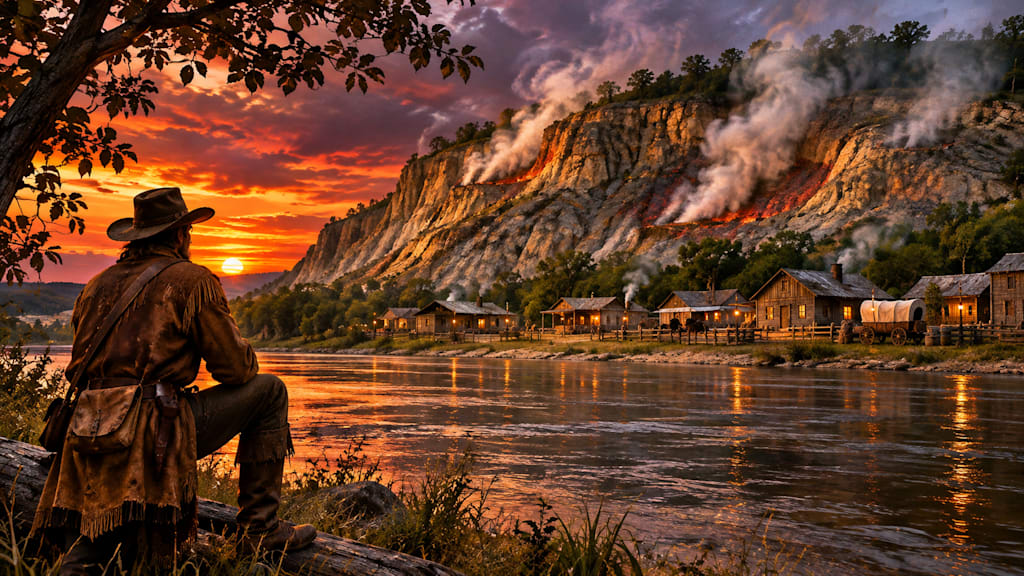
On August 24, 1804, William Clark encountered something along the Missouri River that should not have been there. A bluff was burning. Not a campfire. Not a patch of grass ignited by lightning. An enormous wall of earth, rising nearly 190 feet above the river, seemed to generate heat from somewhere deep inside itself.
The ground was so hot that Clark reported a man could not bear to hold his hand against it. Another member of the expedition noticed a sulfurous smell. Signs of coal and strange mineral deposits were embedded in the exposed hillside. For men already traveling through unfamiliar territory, it was an astonishing discovery. What could make a hillside burn without any obvious source of fire?
The answer would eventually involve chemistry, erosion, and one of the strangest geological misunderstandings in American frontier history. But before scientists understood it, the burning bluff acquired a name that would inspire curiosity and fear for generations—the Ionia Volcano. And although it never erupted, it would become associated with the near-destruction of an entire town.
A Mountain That Burned From Within
In the summer of 1804, the Lewis and Clark Expedition was making its way upriver through the vast territory the United States had acquired in the Louisiana Purchase. The journey was difficult, the river unpredictable, and the landscape filled with unfamiliar features. Near what is now northeastern Nebraska, the expedition passed a towering bluff overlooking the Missouri. Clark examined the formation and recorded its unusual condition. He described the bluff as having been recently on fire and remaining intensely hot. He also noted deposits he believed resembled coal and cobalt.
Expedition member John Ordway provided another revealing detail. The burning bank, he wrote, had a sulfurous smell. That observation would eventually become an important clue. Sulfurous odors can accompany chemical processes involving certain minerals. But to travelers encountering the phenomenon without modern geological knowledge, the combination of heat, smoke, and strange smells presented a disturbing possibility. Was something burning underground? Could the hill itself be volcanic?
European-American explorers were still mapping and studying the American interior. Strange formations often acquired explanations that blended observation, speculation, and local storytelling. And the Missouri River bluffs were no exception. The heat was real enough to be recorded. The volcano was another matter entirely.
The Science Beneath the Smoke
To understand the Ionia Volcano, we need to introduce a mineral with an unfortunate habit of causing trouble: pyrite. Often called fool’s gold, pyrite is an iron sulfide mineral found in many sedimentary formations. When pyrite is exposed to oxygen and moisture, it can undergo oxidation, a chemical reaction that releases heat. Under suitable conditions, that heat can accumulate in mineral-rich rock and surrounding combustible material.
The Ionia bluff contained layers of shale and other sediments with sulfur-bearing minerals and carbonaceous material. As the Missouri River eroded the hillside, it exposed previously buried deposits to air and water. Chemical reactions followed. The National Park Service explains that the apparent volcanic activity resulted from the oxidation of damp, pyrite-bearing and carbonaceous shale. There was no underground magma chamber. No rising column of molten rock. No volcanic vent connected to the Earth’s interior. The heat came from reactions taking place within the exposed sedimentary deposits. In other words, the hill could become dangerously hot without being a volcano at all.
Not everyone accepted that explanation immediately. In 1839, French explorer and geographer Joseph Nicollet investigated the phenomenon and proposed that iron pyrites reacting with water could generate enough heat to ignite other combustible materials. His theory pointed toward chemistry rather than volcanism. But scientific explanations do not always travel as quickly as frightening stories. And the story of Nebraska’s burning mountain was only beginning.
A Town Beneath an Imaginary Volcano
In 1856, a settlement named Ionia was established near the remarkable bluff. The town gave the supposed volcano its enduring name. For residents and travelers, the formation became a familiar local curiosity. Fur traders had reported smoke and fire in the region after Lewis and Clark passed through. The accounts helped sustain the impression that something powerful was occurring beneath the ground.
Imagine settling near a hillside that occasionally seemed to breathe smoke. You might accept a scientific explanation. You might dismiss the whole thing as a harmless curiosity. Or you might wonder whether the earth was preparing to do something considerably less harmless.
By the 1870s, visitors were still reporting remarkable conditions. In 1874, a correspondent writing as Ranger visited the site and described hot vapor escaping through openings in the ground. The earth seemed to contain a hidden source of heat. The writer reported hearing strange sounds beneath the surface, comparing them to the distant roar of a blast furnace. That is a remarkable image. A person standing on an apparently ordinary hillside, hearing something beneath the ground that resembles the machinery of a massive industrial plant. Whether those sounds came from shifting material, escaping gases, or another source remains unclear. But the report illustrates why the site maintained its reputation.
The Ionia Volcano was not merely a name on a map. It was a place where people claimed they could feel the earth’s heat and hear activity beneath their feet. And then, in 1877, the ground shook.
When the Earth Began to Tremble
An earthquake struck the region in 1877. For residents who already believed a volcano might be lurking nearby, the timing was alarming. Earthquakes and volcanoes are connected in many parts of the world. A volcanic eruption can be preceded by seismic activity as magma moves through the Earth’s crust. But not every earthquake signals volcanic activity.
In Nebraska, the shaking did not mean that molten rock was rising beneath Ionia. Nevertheless, the earthquake revived fears that the supposed volcano might finally erupt. It was an understandable concern for people who lacked a clear picture of the region’s geology. The bluff had been associated with heat and smoke for decades. Now the earth itself had moved. What would happen next?
The answer arrived in 1878. But it did not come from below. It came from the river.
The Disaster Nobody Expected
The Missouri River has never been particularly respectful of human plans. Its currents, floods, and shifting channels have altered the landscape for centuries. In 1878, high water undermined the bluffs near Ionia. A large section of the supposed volcano collapsed into the river. The same flooding severely damaged the nearby town. It was an extraordinary reversal. For years, residents had worried that a fiery eruption might destroy their community. Instead, the Missouri River attacked the land supporting it.
The feared volcano did not explode. The bluff simply gave way. The town suffered devastating flood damage. History Nebraska notes that the river’s destruction nearly wiped out Ionia. The community never recovered its former promise. Over time, its population declined, and the settlement was abandoned. By 1907, the Ionia post office had closed. The place that had lent its name to Nebraska’s imaginary volcano was fading from the map. And the burning mountain itself had been dramatically altered by the river. The disaster had nothing to do with an eruption. But the irony was difficult to miss. The town feared destruction by fire and was nearly destroyed by water.
The Volcano That Science Extinguished
By the beginning of the twentieth century, geologists had reached a broad consensus about the Ionia phenomenon. The apparent volcanic activity resulted from heat generated by chemical oxidation in exposed sedimentary deposits. The explanation removed the need for a volcano beneath the Great Plains. But it did not make the original observations meaningless.
Clark had encountered genuinely hot ground. Ordway had recorded a sulfurous smell. Later travelers had described smoke, vapor, and other unusual effects. The witnesses did not necessarily imagine what they experienced. They simply lacked the information needed to identify its cause. And that distinction is important. A mistaken explanation does not automatically mean a mistaken observation. Sometimes people accurately describe something extraordinary while misunderstanding why it happens. That is how a chemical reaction in a river bluff became an alleged volcano. And how a place that never erupted acquired a reputation powerful enough to frighten settlers for decades.
What Remains of the Burning Mountain?
Today, the Ionia Volcano is recognized as a historic site associated with the Lewis and Clark National Historic Trail. Its surviving remnants lie near Newcastle in Dixon County, Nebraska. The National Park Service identifies the location as historically significant, and a nearby historical marker preserves the story of the burning bluff and the settlement that once stood in its shadow. The Ponca Tribe also regards the bluff as a sacred site, an important reminder that the landscape holds meanings beyond the expedition journals and settler accounts most often used to tell this story.
The Ionia Volcano is not an active volcano. It is not a dormant volcano waiting to awaken. And no evidence shows it ever contained the magma system needed to produce a true volcanic eruption. Yet its history remains remarkable. The people who encountered it observed a real geological phenomenon that challenged their understanding of the natural world. A hillside grew hot enough to alarm explorers. Smoke and strange odors drew travelers' attention. A town grew beneath the shadow of a supposed volcano. An earthquake revived fears of catastrophe. And then a river accomplished what the imaginary volcano never could.
Perhaps the most fascinating part of the story is that its mystery did not disappear when scientists explained it. The explanation made it more interesting. A mountain did not need molten rock to generate heat. It needed the right minerals, moisture, oxygen, and the slow work of erosion. Nature had produced something that looked volcanic without involving a volcano at all. And for nearly a century, people tried to make sense of it.
The Ionia Volcano reminds us that American history contains countless extraordinary stories hiding behind ordinary place names. Some are legends. Some are misunderstandings. And some begin with perfectly accurate observations that take generations to explain.
On a summer day in 1804, William Clark stood beside a bluff that seemed to burn from within. He could not have known that its reputation would survive long after the nearby town disappeared. Nor could the settlers of Ionia have known that the river beneath their supposed volcano posed the greater threat. The mountain never erupted. The town eventually vanished. But the story survived. And more than two centuries later, Nebraska’s volcano that wasn’t a volcano still has the power to make us wonder what else might be hiding beneath our feet.
"Illuminating the extraordinary stories hiding in America’s past." - The Iron Lighthouse
About the Creator
The Iron Lighthouse
Where folklore meets freeway. A guide to the strange heart of the American backroads...
Enjoyed the story? Support the Creator.
Subscribe for free to receive all their stories in your feed.
Comments
There are no comments for this story
Be the first to respond and start the conversation.