
The Myth of the Famous General: Why Stone Castles and Logistics Won Medieval Wars
Forget duels and genius. Walls, grain, and organization decided more battles than any sword ever did.
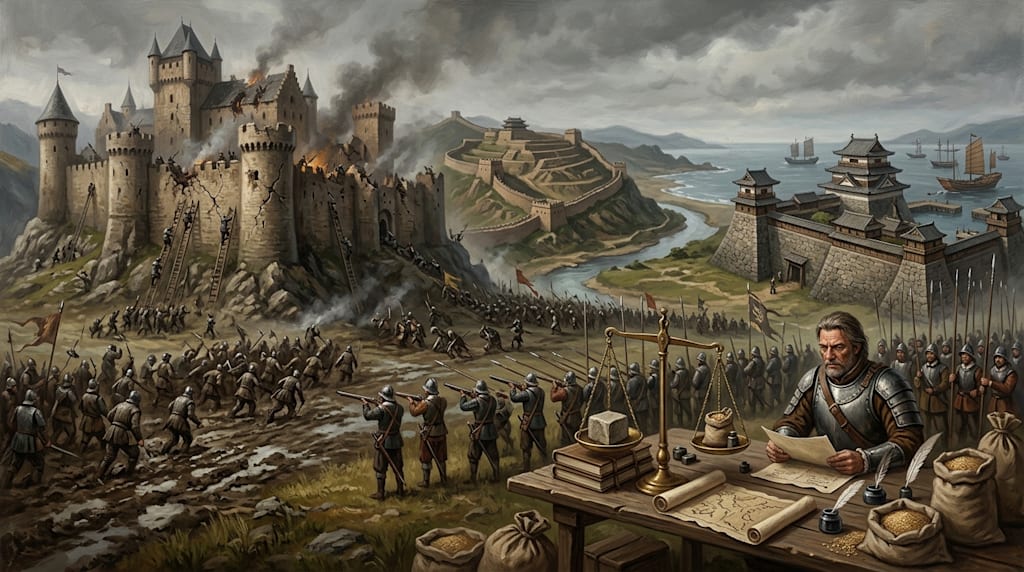
A stone wall changes arithmetic.
A few hundred men behind cut stone can hold a gate against thousands. Stone is not holy. The attacker still has to climb, dig, starve, or bribe. In the age of cold weapons, that gives the defender an edge. A local lord with a granary, a cistern, a well, and a ring of kinsmen can defy a central army for months. The castle pulls power away from the capital and into the hands of whoever owns the wall.
That part of the argument holds. Castles multiplied force. Sieges were nightmares. Field battles were not the only thing that mattered.
The mistake comes next. Stone fortresses shaped war. That does not mean China could not build them because Chinese mathematics and mechanics lagged. That leaps over geography, materials, finance, and political structure. It lands on a scoreboard that does not exist.
The arithmetic of walls
A castle is a machine for buying time. The defender needs water, grain, salt, arrows, and a reason to keep fighting. The attacker needs food for thousands of men, fodder for horses, dry powder, replacement troops, and a camp that does not dissolve into dysentery. The wall does not win by itself. It makes the attacker pay in days. Days become weeks. Weeks become winter. Winter becomes a graveyard.
A small garrison can hold off a large army for that reason. The attacker can storm the gate, but ladders are slow and murderous. He can mine the wall, but digging takes time and the defenders can countermine. He can burn the gate, but a fire can be put out. He can bribe a guard, but the guard may be loyal. He can wait, but waiting is its own battle.
The castle is expensive to take. That is enough to make it a bug in the political system. A fortress can shelter a rebel, a rival, a bandit lord, a heretic, or a dynastic pretender. It turns a local family into a small state. It makes central power negotiable.
China did not lack stone
The claim that China could not build stone castles because of weak mathematics and mechanics does not survive contact with Chinese engineering.
China built stone bridges, stone towers, stone gates, stone-faced walls, and stone fortresses. The Zhaozhou Bridge is a stone arch bridge from the Sui dynasty. The Lugou Bridge is a stone bridge with carved lions. The Nanjing city wall is a massive brick-and-stone construction. The Ming Great Wall has long sections of stone masonry. Hailongtun in Guizhou is a mountain fortress with stone passes and gates. Fujian tulou are communal fortified buildings with thick earthen walls, some faced with stone. Chinese builders understood arches, load, mortar, rammed earth, brick facing, and large-scale organization.
Ability was never the issue. Choice was.
Europe had many quarries and a fragmented lordship system. A local lord wanted a small, hard shell for his family and retainers. Stone was nearby. Labor was tied to the manor. The castle was a home, a court, a prison, a treasury, and a strongpoint.
China had vast plains, huge populations, and a central state. It built walls around cities, forts along roads, and mountain defense networks. It used rammed earth and brick because those materials were available, cheap, and effective. A Chinese city wall could be miles long and thick enough to absorb catapult stones. A European castle was a knot. A Chinese walled city was a fabric.
Early European castles were often timber and earth. Stone came later. Masons learned by doing. They copied what stood and avoided what fell. Mathematics later explained the arch. It did not invent it.
Sieges are not wall-punching contests
The image of a siege is a ladder, a sword, and a shout. Sieges were boredom, hunger, and betrayal.
An attacking army rarely wants to storm a wall. It wants the wall to become useless. It cuts aqueducts. It blocks roads. It occupies the fields. It bribes a captain. It spreads disease. It waits for the harvest to fail. It offers terms. It lets the defenders argue among themselves.
Constantinople is the great example. The Theodosian Walls were a marvel. The sea walls, the chain across the Golden Horn, the Greek fire, the grain stores, and the diplomacy made the city a fortress that many armies failed to take. Persians, Avars, Arabs, Bulgarians, Rus, Turks, and others came. Most left without the city.
Constantinople still fell. In 1204, the Fourth Crusade broke in through the sea walls. In 1453, Mehmed II used massive bombards, hauled ships overland into the Golden Horn, and attacked again and again. The walls were a card. They were not the whole deck. When the deck ran out, the card could not save the hand.
Diaoyucheng is another case. It held for about thirty-six years against the Mongols. It was a mountain fortress above rivers, with terraces, granaries, and links to a wider Song defense network. Mongke Khan died under its shadow in 1259, and his death triggered a succession struggle that changed Mongol strategy across Eurasia. The wall mattered. The mountain mattered. The river mattered. The food mattered. The politics of the Mongol court mattered.
The Japanese wajo in Korea
The Japanese castles in Korea during the second invasion of 1597-1598 show the same principle. Hideyoshi was losing his grip. Many daimyo did not want to send more men. They built coastal forts called wajo: stone bases, earth ramparts, moats, angled walls, and firing positions for arquebuses. Sea supply kept them fed. The forts were meant to hold the coast until Hideyoshi died and the army could come home.
Ming and Korean forces attacked them. Ulsan, Sacheon, and Suncheon became killing grounds. The allies had numbers, cannon, and determination. The Japanese had stone, guns, and the sea. Winter came. Supply failed. A powder explosion tore through a camp. Command was divided. The attacks failed.
The numbers are often inflated. There were not two hundred thousand allied soldiers sitting around one city for a year. Ming forces in Korea peaked at roughly seventy to eighty thousand, with Korean troops and rotating reinforcements. The Japanese were not invulnerable. At Noryang, the allied fleet caught the retreating Japanese and won a tactical victory. Yi Sun-sin and Deng Zilong died in that fight. The Japanese fleet took losses. The withdrawal was not a parade.
The walls did their job. They bought time. Hideyoshi died in 1598. The Japanese went home. The forts were abandoned. The war ended when a ruler died in a distant room. No wall fell to end it.
Field battles and the general myth
Novels love the duel. Two generals ride out, exchange blows, and the fate of an army hangs on a spear thrust. Novels love the strategist. A man with a fan predicts the wind, the fire, and the enemy's heart. Battles are less poetic.
Training matters. Equipment matters. Food matters. Pay matters. A well-drilled pike block can break a larger mob. A line of arquebusiers can stop a cavalry charge. A soldier who has eaten and been paid will stand longer than a soldier who has not. The famous generals knew this. They were tacticians. They were also administrators of violence.
Han Xin at the Jingxing Pass is the classic example. The story says he put his army with its back to the river and made them fight because they had no escape. That is the novel version. The historical record adds the other half. Han Xin sent two thousand light cavalry with red flags to seize the Zhao camp. When the Zhao army left its walls to chase the supposedly trapped Han army, the cavalry took the camp and changed the flags. The Zhao soldiers turned back, saw their own camp flying Han banners, and broke. Training mattered. The trick mattered. Intelligence mattered. The river was one piece of the board.
Famous generals were more than rich men who hired good trainers. Han Xin was an organizer of armies. Li Jing was a master of surprise and speed. Yue Fei built a disciplined force that could march without looting. Qi Jiguang reformed recruitment, drill, weapons, and logistics to fight Japanese pirates. They fed their men, paid them, and trained them. They also read ground, used spies, timed attacks, and held coalitions together. The "rich trainer" image is half a portrait. The other half is the manager of a system.
The bug is organization
A castle is a multiplier. A field battle is a knife. Logistics is the handle. Institutions are the hand that holds it.
A state that can tax, conscript, train, feed, move, and replace soldiers will beat a state that cannot, even if the second state has thicker walls. A state that can keep a coalition together will outlast a state that can only win one battle. A state that can build roads, bridges, granaries, and forts will turn geography into an advantage.
China did not fail to build stone castles because it lacked mathematics. It built what its geography and politics demanded. Europe did not dominate because it had stone. It had stone because it had quarries and fragmented lordship. The castle was a symptom. The cause was the system that built it.
The cold-weapon era was a contest between systems. The wall bought time. The army spent it. The general tried not to waste it. The state tried to replace what was lost.
At Suncheon, the tide went out. The allied ships waited. The Japanese boats slipped toward Busan. The walls stayed where they were. The war ended with a death in a distant room. No flag rose over a broken gate.
About the Creator
Jin
Writer of reamstories
https://reamstories.com/jin
Enjoyed the story? Support the Creator.
Subscribe for free to receive all their stories in your feed. You could also become a paid subscriber, letting them know you appreciate their work.
Comments
There are no comments for this story
Be the first to respond and start the conversation.