
The Mountain That Fought Back: The Forgotten War of Blair Mountain
An Iron Lighthouse Special Edition

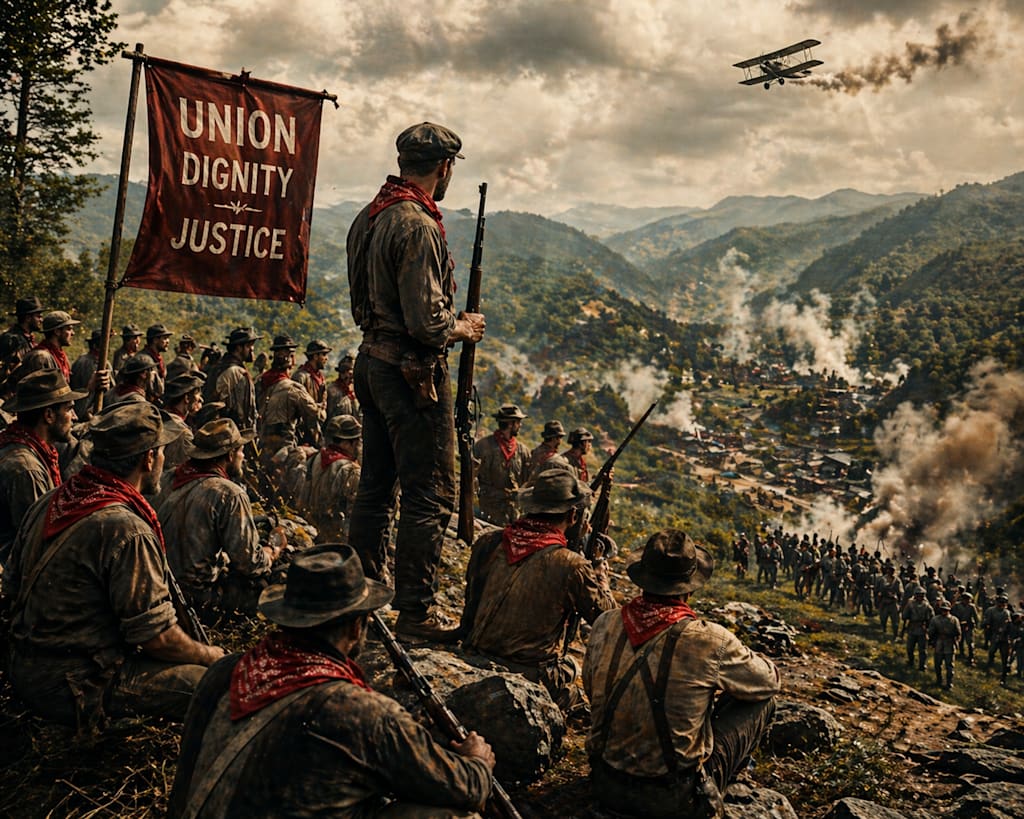
In late August of 1921, the mountains of southern West Virginia began to fill with men...
They came from coal camps and hollows, from company towns tucked into narrow valleys where the sun rose late and disappeared early behind ridgelines blackened by years of mining. They came on foot, on trains, and by whatever means they could find. Some carried rifles slung over their shoulders. Others carried little more than determination and the quiet understanding that something had to change.
By the time they gathered, there were thousands of them. Not soldiers. Miners. Fathers. Sons. Veterans of another war not long ended. Men who had spent their lives underground, pulling coal from the earth while living above it under conditions that bordered on impossible. And now, for reasons both simple and profound, they had decided to rise up. They were marching toward Blair Mountain. And they were ready to fight.
The Weight of the Coalfields
To understand Blair Mountain, it is essential to grasp the world the miners inhabited. In early 20th-century Appalachia, coal mining was not merely a job but a tightly controlled and inescapable system. Coal companies owned the mines, the towns, the houses, the stores, and even the currency, scrip, used by miners.
Many miners were paid in scrip, a form of currency that could only be used at company-owned stores. Prices were often inflated. Wages were low. Debt was common. And always, there was the danger. Cave-ins. Explosions. Black lung. The constant, quiet risk of not coming home. The men who worked these mines knew exactly what their labor cost them. What they didn’t have was a voice.
Coal mining in early 20th-century Appalachia was not just a job. It was a system, tight, controlled, and inescapable. Coal companies owned not only the mines, but the towns themselves. The houses miners lived in. The stores they shopped at. Even the money they used.
The Idea of a Union
Although unionization was not new in 1921, in West Virginia coal country, it was viewed as a threat by coal companies, who fought to prevent it through intimidation, eviction, and violence. Private security forces, such as those from Baldwin-Felts, were hired to suppress organizing efforts, and miners who advocated for unions risked blacklisting, violence, or eviction. Despite these dangers, the desire for a union persisted because the alternative was continued hardship and little hope for change. Unionization was not a new concept in 1921, but in West Virginia coal country, it was something closer to a threat.
Coal companies fought it fiercely. Attempts to organize were met with intimidation, eviction, and violence. Private security forces, often hired through agencies like Baldwin-Felts, were brought in to keep order, though “order” often meant suppressing any sign of resistance. Miners who spoke openly about unions could find themselves blacklisted, beaten, or simply removed from their homes. Still, the idea persisted. Because the alternative was to accept a system that offered little hope of change.
The Spark
By the summer of 1921, tensions in the coalfields reached a breaking point. Previous incidents like the Matewan Massacre had shown that violence was inevitable, and both sides recognized the stakes. Reports of abuses, arrests, and ongoing suppression of union organizing galvanized the miners to move beyond secret discussions. They began to organize openly, gathering in large numbers, arming themselves, and making the fateful decision to march for their rights. Tensions had been building for years, but by the summer of 1921, they were ready to break.
Events like the Matewan Massacre had already shown that violence was not just possible, it was inevitable. Lines had been drawn, and both sides understood what was at stake. When word spread of abuses, arrests, and continued suppression of union efforts, something shifted. The miners began to organize, not just in whispers, but in action. They gathered in numbers. They armed themselves. And they made a decision that would echo far beyond the mountains: They would march.
The Red Bandanas
As the miners gathered, many tied red bandanas around their necks. A simple but powerful symbol of solidarity and identification. This gesture helped unite the group and gave rise to the term “redneck,” which originated as a badge of unity among workers prepared to stand together. United by this symbol, they advanced toward Blair Mountain. As the miners assembled, many of them tied red bandanas around their necks.
It was a simple gesture, but it carried meaning. A way to identify one another. A symbol of solidarity. A quiet declaration that they were part of something larger than themselves. It’s from this moment that the term “redneck” is often said to have originated, not as an insult, but as a badge of unity worn by working men prepared to stand together. And together, they moved toward Blair Mountain.
The March
Estimates suggest up to 10,000 miners participated in the march, which was disciplined and organized under leaders with military experience, many of whom were World War I veterans. Their objective was to confront those blocking their right to unionize. Awaiting them were local law enforcement, private guards, and coal company allies, all determined to resist the miners’ advance. The stage was set for a major confrontation. Estimates vary, but as many as 10,000 miners took part in the march.
It was not a chaotic mob. It was, in many ways, organized. Disciplined. Led by men who understood conflict.
Many of them had served in World War I. They knew what it meant to fight. They knew what it meant to lose. And yet, they marched anyway. Their goal was clear: to confront the forces that stood between them and the right to organize. Waiting for them on the mountain were local law enforcement, private guards, and others aligned with the coal companies, men equally determined to stop them. The stage was set…
The Battle Begins
When fighting erupted, gunfire echoed through the mountains, turning the rugged terrain into a chaotic battlefield. There were no formal uniforms or command structures, but the violence was real. For several days, both sides exchanged fire, and at one point, planes dropped small bombs and improvised explosives onto the mountainside. A shocking image of American aircraft targeting American citizens. The distinction between order and open conflict was lost. When the fighting started, it came quickly.
Gunfire echoed through the hills. Smoke rose between the trees. The rugged terrain turned the mountain into a natural battlefield, where visibility was limited, and every movement carried risk. This was not a formal war. There were no uniforms. No official command structures are recognized by both sides. But it was war all the same.
For several days, the miners and their opponents exchanged fire across ridgelines and through dense forest. The sounds of battle carried across the valleys, a reminder that something unprecedented was unfolding in the American landscape.
At one point, planes were brought in. From the air, small bombs and improvised explosives were dropped onto the mountainside. A surreal and deeply unsettling image. American aircraft dropping munitions on American citizens. The lines between order and conflict blurred completely.
The Arrival of the Army
The arrival of federal troops marked a turning point. The miners, willing to confront private guards and local authorities, were unwilling to fight against the U.S. Army, whose soldiers included fellow veterans. Recognizing this, the miners ultimately chose to lay down their arms, not out of defeat, but because some lines, even in conflict, could not be crossed. And then, the United States Army arrived.
Federal troops were sent in to restore order, a move that would ultimately end the conflict. For the miners, this was a turning point. They had been willing to fight private guards. To stand against local authorities. To risk everything for the chance at change.
But the U.S. Army was different. These were not distant figures. These were soldiers, many of whom had served in the same war, under the same flag. Men who had once stood shoulder to shoulder in another fight, now facing each other across a divide that should never have existed.
Faced with that reality, the miners made a choice. They laid down their arms. Not because they had been decisively defeated. But because there are some lines that even in the heat of conflict, people are unwilling to cross.
The Aftermath
In the immediate aftermath, the miners suffered defeat: many were arrested, and unionization efforts faced setbacks while the system persisted. However, the events at Blair Mountain drew national attention to the harsh realities of company towns and labor rights, sparking conversations that would eventually lead to change, though not quickly or easily. In the immediate sense, the Battle of Blair Mountain was a loss for the miners.
Many were arrested. Union efforts in the region suffered setbacks. The system they had risen against remained largely intact, at least for a time. But history rarely moves in straight lines.
The events at Blair Mountain drew national attention to the conditions in the coalfields. They exposed the realities of life in company towns. They forced a broader conversation about labor rights, fairness, and the balance of power between workers and industry.
In the years that followed, those conversations would continue. And eventually, they would lead to change. Not immediately or easily, to be sure, but inevitably.
The Mountain Remembers
Blair Mountain remains quiet and unmarked, its history not obvious to casual visitors. There are no grand monuments, but the memory of what transpired endures in those who seek to remember, keeping alive the story of the men who fought for a better life. Today, Blair Mountain still stands.
Quiet. Unassuming… You could walk its slopes and never know what happened there unless someone told you. There are no massive monuments marking the scale of what occurred. No constant reminders of the days when thousands of men stood ready to fight for something they believed in.
And yet, the story remains. Carried not in the landscape itself, but in the memory of those who choose to look a little closer.
The Lighthouse Reflection
The Battle of Blair Mountain is a complex and deeply human story that resists simple categories of victory or defeat. It is a testament to people who could no longer accept silence or injustice, and who came together to demand dignity and recognition. While the battle ended, the spirit behind it persisted, carried forward by the belief that dignity must be claimed, not granted. The Battle of Blair Mountain is not an easy story.
It doesn’t fit neatly into categories of right and wrong, victory and defeat. It is messy. Complicated. Human. But maybe that’s exactly why it matters. Because at its core, this is a story about people who reached a point where silence was no longer an option. Who looked at the world around them and decided, together, that something had to change.
They weren’t trying to overthrow a nation. They were trying to be seen within it. To be heard. To be treated as something more than replaceable parts in a machine that demanded everything and offered little in return.
For a brief moment, on a mountain in West Virginia, they stood together and made that demand known in the only way they believed would be understood. And while the battle itself may have ended, the idea behind it did not.
It moved forward. Quietly… Like so many things do. Carried not by force, but by the simple, persistent belief that dignity is not something to be granted. It is something to be claimed...
About the Creator
The Iron Lighthouse
Where folklore meets freeway. A guide to the strange heart of the American backroads...
Enjoyed the story? Support the Creator.
Subscribe for free to receive all their stories in your feed.
Comments
There are no comments for this story
Be the first to respond and start the conversation.