
The Life and Legacy of Poet Mary Weston Fordham
The Poet Who Deserves to Be Remembered

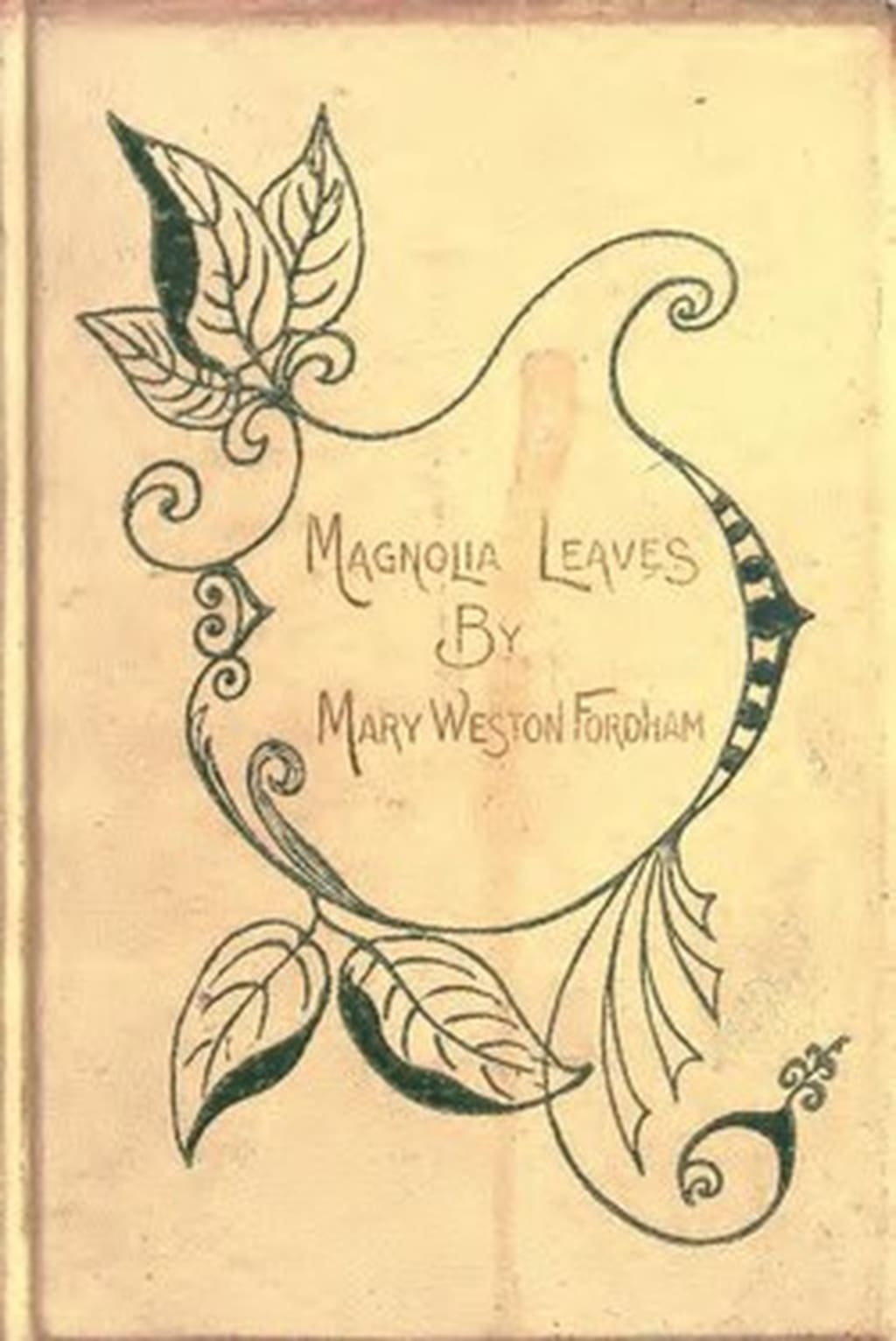
I was recently at our local library when the Librarian told me about a poet I had never heard of, Mary Weston Fordham. I sat down and began reading her work on the library's computer, moving through the pages of her 1897 collection, Magnolia Leaves. I had planned to read a few poems, but I couldn't stop. One poem led me to another, and soon I was absorbed in the work of an amazing woman whose name had somehow escaped me for all these years.
Some poets become part of literary history, while others leave behind work that lives in libraries even as their names gradually slip from public memory. Mary Weston Fordham belongs to the second group, though the life behind her poems makes that disappearance difficult to understand. She was a Black poet, educator, and mother from Charleston, South Carolina, born around 1843 as a free woman of color. She taught Black children during the Civil War, continued that work during Reconstruction, fought for fair treatment as a teacher, and in 1897 published Magnolia Leaves, a collection of sixty-six poems. Booker T. Washington wrote its introduction.
That brief outline hardly conveys the life contained within it.
Fordham was born into Charleston's established community of free people of color, in a city where race and freedom were never simple matters. She came of age before emancipation, yet slavery surrounded her, shaping the laws, customs, and possibilities of the world in which she lived. Her parents, Louise Bonneau and the Reverend Samuel Weston, belonged to a family with property, education, and skilled occupations. Fordham inherited more than the advantages of that education. She inherited an understanding of what education could mean for a Black person in a country determined to restrict it.
Teaching became her first great work.
During the Civil War, Fordham operated a school for Black children in Charleston. The city was still under Confederate control, and teaching Black children to read and write was hardly a neutral undertaking. After the war, she joined the American Missionary Association and continued teaching during Reconstruction. By November 1865, she was part of an eighteen-teacher staff serving approximately 800 students in Charleston. When she discovered that Black women teachers were being paid less than white women for their work, she challenged the inequality.
It is easy to separate the teacher from the poet when looking back at Fordham's life. Her poetry suggests that the two were never separate at all.
Fordham understood the value of a voice being given room to exist. Her classroom and her poems were different kinds of work, but both required the same refusal to accept silence as the natural condition of Black life.
Her connection with the Saxon School placed her within Charleston's developing educational institutions, and her influence did not end with her own generation. Her daughter, Louise Fordham Holmes, became a teacher. Education passed through the family not simply as an occupation, but as a way of moving forward.
When Magnolia Leaves appeared in 1897, Fordham was writing within the formal traditions of nineteenth-century American poetry. Her poems use rhyme and meter familiar to readers of the period, and she was not interested in discarding those forms simply to announce herself as different. Instead, she made room inside them for the subjects that mattered to her.
Motherhood. Labor. Faith. Death. History. Love. Patriotism. Grief.
The collection is striking in part because of how freely Fordham moves among them. One poem may turn inward toward private sorrow; another looks outward toward public life. She could write about a mother's grief and then turn her attention toward an exposition, a question of national identity, or the possibilities opening before women.
Booker T. Washington's introduction placed Magnolia Leaves within the larger emergence of African American literature at the end of the nineteenth century. Fordham was not writing in isolation. Black writers were building a literary presence in a country that had spent generations denying Black people access to education, publication, and intellectual authority.
Yet the poems that remain most affecting may be the ones in which history narrows to the size of a single life.
Fordham knew the death of children. Several of her poems speak from the experience of losing them, and biographical accounts associate her with the deaths of six children. In “In Memorium: Alphonse Campbell Fordham,” she writes for a son who died at six years, two months, and twenty days. The precision of the child's age is painful in itself. It tells us that this was not an abstract meditation on mortality. This was a child, remembered down to the day.
That is one of the powers of Fordham's poetry. She gives history a human scale.
Her poem “The Washerwoman” does something similar with labor. The washerwoman's work is physically demanding, repetitive, and exhausting, but Fordham does not treat the woman performing it as background scenery. She gives her a presence. The work becomes worthy of attention, and the woman doing it becomes worthy of being seen.
For a Black woman writing in the nineteenth century, that act carries its own significance. Fordham understood that literature did not have to concern itself only with celebrated lives. It could look toward the woman whose hands were tired at the end of the day and find there a subject worthy of poetry.
Then there is “The Coming Woman,” one of the collection's more playful poems and perhaps one of its most revealing. Fordham imagines a future in which a woman takes on a public and professional life while her husband remains at home caring for the children and doing domestic work. The joke depends upon reversing the roles expected of men and women, but beneath the humor is a serious curiosity about what marriage might look like if those expectations changed.
Fordham was not merely recording the world she knew. She was capable of imagining another one.
Her range extends further still. Magnolia Leaves includes poems about the Chicago Exposition and the Atlanta Exposition, peace, patriotism, history, faith, and the Cherokee people. She could move from the intimate to the public without abandoning the musical forms of her time. The result is a collection that feels larger than the narrow biographical category into which Fordham might easily be placed.
She was not simply a Black woman poet.
She was a poet who happened to have lived through an extraordinary American century and who brought that world into her work.
There is also something poignant about the distance between the life she lived and the place she occupies now. Fordham spent her years teaching, writing, raising children, enduring loss, and participating in the intellectual life of Charleston. Yet somewhere along the way, the name began to fade.
Fordham died in Charleston on July 4, 1905. She was buried at Brotherly Cemetery, a historic burial ground associated with Charleston's Black community, though her precise burial location is unknown.
The uncertainty is strangely fitting. So much of Fordham's life has survived in fragments: a book, school records, references in biographical accounts, the names of her children, the recollections preserved by institutions. And yet the poems remain.
That may be the most important thing.
Magnolia Leaves has survived in libraries and digital collections, allowing readers more than a century later to encounter Fordham without having to approach her merely as a forgotten historical figure. Her poems are still available to be read as poems.
And that is where Fordham deserves to begin again.
Not with the fact that she has been forgotten, but with the fact that she wrote.
She wrote as a Black woman born free in Charleston before emancipation. She wrote as a teacher who believed Black children deserved an education. She wrote as a mother who knew the terrible grief of loss. She wrote about women who worked, women who dreamed, women who might one day live differently. She wrote about faith and death, public life and private sorrow, the country around her and the people who inhabited it.
The years have done their work of erasure, but they have not erased everything.
Mary Weston Fordham is still here in the pages of Magnolia Leaves, waiting for the thing every poet asks of the future, not fame, exactly, but a reader.
And more than a century later, she has one.
Below is a poem by Mary Weston Fordham:
The Coming Woman
Just look, ’tis quarter past six, love—
And not even the fires are caught;
Well, you know I must be at the office—
But, as usual, the breakfast ’ll be late.
Now hurry and wake up the children;
And dress them as fast as you can;
‘Poor dearies,’ I know they’ll be tardy,
Dear me, ‘what a slow, poky man!’
Have the tenderloin broiled nice and juicy—
Have the toast browned and buttered all right;
And be sure you settle the coffee:
Be sure that the silver is bright.
When ready, just run up and call me—
At eight, to the office I go,
Lest poverty, grim, should o’ertake us—
‘’Tis bread and butter,’ you know.
The bottom from stocks may fall out,
My bonds may get below par;
Then surely, I seldom could spare you
A nickel, to buy a cigar.
All ready? Now, while I am eating,
Just bring up my wheel to the door;
Then wash up the dishes; and, mind now,
Have dinner promptly at four;
For tonight is our Woman’s Convention,
And I am to speak first, you know—
The men veto us in private,
But in public they shout, ‘That’s so.’
So ‘by-by’ – In case of a rap, love,
Before opening the door, you must look;
O! how could a civilized woman
Exist, without a man cook.
About the Creator
Tim Carmichael
Let your becoming be louder than your fear, and your smallest steps become the road you once thought impossible to walk. An Appalachian poet and cookbook author my book Beautiful and Brutal Things is on Amazon, Link 👇
Enjoyed the story? Support the Creator.
Subscribe for free to receive all their stories in your feed. You could also become a paid subscriber, letting them know you appreciate their work.
Comments
There are no comments for this story
Be the first to respond and start the conversation.