
The Great Wall of China: The Longest Grave in the World, or the Greatest Proof of Human Will?
The Great Wall of China is not only a stone symbol of power. It is a story of a huge empire built through human work, suffering and the lives of people whose names remained, quite literally, written into stone.
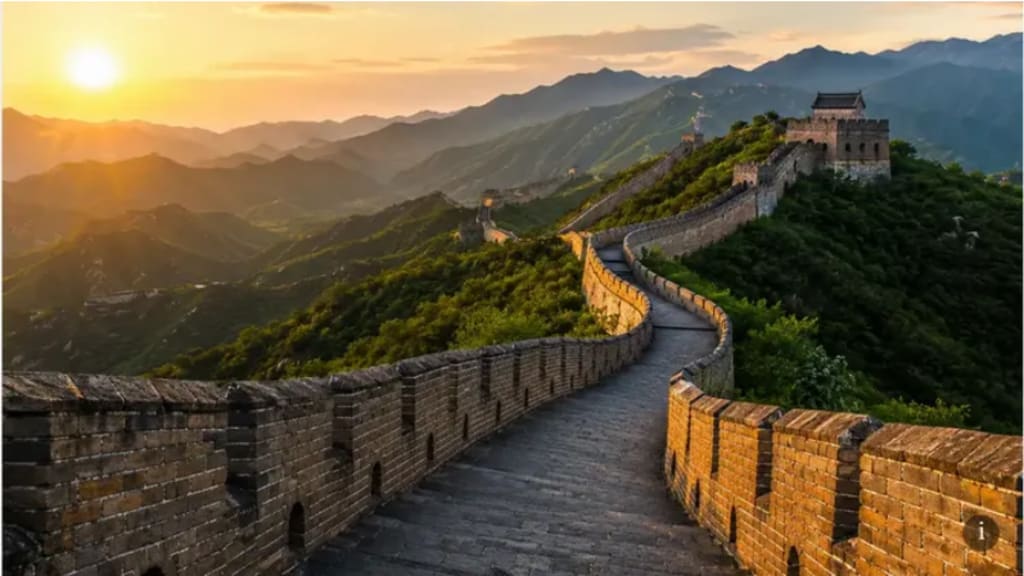
The Stone Snake Across the Mountains
A stone snake winding endlessly across the ridges of the wild Chinese mountains, the Great Wall is today a national symbol, an architectural wonder and one of the greatest monuments ever built by mankind.
But underneath the tourist attractions and beautiful photographs, there is a much darker reality.
The Great Wall is not only a demonstration of the building skills and power of ancient emperors. It is also a gigantic monument to human suffering.
Behind every solid stone block there may have been not only hard work, but also a human life that was lost.
The whole enormous system was not created at once, and it was not the idea of one enlightened ruler.
The first defensive walls appeared in ancient China during the period known as the Warring States, between the fifth and third centuries BC. At that time, individual Chinese kingdoms were fighting each other for survival. They built defensive walls not only against their neighbors, but especially against warriors and raiders coming from the northern steppes.
There was nothing beautiful or impressive about these early walls.
There was no thought about tourists thousands of years in the future.
It was simply about survival.
People built walls from wood, reeds and packed earth in some of the most difficult places imaginable.
And for the workers, one of the biggest enemies was time.
Qin Shi Huang and a Death Sentence for Hundreds of Thousands
When the ambitious emperor Qin Shi Huang united China into one empire in 221 BC, he decided to connect and strengthen many of the existing defensive walls.
He did not simply build the Great Wall from nothing.
Instead, he turned existing fortifications into a huge military project unlike anything China had seen before.
The emperor placed his famous general Meng Tian in charge of the northern frontier. Enormous numbers of people were sent there — soldiers, poor farmers, prisoners and people forced into labor.
For ordinary people from the interior of China, receiving an order to go north did not mean an honor or an opportunity to protect their country.
For many of them, it was almost a death sentence.
The conditions were brutal.
Hunger, disease, exhaustion and harsh treatment caused enormous suffering, and many workers died during the construction.
This is where one of the darkest legends connected with the Great Wall comes from.
For centuries, people have told the story that workers who died from exhaustion were buried directly inside the wall.
Modern archaeological research has not confirmed that human bodies were routinely built into the wall. But the number of people who died during the construction was certainly large enough to create generations of stories about their suffering.
One of the most famous is the legend of Lady Meng Jiang.According to the story, her husband was sent to work on the Great Wall and died there. When Meng Jiang finally learned what had happened, she travelled to the wall and cried so desperately that part of it collapsed, revealing the bones of her husband.
The story is not historical fact.
But perhaps it does not need to be.
It perfectly expresses the pain that the construction of the Great Wall represented for generations of ordinary Chinese people.When Earth Became a Technical Wonder
The wall tourists admire today around Beijing, with its massive stone sections, brick fortifications, towers and defensive positions, mostly comes from a much later period.
Its most famous form was created during the Ming dynasty, mainly between the fifteenth and seventeenth centuries.
The builders of that period transformed older earth walls into a sophisticated military defense system.
And they used technologies which can still surprise modern researchers.
One of the fascinating discoveries from chemical analysis of historical mortar from the Ming period is the presence of amylopectin.
This substance comes from ordinary sticky rice.
Builders deliberately added cooked sticky rice to the lime mortar.
The result was a strong, flexible and water-resistant material which helped hold the enormous blocks and bricks together for centuries.
So one of the world’s most famous defensive structures owes part of its incredible durability to something that ordinary people once had on their dinner plates.
Rice.
Perhaps history has a strange sense of humor.
The First Internet of the Ancient World
The Great Wall was also much more than a passive stone barrier.
It was a huge communication system — almost like the nervous system of the empire.
Thousands of watchtowers and signal towers were built along strategic sections of the frontier.
The soldiers stationed there could send warnings using carefully arranged smoke signals during the day and fires at night.
The number and sequence of signals could communicate information about an approaching enemy.
If soldiers on a distant part of the frontier saw an enemy in the morning, the information could travel enormous distances before the day was over.
In a way, this was an ancient version of instant communication.
No internet.
No telephones.
No satellites.
Just fire, smoke and people watching from towers on the mountains.
But there is an enormous historical irony behind this incredible military system.
Even the Great Wall could not protect China forever.The Wall That Could Not Stop History
In 1211, Mongol forces under Genghis Khan invaded northern China.
The enormous defensive system did not simply disappear, of course. But walls alone could not stop a determined enemy.
The Mongols found ways around sections of the defenses and also benefited from political divisions and cooperation from people inside the empire.
Centuries later, the Ming dynasty faced another threat.
In 1644, General Wu Sangui, who controlled the strategically important Shanhai Pass, opened the gates to Manchu forces.
The Manchus entered China.
The Ming dynasty collapsed.
And the Great Wall, despite everything that had been invested into it, could not prevent the fall of an empire.
It turned out that no wall in the world is high enough when the human factor fails.People With Names Instead of an Anonymous Mass
There are many modern myths surrounding the Great Wall.
The most famous one says that the wall is the only human-made structure visible from the Moon with the naked eye.
It isn’t.
Astronauts and space agencies, including NASA, have repeatedly explained that the wall is far too narrow and blends into the surrounding landscape to be easily visible from such a distance.
But this does not make the Great Wall any less impressive.
In fact, its real fascination is not in space.
It is here on Earth.
In the details.
On many bricks from the Ming period, researchers have found stamped names and marks connected with the people who produced them.
This was partly a brutal form of quality control.
If a brick failed, the people responsible for making it could be identified and punished.
For us today, however, those marks tell us something else.
They remind us that behind this gigantic construction was not some anonymous grey mass of workers.
There were individual people.
People who had names.
People who had families.
People who had dreams.
And people who were afraid.
They probably never imagined that someone thousands of years later would stand beside the wall and wonder who had made the brick beneath their hand.
The Real Monument
Perhaps that is the greatest story hidden inside the Great Wall of China.
We usually look at it and see the power of emperors.
We see military strategy.
We see enormous engineering.
We see one of the greatest architectural achievements in human history.
But the wall was not built by emperors.
It was built by ordinary people.
Farmers.
Soldiers.
Prisoners.
Craftsmen.
People who had no choice but to carry stones, make bricks and work in places where survival itself was difficult.
Their names are mostly lost.
Their individual stories disappeared centuries ago.
But the wall remained.
And perhaps that is why the Great Wall is much more than a monument to Chinese imperial power.
It is a monument to human endurance.
A monument built from stone, earth, sweat and countless lives.
And when we look at it today, perhaps the most interesting question is not how the emperors managed to build something so enormous.
Perhaps it is this:
How many ordinary people had to give their lives before the world received the Great Wall we admire today?
About the Creator
Enjoyed the story? Support the Creator.
Subscribe for free to receive all their stories in your feed.
Comments
There are no comments for this story
Be the first to respond and start the conversation.