
The Great American Cheese Stockpile
Lactose intolerant need not apply...

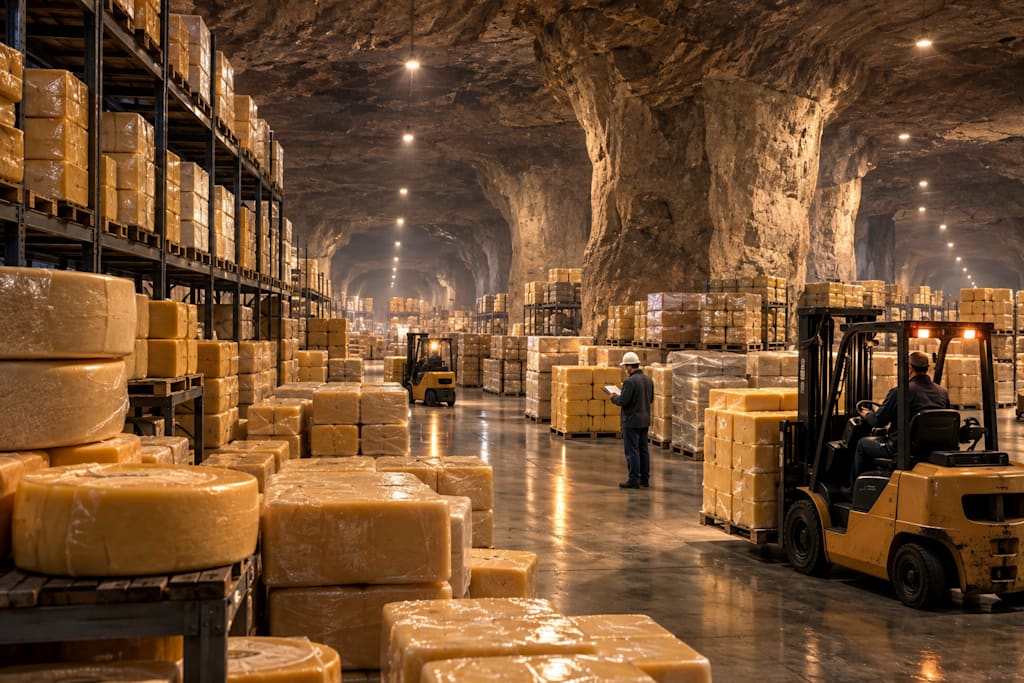
Somewhere beneath Missouri in 1981, the United States government had a problem. It wasn’t nuclear weapons. It wasn’t Soviet espionage. It wasn’t an experimental aircraft or some classified Cold War project buried safely underground. It was cheese... Lots and lots of cheese!
Inside a converted limestone mine in Independence, Missouri, millions of pounds of government-owned dairy products sat in refrigerated storage. The cavernous underground complex contained cheese, butter, and dried milk stacked away beneath the American landscape. In December 1981, The Washington Post visited the facility and reported that approximately 47 million pounds of government-owned dairy products were stored there. And that was only one warehouse.
There was no plan to preserve this enormous dairy reserve for nuclear war, Soviet invasion, or a future zombie apocalypse. Lactose-intolerant survivors of civilization, presumably, had nothing to fear. The truth was simultaneously less dramatic and considerably stranger. The federal government had simply acquired an astonishing quantity of dairy products. Now it had to figure out what to do with them.
The story is sometimes retold today as the tale of a secret government cheese cave beneath Springfield, Missouri, containing a billion pounds of cheese. Like many wonderful pieces of internet history, it begins with genuine facts and gradually acquires a larger hat. Missouri really does contain enormous underground commercial storage facilities created from former limestone mines. Government-owned dairy products really were stored underground. And the federal government really did accumulate dairy inventories measured in the billions of pounds. But there was no single secret billion-pound government cheese cave. The actual story was nationwide. And arguably much crazier.
To understand how America wound up putting cheese underground, we have to begin with a perfectly reasonable goal. Farmers need some degree of economic stability. Agriculture can be brutally unpredictable. Weather changes. Feed costs rise. Demand fluctuates. Production doesn’t stop simply because market conditions have become unfavorable. A dairy cow, particularly, does not read the morning commodities report and decide to postpone milk production until prices improve.
For decades, the federal government had used agricultural price-support programs intended to protect farmers from catastrophic price collapses. Dairy was part of that system. The federal government established a support price for milk used in the manufacture of dairy products. Through the Commodity Credit Corporation, the government could purchase products such as cheese, butter, and nonfat dry milk when commercial buyers wouldn’t absorb the available supply at prices consistent with the support level.
In principle, the mechanism made sense. If dairy prices collapsed, the government became a buyer of last resort. Unfortunately, there was an awkward question hiding inside that arrangement: what happens when the government becomes a very enthusiastic buyer?
During the inflation-plagued 1970s, dairy support prices rose substantially. Those higher guaranteed returns encouraged greater milk production. Farmers responded rationally. They produced more. The market couldn’t absorb everything. So the government purchased the surplus. That prevented prices from falling. This helped preserve the incentive to produce, which generated more surplus. Which the government purchased... For what exactly??
Somewhere along the way, a bureaucratic policy problem transformed into a warehousing problem. The dairy industry could reasonably say, “The market doesn’t need this cheese.” The government replied, “We’ll buy it.” The dairy industry said, “Excellent.” The government said, “Excellent.” And somewhere in Missouri, a warehouse manager looked down an increasingly crowded aisle and said, “Guys?”
The scale became extraordinary. According to a 1982 review by the U.S. General Accounting Office, government inventories of cheese, butter, and nonfat dry milk increased from approximately 705 million pounds in the fall of 1979 to more than two billion pounds by the fall of 1981. Two billion pounds. That wasn’t all cheese, an important distinction frequently lost in modern retellings. It included butter and powdered milk as well. But there was plenty of cheese.
By December 1981, President Ronald Reagan reported that the Commodity Credit Corporation had consigned more than 560 million pounds of cheese to warehouses across the United States. At that point, America wasn’t maintaining an emergency reserve. America had accidentally created a cheese archipelago. Warehouses around the country held government dairy products that taxpayers had already purchased and were now paying to store.
And storing dairy products presents slightly different challenges than storing, say, office chairs. Temperature matters. Humidity matters. Refrigeration costs money. The products have useful storage lives. You can’t simply stack several hundred million pounds of cheese behind the Department of Agriculture and promise to circle back sometime next decade.
That was where places such as Missouri became particularly useful. Missouri is famously rich in caves and limestone geology. Mining operations in Missouri and neighboring Kansas created enormous underground spaces, some of which were eventually converted into commercial warehouses. The advantages were considerable.
Underground temperatures are relatively stable. The surrounding rock provides natural insulation. Huge rooms can be converted into climate-controlled storage while massive limestone pillars support the ceilings. These aren’t tiny caves where a government employee crawls through a hole carrying a wheel of cheddar; they’re industrial spaces. Roadways can run through them. Trucks and forklifts can operate inside. Storage areas can cover enormous distances. And in 1981, one such Independence facility held those approximately 47 million pounds of government-owned dairy products.
Imagine walking through it: cold air, limestone columns disappearing into the distance, forklifts moving between storage areas, pallet after pallet of dairy products. It would have looked like the Strategic Cheese Reserve of the United States—except there was nothing particularly strategic about it. That was becoming the problem.
Buying the surplus was comparatively easy. Getting rid of it without destroying the very market the program existed to protect was harder. Suppose the government simply sold hundreds of millions of pounds of cheese cheaply. That could drive commercial prices downward. Dairy producers would suffer. The government would therefore undermine its own price-support policy while attempting to dispose of the products created by that policy. Exporting enormous quantities raised other economic complications. Continuing to warehouse everything meant continued storage expenses. And the cows were still producing milk. The cheese factory had legs and was still eating grass.
By late 1981, the situation had become so ridiculous that officials and policymakers were openly considering disposal options. One Agriculture Department official told The Washington Post that dumping surplus cheese into the ocean might be the cheapest practical solution. Somewhere, thousands of future marine archaeologists should be grateful that this did not happen.
But the absurdity concealed something considerably less funny. The United States was entering a painful recession. Millions of Americans were struggling financially. Unemployment was rising. Families were having difficulty buying food. Meanwhile, the federal government possessed hundreds of millions of pounds of edible cheese sitting in storage.
Consumer and hunger advocates noticed the contradiction. They demanded that the government release it. The campaign adopted perhaps the only slogan appropriate for the situation: "Free the cheese."
The pressure worked. On December 22, 1981, President Reagan announced that the government would make 30 million pounds of cheese available for distribution to needy Americans through states and nonprofit organizations. The administration acknowledged the uncomfortable reality directly: the cheese had been purchased with taxpayer money, storage was costing additional taxpayer money, and distributing some of it could simultaneously reduce inventories and provide food to people in need.
Thirty million pounds sounded enormous. It wasn’t enough. In February 1982, Reagan authorized another 70 million pounds for distribution. Even after that decision, the Commodity Credit Corporation still held approximately 547 million pounds of cheese. Thus began one of the strangest culinary memories of twentieth-century America: government cheese.
For many Americans who lived through the 1980s, particularly families receiving food assistance, the phrase needs no explanation. Large blocks of cheese distributed through government programs became instantly recognizable. Some people remember it fondly. Others remember what receiving it meant: unemployment, poverty, economic insecurity, and standing in line for assistance because a family needed help. That deserves remembering alongside the jokes.
Government cheese wasn’t created as a novelty product. Its widespread distribution resulted from the collision of two genuine problems. America had produced more dairy than the commercial market needed. And many Americans needed food. Putting those problems together was more humane and sensible than throwing edible products away.
The underlying dairy problem, however, couldn’t be solved merely by handing out bigger blocks of cheese. Washington eventually had to attack the production incentives themselves. Congress reduced support levels and adopted programs intended to discourage excess milk production. In the 1980s, federal dairy policy increasingly shifted toward reducing the enormous surpluses rather than endlessly purchasing them.
The great dairy mountains gradually diminished. But the story left behind one of the most wonderfully tangible demonstrations of an economic principle imaginable. Government policies create incentives. People respond to incentives. And sometimes the consequences become physical. Very physical.
You can write “excess supply resulting from agricultural price supports” in an economics textbook and put half the classroom to sleep. Or you can descend into a limestone mine beneath Missouri and stare at millions of pounds of government dairy products. Same lesson. Much better field trip.
The famous underground cheese story survives today because it sounds too ridiculous to be real. Over the years, hundreds of storage facilities became one mysterious cave. Government dairy inventories became cheese alone. Millions of pounds became a billion. Commercial underground warehouses became a secret federal bunker.
Reality doesn’t require any of that embellishment. By the fall of 1981, the government really did possess more than two billion pounds of cheese, butter, and powdered milk. More than half a billion pounds of cheese really did sit in warehouses around the country. Tens of millions of pounds of government-owned dairy products really were stored inside Missouri limestone mines. Officials really did debate what to do with it. Advocates really did demand that America “free the cheese.” And eventually, millions of pounds were handed to Americans who could use it.
There was no secret billion-pound cheese cave. There was something much more interesting. For a remarkable moment in American history, a well-intentioned system designed to protect dairy farmers encouraged so much production that the federal government became the reluctant owner of a mountain of food it couldn’t easily sell, couldn’t indefinitely store, and certainly couldn’t persuade the cows to stop replacing.
So America did what America sometimes does when a problem has become too large to ignore. We held hearings. We changed policies. We distributed some of it to people who needed it. And until we figured everything out... we put the cheese underground!
About the Creator
The Iron Lighthouse
Where folklore meets freeway. A guide to the strange heart of the American backroads...
Enjoyed the story? Support the Creator.
Subscribe for free to receive all their stories in your feed.
Comments
There are no comments for this story
Be the first to respond and start the conversation.